1. มวลของวัตถุ= 2 กิโลกรัม, ความเร่งเนื่องจากแรงโน้มถ่วง = 9.8 เมตร/วินาที² , สัมประสิทธิ์แรงเสียดทานสถิต = 0.2, สัมประสิทธิ์แรงเสียดทานจลน์ = 0.1 วัตถุอยู่นิ่งหรือกำลังเร่งความเร็ว? ถ้าวัตถุกำลังเร่งความเร็ว จงหา (ก) แรงลัพธ์ (ข) ขนาดและทิศทางของ ความเร่งของกล่อง!
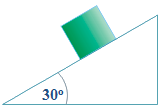
Solution
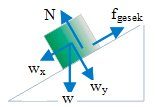
เป็นที่รู้จัก :
มวล (ม.) = 2 กก.
ความเร่งเนื่องจากแรงโน้มถ่วง (g) = 9.8 m/ s²
สัมประสิทธิ์แรงเสียดทานสถิต ( μs ) = 0.2
สัมประสิทธิ์แรงเสียดทานจลน์ ( μk ) = 0.1
น้ำหนัก (w) = มิลลิกรัม = (2)(9.8) = 19.6 นิวตัน
ส่วนประกอบแนวนอนของน้ำหนัก (w x ) = w sin 30 o = (19.6)(0.5) = 9.8 นิวตัน
ส่วนประกอบแนวตั้งของน้ำหนัก (w y ) = w cos 30 o = (19.6)(0.5√3) = 9.8√3 นิวตัน
แรงปฏิกิริยาตั้งฉาก (N) = w y = 9.8√3 นิวตัน
แรงเสียดทานสถิต (f s ) = (0.2)(9.8√3) = 1.96√3 นิวตัน = 3.39 นิวตัน
แรงเสียดทานจลน์ (f k ) = (0.1)(9.8√3) = 0.98√3 นิวตัน = 1.69 นิวตัน
วิธีการแก้ปัญหา:
วัตถุจะหยุดนิ่งถ้า w x < f s และ วัตถุจะเคลื่อนที่ลงถ้า w x > f s
w x = 9.8 นิวตัน และ f s = 3.39 นิวตัน
(ก) แรงลัพธ์
∑ F = w x – f k = 9.8 – 1.69 = 8.11 นิวตัน
(ข) ขนาดและทิศทางของความเร่ง
∑ F = ma
8.11 = (2) ก
เอ = 4.05
ขนาดของความเร่ง = 4.05 m/s² และทิศทางของความเร่ง = ลงด้านล่าง
[irp]
2. มวลของวัตถุ = 4 กิโลกรัม ความเร่งเนื่องจากแรงโน้มถ่วง = 9,8 เมตร/วินาที²สัมประสิทธิ์แรงเสียดทานจลน์ = 0.2 และสัมประสิทธิ์แรงเสียดทานสถิต = 0.4 ขนาดของแรง F = 40 นิวตัน วัตถุอยู่นิ่งหรือกำลังเลื่อนลง? ถ้าวัตถุเลื่อนลง จงหา (ก) แรงลัพธ์ (ข) ขนาดและทิศทางของความเร่ง!
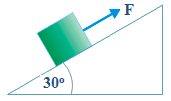
Solution
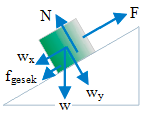
เป็นที่รู้จัก :
มวล (ม.) = 4 กก.
ความเร่งเนื่องจากแรงโน้มถ่วง (g) = 9.8 m/ s²
สัมประสิทธิ์แรงเสียดทานสถิต( μs ) = 0.4
สัมประสิทธิ์แรงเสียดทานจลน์( μk ) = 0.2
น้ำหนัก (w) = มิลลิกรัม = (4)(9.8) = 39.2 นิวตัน
ส่วนประกอบแนวนอนของน้ำหนัก (w x ) = w sin 30 o = (39.2)(0.5) = 19.6 นิวตัน
ส่วนประกอบแนวตั้งของน้ำหนัก (w y ) = w cos 30 o = (392)(0..5√3) = 19.6√3 นิวตัน
แรงปฏิกิริยาตั้งฉาก (N) = w y = 19.6√3 นิวตัน = 33.95 นิวตัน
แรงเสียดทานสถิต (f s ) = μ s N = (0,4)(33.95) = 13.58 นิวตัน
แรงเสียดทานจลน์ (f k ) = μ k N = (0.2)(33.95) = 6.79 นิวตัน
F = 40 นิวตัน
วิธีการแก้ปัญหา:
วัตถุจะเลื่อนลงถ้า F < w x + f s และจะเลื่อนขึ้นถ้า F > w x + f s
F = 40 นิวตัน, w x = 19.6 นิวตัน และ f s = 13.58 นิวตัน
F มีค่ามากกว่า w x + f s ดังนั้นวัตถุจึงเลื่อนขึ้น
(ก) แรงลัพธ์
∑ F = F – w x – f k = 40 – 19.6 – 6.79 = 13.61 นิวตัน
(ข) ขนาดและทิศทางของความเร่ง
∑ F = ma
6.4 = (4) ก
เอ = 1.6
ขนาดของความเร่งคือ 1.6 m/s² และทิศทางของความเร่งคือขึ้นด้านบน
[irp]
แพ็คเกจ wpdm_id='481'
- มวลและน้ำหนัก
- แรงปกติ
- กฎการเคลื่อนที่ข้อที่สองของนิวตัน
- แรงเสียดทาน
- การเคลื่อนที่บนพื้นผิวแนราบโดยไม่มีแรงเสียดทาน
- การเคลื่อนที่ของวัตถุสองชิ้นที่มีความเร่งเท่ากันบนพื้นผิวแนวนอนขรุขระที่มีแรงเสียดทาน
- การเคลื่อนที่บนระนาบเอียงโดยไม่มีแรงเสียดทาน
- การเคลื่อนที่บนพื้นเอียงขรุขระที่มีแรงเสียดทาน
- การเคลื่อนไหวภายในลิฟต์
- การเคลื่อนที่ของวัตถุเชื่อมโยงกันด้วยเชือกและรอก
- วัตถุสองชิ้นที่มีความเร่งขนาดเท่ากัน
- การทำให้เส้นโค้งแบนราบกลายเป็นเส้นโค้งมน – พลศาสตร์ของการเคลื่อนที่แบบวงกลม
- การเข้าโค้งบนพื้นเอียง – พลศาสตร์ของการเคลื่อนที่แบบวงกลม
- การเคลื่อนที่สม่ำเสมอในวงกลมแนวนอน
- แรงสู่ศูนย์กลางในการเคลื่อนที่แบบวงกลมสม่ำเสมอ
