1. Twee dozen zijn met elkaar verbonden door een koord dat over een katrol loopt. Negeer de massa van het koord en de katrol, evenals eventuele wrijving in de katrol. Massa van doos 1 = 2 kg, massa van doos 2 = 3 kg, zwaartekrachtversnelling = 10 m/s² . Bereken (a) de versnelling van het systeem en (b) de spanning in het koord!
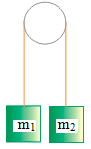
Het resultaat
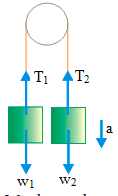 Bekend:
Massa van de doos 1 (m 1 ) = 2 kg
Massa van de doos 2 (m 2 ) = 3 kg
Versnelling als gevolg van de zwaartekracht (g) = 10 m/ s²
Gewicht van de doos 1 (w 1 ) = m 1 g = (2)(10) = 20 Newton
Gewicht van de doos 2 (w 2 ) = m 2 g = (3)(10) = 30 Newton
oplossing:
(a) grootte en richting van de versnelling
w 2 > w 1 , dus doos 2 versnelt naar beneden en doos 1 versnelt naar boven.
Krachten die dezelfde richting hebben als de versnelling (w₂ en T₁ ) , hebben een positief teken. Krachten die een tegengestelde richting hebben als de versnelling (T₂ en w₁ ) , hebben een negatief teken.
∑ F = ma
w2 - T2 + T1 - in1 = (m1 + m2) een ——-> T1 = T2 = T
w 2 – T + T – w 1 = (m 1 + m 2 ) a
w 2 – w 1 = (m 1 + m 2 ) a
30 – 20 = (2 + 3) a
10 = 5 a
een = 10 / 5
a = 2 m/ s²
De grootte van de versnelling is 2 m/ s².
(b) De trekkracht
Vak 2:
Er werken twee krachten op doos 2: ten eerste het gewicht van doos 2 (w2 ) , dat naar beneden wijst en dus positief is. Ten tweede de trekkracht die op doos 2 wordt uitgeoefend (T2 ) , dat naar boven wijst en dus negatief is. Pas de tweede wet van Newton toe.
∑ F = ma
w 2 – T 2 = m 2 a
30 – T 2 = (3)(2)
30 – T 2 = 6
T 2 = 30 – 6
T 2 = 24 Newton
Vak 1:
Er werken twee krachten op doos 1. Ten eerste is er het gewicht van doos 1 (w1 ) , dat naar beneden wijst en dus negatief is. Ten tweede is er de trekkracht die op doos 1 wordt uitgeoefend (T1 ) , dat naar boven wijst en dus positief is. Pas de tweede wet van Newton toe:
∑ F = ma
T 1 – w 1 = m 1 a
T 1 – 20 = (2)(2)
T 1 – 20 = 4
T 1 = 20 + 4
T 1 = 24 Newton
Grootte van de trekkracht = T 1 = T 2 = T = 24 Newton
[irp]
2. Een object bevindt zich op een ruw horizontaal oppervlak. Massa van object 1 = 2 kg, massa van object 2 = 4 kg, zwaartekrachtversnelling = 10 m/s² , statische wrijvingscoëfficiënt = 0.4, kinetische wrijvingscoëfficiënt = 0.3. Is het systeem in rust of versneld? Als het systeem versneld is, bepaal dan de grootte en richting van de versnelling!
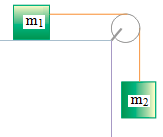
Het resultaat
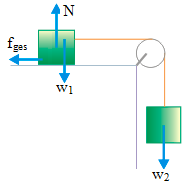 Bekend:
Massa van het object 1 (m 1 ) = 2 kg
Massa van het object 2 (m 2 ) = 4 kg
Versnelling als gevolg van de zwaartekracht (g) = 10 m/ s²
Coëfficiënt van de statische wrijving ( μs ) = 0.4
De coëfficiënt van kinetische wrijving ( μk ) = 0.3
Gewicht van het object 1 (w 1 ) = m 1 g = (2)(10) = 20 Newton
Gewicht van het object 2 (w 2 ) = m 2 g = (4)(10) = 40 Newton
Normale kracht uitgeoefend op het object 1 (N) = w 1 = 20 Newton
Kracht van de statische wrijving uitgeoefend op het object 1 (f s ) = μ s N = (0.4)(20) = 8 Newton
Kracht van de kinetische wrijving uitgeoefend op het object 1 (f k ) = μ k N = (0.3)(20) = 6 Newton
Gezocht: versnelling (a)
oplossing:
w 2 > f s (40 Newton > 8 Newton), dus object 2 wordt verticaal naar beneden versneld en object 1 wordt horizontaal naar rechts versneld. De wrijvingskracht die op object 1 werkt, is de kinetische wrijvingskracht (f k ). Pas de tweede wet van Newton toe:
∑ F = ma
w 2 – de = (m 1 + m 2 ) a
40 – 6 = (2 + 4) a
34 = 6 a
a = 34 / 6 = 17 / 3
a = 5.7 m/ s²
Grootte van de versnelling = 5.7 m/ s²
[wpdm_package id = '484 ′]
- Massa en gewicht
- Normale kracht
- Newton's tweede bewegingswet
- Wrijvingskracht
- Beweging op een horizontaal oppervlak zonder wrijvingskracht
- De beweging van twee lichamen met dezelfde versnelling op een ruw horizontaal oppervlak met wrijvingskracht.
- Beweging op een hellend vlak zonder wrijvingskracht
- Beweging op het ruwe hellende vlak met wrijvingskracht
- Beweging in een lift
- De beweging van lichamen wordt mogelijk gemaakt door touwen en katrollen.
- Twee lichamen met dezelfde versnellingsgrootte.
- Het nemen van een vlakke bocht – dynamiek van cirkelbeweging
- Het nemen van een hellende bocht – dynamiek van cirkelbeweging
- Gelijkmatige beweging in een horizontale cirkel
- Middelpuntzoekende kracht bij eenparige cirkelbeweging
