1. Twee massa's m₁ = 2 kg en m₂ = 5 kg bevinden zich op een hellend vlak en zijn met elkaar verbonden door een touw, zoals weergegeven in de figuur. De wrijvingscoëfficiënt tussen m₁ en het hellende vlak is 0.2 en de wrijvingscoëfficiënt tussen m₂ en het hellende vlak is 0.1.
(a) Bepaal hun versnelling
(b) Bepaal de trekkracht
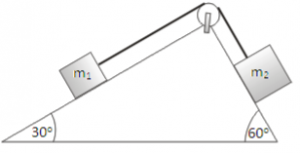
Bekend:
Massa 1 (m 1 ) = 2 kg
Massa 2 (m 2 ) = 4 kg
Coëfficiënt van kinetische wrijving tussen m 1 en het hellende vlak (μ k1 ) = 0.2
Coëfficiënt van kinetische wrijving tussen m 2 en hellend vlak (μ k2 ) = 0.1
Versnelling als gevolg van de zwaartekracht (g) = 9.8 m/ s²
a) De grootte en richting van de versnelling
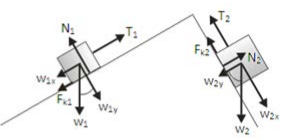
w 1 = gewicht 1 = m 1 g = (2 kg)(9.8 m/s 2 ) = 19.6 Newton
w 1x = w 1 sin 30 o = (19.6 N)(0.5) = 9.8 Newton
w 1y = w 1 cos 30 o = (19.6 N)(0.87) = 17 Newton
N 1 = De normaalkracht op m 1 = w 1y = 17 Newton
F k1 = De kracht van de kinetische wrijving op m 1 = μ k1 N 1 = (0.2)(17 N) = 3.4 Newton
---
w 2 = gewicht 2 = m 2 g = (4 kg)(9.8 m/s 2 ) = 39.2 Newton
w 2x = w 2 sin 60 o = (39.2 N)(0.87) = 34.1 Newton
w 2y = w 2 cos 60 o = (39.2 N)(0.5) = 19.6 Newton
N 2 = De normaalkracht op m 2 = w 2y = 19.6 Newton
F k2 = De kracht van de kinetische wrijving op m 2 = μ k2 N 2 = (0.1)(19.6 N) = 1.96 Newton
---
De grootte van de versnelling:
∑ F x = ma x
w 2x > w 1x , dus de richting van de versnelling is gelijk aan de richting van w 2x.
Krachten die in dezelfde richting wijzen als de versnelling zijn positief, en krachten die in tegengestelde richting wijzen ten opzichte van de versnelling zijn negatief.
w2x - Fk2 - T2 + T1 - in1x - Fk1 = (m1 + m2) omx
w 2x – F k2 – w 1x – F k1 = (m 1 + m 2 ) a x
34.1 N – 1.96 N – 9.8 N – 3.4 N = (2 kg + 4 kg) a x
18.94 N = (6 kg) a x
a x = 18.94 N : 6 kg
a x = 3.16 m/s 2
Grootte van de versnelling = 3.16 m/s² . Richting van de versnelling = richting van T1 = richting van w2x
b) Grootte van de trekkracht
Pas de tweede wet van Newton toe op object 2:
w 2x – F k2 – T 2 = m 2 a x
34.1 N – 1.96 N – T 2 = (4 kg)(3.16 m/s 2 )
32.14 N – T 2 = 12.64 N
T 2 = 32.14 N – 12.64 N = 19.5 Newton
De trekkracht = T = T 1 = T 2 = 19.5 Newton
[irp]
2. m 1 = 4 kg, m 2 = 2 kg. Bepaal (a) de grootte en richting van de versnelling, (b) de grootte van de trekkracht die m 1 en m 2 verbindt , en (c) de grootte van de trekkracht die de katrol en het dak verbindt.
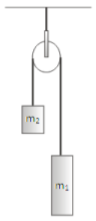
Het resultaat
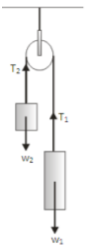
w 1 = m 1 g = (4 kg)(9.8 m/s 2 ) = 39.2 Newton
w 2 = m 2 g = (2 kg)(9.8 m/s 2 ) = 19.6 Newton
a) Grootte en richting van de versnelling
∑ F y = mei y
w 1 > w 2 , dus de richting van het object is gelijk aan de richting van het gewicht 1 ( w 1 ) . Krachten die dezelfde richting hebben als de versnelling zijn positief en krachten die de tegenovergestelde richting hebben van de versnelling zijn negatief.
w 1 – T 1 + T 2 – w 2 = (m 1 + m 2 ) a y
w 1 – w 2 = (m 1 + m 2 ) a y
39.2 N – 19.6 N = (4 kg + 2 kg) per jaar
19.6 N = (6 kg) a y
a y = 19.6 N : 6 kg
a y = 3.26 m/s 2
Grootte van de versnelling = 3.26 m/s² . Richting van de versnelling = richting van w₁.
b) Grootte van de trekkracht die m 1 en m 2 verbindt
Pas de tweede wet van Newton toe op m 2 :
∑ F y = mei y
w 1 – T 1 = m 1 a y
39.2 N – T 1 = (4 kg)( 3.26 m/s 2 )
39.2 N – T 1 = 13.04 N
T 1 = 39.2 N – 13.04 N
T 1 = 26.16 Newton
Grootte van de trekkracht die de objecten verbindt = T = T 1 = T 2 = 26.16 Newton
c) Grootte van de trekkracht die de katrol met het dak verbindt.
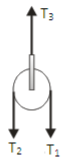 De katrol is in rust:
∑ F y = mei y —— a y = 0
∑ F y = 0
Opwaartse krachten zijn positief, neerwaartse krachten zijn negatief:
T 3 – T 1 – T 2 = 0
T3 = T1 + T2
T 1 en T 2 hebben dezelfde grootte , T 1 = T 2 = T = 26.16 N :
T 3 = 2T = 2(26.16 N) = 52.32 Newton
[irp]
3. Blok 1 (m1 = 10 kg) en blok 2 (m2 = 15 kg) zijn verbonden door een koord over een wrijvingsloze katrol. De coëfficiënt van de statische wrijving tussen blok 2 en de helling is 0.6. De coëfficiënt van de kinetische wrijving tussen blok 2 en de helling is 0.42. Bepaal (a) de grootte van de minimale kracht F die op de objecten wordt uitgeoefend zodat de objecten naar boven versnellen. (b) Bepaal de grootte van de trekkracht.
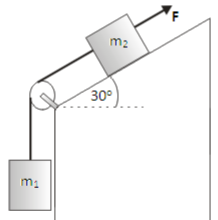
Het resultaat
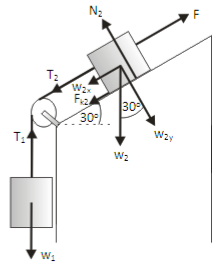
w 1 = Het gewicht van het blok 1 = m 1 g = (10 kg)(9.8 m/s 2 ) = 98 Newton
w 2 = Het gewicht van het blok 2 = m 2 g = (15 kg)(9.8 m/s 2 ) = 147 Newton
w 2y = w 2 cos 30 o = (147 N)(0.87) = 127.89 Newton
w 2x = w 2 sin 30 o = (147 N)(0.5) = 73.5 Newton
N 2 = De normaalkracht op het blok 2 = w 2y = 127.89 Newton
F k2 = De kracht van de kinetische wrijving op het blok 2 = μ k2 N 2 = (0.42)(127.89 N) = 53.7 Newton
F s2 = De kracht van de statische wrijving op het blok 2 = μ s2 N 2 = (0.6)(127.89 N) = 76.7 Newton
a) De grootte van de minimale kracht F die op de objecten wordt uitgeoefend, zodat de objecten naar boven versnellen.
∑ F x = ma x —— a x = 0
∑ F x = 0
Opwaartse en rechtse krachten zijn positief, neerwaartse en linkse krachten zijn negatief.
F – F k2 – w 2x – w 1 – T 2 + T 1 = 0
F – F k2 – w 2x – w 1 = 0
F = F k2 + w 2x + w 1
F = 53.7 N + 73.5 N + 98 N
F = 225.2 Newton
b) De grootte van de trekkracht
Pas de bewegingswetten van Newton toe op blok 1:
∑ F y = mei y —— a y = 0
∑ F y = 0
T 1 – w 1 = 0
T 1 = w 1 = 98 Newton
Pas de bewegingswetten van Newton toe op blok 2:
F – F k2 – w 2x – T 2 = 0
T 2 = F – F k2 – w 2x
T 2 = 225.2 N – 53.7 N – 73.5 N
T 2 = 98 Newton
Grootte van de trekkracht = T 1 = T 2 = T = 98 Newton
[irp]
4. Blok 1 (m 1 = 16 kg) ligt op een horizontaal oppervlak en blok 2 (m 2 = 12 kg) ligt op een glad hellend vlak. Ze zijn met elkaar verbonden door een koord dat over een kleine, wrijvingsloze katrol loopt. Blok 3 (m 3 = 5 kg) ligt op blok 2. De coëfficiënt van de kinetische wrijving tussen blok 2 en het horizontale oppervlak is 0,4. De coëfficiënt van de statische wrijving tussen blok 2 en blok 3 is 0,3.
(a) Wanneer het systeem vanuit rust wordt losgelaten, schuiven blok 3 en blok 2 dan nog steeds samen?
(b) Als er blok 3 is, wat is dan de versnelling van blok 1 en blok 2?
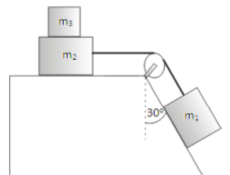
oplossing:
a) Wanneer het systeem vanuit ruststand wordt losgelaten, schuiven blok 3 en blok 2 dan nog steeds samen?
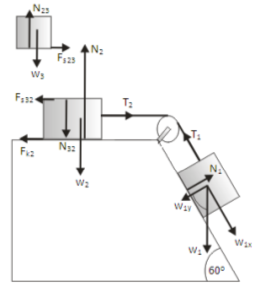
w 1 = Het gewicht van het blok 1 = m 1 g = (16 kg)(9.8 m/s 2 ) = 156.8 Newton
w 1x = w 1 sin 60 o = (156.8 N)(0.87) = 136.4 Newton
w 1y = w 1 cos 60 o = (156.8 N)(0.5) = 78.4 Newton
N 1 = De normaalkracht die het hellende vlak op blok 1 uitoefent = w 1y = 78.4 Newton
w 3 = Het gewicht van het blok 3 = m 3 g = (5 kg)(9.8 m/s 2 ) = 49 Newton
N 23 = De normaalkracht die blok 2 op blok 3 uitoefent = w 3 = 49 Newton
N 32 = De normaalkracht die blok 3 op blok 2 uitoefent = N 23 = w 3 = 49 Newton
(N 23 en N 32 vormen een actie-reactiepaar )
F s23 = De kracht van de statische wrijving die blok 2 op blok 3 uitoefent = μ s N 23 = (0.3)(49 N) = 14.7 Newton
F s32 = De kracht van de statische wrijving die blok 3 op blok 2 uitoefent = F s 23 = 14.7 Newton
(F s23 en F s32 vormen een actie-reactiepaar )
w 2 = Het gewicht van het blok 2 = m 2 g = (12 kg)(9.8 m/s 2 ) = 117.6 Newton
N 2 = De normaalkracht die het horizontale oppervlak op het object uitoefent = w 2 + N 32 = 117.6 Newton + 49
Newton = 166.6 Newton
F k2 = De kracht van de kinetische wrijving op het blok 2 = μ k N 2 = (0.4)(166.6 N) = 66.64 Newton
Pas de bewegingswetten van Newton toe op blok 3:
∑ F x = ma x
F s23 = m 3 a x
—–> Fs23 =s N23 =s w3 =s m3 g
μ s m 3 g = m 3 a x
μ s g = a x
a x = (0.3)(9.8 m/s² ) = 2.94 m/ s²
De maximale versnelling van blok 3, zodat blok 3 en blok 2 nog steeds samen schuiven, is 2.94 m/ s².
Nu berekenen we de grootte van de versnelling van het systeem nadat het vanuit rust is losgelaten.
De richting van de verplaatsing van het blok = de richting van de versnelling van het blok = de richting van T 2 = de richting van w 1x.
∑ F x = ma x
w1x - T1 + T2 - Fk2 - Fs32 + Fs23 = (m1 + m2 + m3) omx
w 1x – F k2 = (m 1 + m 2 + m 3 ) a x
136.4 N – 66.64 N = (16 kg + 12 kg + 5 kg) a x
69.76 N = (33 kg) a x
a x = 2.11 m/s 2
a x is positief, wat betekent dat de richting van de blokverplaatsing of de richting van de versnelling gelijk is aan de richting van T 2 of de richting van w 1x.
De grootte van de versnelling is 2.11 m/s² , lager dan 2.94 m/s² , dus we kunnen concluderen dat blok 3 en blok 2 nog steeds samen schuiven nadat ze vanuit rust zijn losgelaten.
b) De grootte van de versnelling van blok 1 en blok 2
∑ F x = ma x
w 1x – F k2 = (m 1 + m 2 ) a x
—–> Fk2 =k N2 =k w2 =k m2 g = (0.4)(12 kg)(9.8 m/s²)2) = 47.04 Newton
136.4 N – 47.04 N = (16 kg + 12 kg) a x
89.36 N = (28 kg) a x
a x = 89.36 N : 28 kg = 3.19 m/s 2
[wpdm_package id = '493 ′]
- Massa en gewicht
- Normale kracht
- Newton's tweede bewegingswet
- Wrijvingskracht
- Beweging op een horizontaal oppervlak zonder wrijvingskracht
- De beweging van twee lichamen met dezelfde versnelling op een ruw horizontaal oppervlak met wrijvingskracht.
- Beweging op een hellend vlak zonder wrijvingskracht
- Beweging op het ruwe hellende vlak met wrijvingskracht
- Beweging in een lift
- De beweging van lichamen wordt mogelijk gemaakt door touwen en katrollen.
- Twee lichamen met dezelfde versnellingsgrootte.
- Het nemen van een vlakke bocht – dynamiek van cirkelbeweging
- Het nemen van een hellende bocht – dynamiek van cirkelbeweging
- Gelijkmatige beweging in een horizontale cirkel
- Middelpuntzoekende kracht bij eenparige cirkelbeweging
