30 Isotherme thermodynamische processen – problemen en oplossingen
1. Het onderstaande PV-diagram toont een isotherm proces van een ideaal gas . Bereken de arbeid die het gas verricht tijdens het proces AB.
Het resultaat
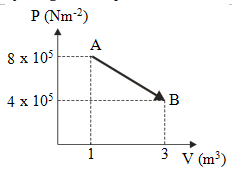 werken De energie die door een gas wordt opgewekt, is gelijk aan het oppervlak onder de PV-curve.
AB = oppervlakte van de driehoek + oppervlakte van de rechthoek
W = [½ (8 x 10 5 –4 x 10 5 )(3-1)] + [4 x 10 5 (3-1)]
W = [½ (4 x 10 5 )(2)] + [4 x 10 5 (2)]
W = [4 x 10⁵ ] + [8 x 10⁵ ]
W = 12 x 10⁷ Joule
De arbeid die door het gas in het proces wordt verricht, bedraagt AB = 12 x 10⁵ joule.
2. Bereken de arbeid die een ideaal gas verricht in het proces ABC.
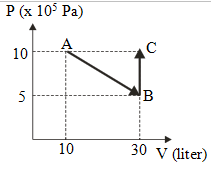 Het werk wordt verricht door een ideaal gas in het proces ABC = het gebied onder de PV-curve
AB = oppervlakte van de driehoek + oppervlakte van de rechthoek
W = [½(10×10 5 –5×10 5 )(30-10)]+[5×10 5 (30-10)]
W = [½ (5 x 10 5 )(20)] + [5 x 10 5 (20)]
W = [(5 x 10 5 )(10)] + [100 x 10 5 ]
W = [50 x 10⁵ ] + [100 x 10⁵ ]
W = 150 x 10⁷ Joule
W = 1.5 x 10⁷ Joule
3. Een ideaal gas ondergaat isotherme processen. Welke hoeveelheid warmte wordt aan het gas toegevoegd zodat het gas een arbeid van 5000 Joule op de omgeving verricht?
Bekend:
Arbeid (W) = 5000 Joule
Gewenst: Er wordt warmte aan het gas toegevoegd (Q)
oplossing:
Een isotherm proces is een thermodynamisch proces dat plaatsvindt bij een constante temperatuur.
ΔU = 3/2 n R ΔT
ΔU = de verandering in interne energie, n = aantal mol, R = universele gasconstante, ΔT = de verandering in temperatuur.
Volgens de bovenstaande vergelijking geldt dat als ΔT = 0, dan is ΔU = 0.
De vergelijking van de eerste wet van de thermodynamica:
ΔU = Q – W
0 = Q – W
Q = W
Q = 5000 Joule.
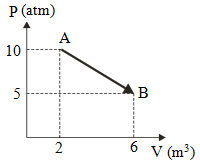
4. PV-diagram voor een ideaal gas dat een isotherm proces ondergaat, zoals weergegeven in de onderstaande figuur. Bereken de warmte die door het gas wordt toegevoerd tijdens proces AB.
 Bekend:
Druk 1 (P 1 ) = 5 atm = 5 x 10 5 Pa
Druk 2 (P 2 ) = 10 atm = 10 x 10 5 Pa
Volume 1 (V 1 ) = 2 m 3
Volume 2 (V 2 ) = 6 m 3
Gezocht : Er wordt warmte toegevoegd aan proces AB.
oplossing:
Isotherm = constante temperatuur. Volgens de onderstaande vergelijking geldt: als ΔT = 0, dan is ΔU = 0.
ΔU = 3/2 n R ΔT
ΔU = 3/2 n R (0)
ΔU = 0
Pas dit toe op de eerste wet van de thermodynamica :
ΔU = QW
0 = QW
Q=W
De arbeid verricht door een ideaal gas = oppervlakte onder de PV-curve = oppervlakte van de driehoek + oppervlakte van de rechthoek
W = ½ (P 2 – P 1 )(V 2 – V 1 ) + P 1 (V 2 – V 1 )
W = ½ (10 x 10 5 – 5 x 10 5 )(6-2) + (5 x 10 5 )(6-2)
W = ½ (5 x 10 5 )(4) + (5 x 10 5 )(4)
W = ½ (20 x 10⁵ ) + (20 x 10⁵ )
W = (10 x 10⁵ ) + (20 x 10⁵ )
W = 30 x 10⁵ Joule
5. Bereken de arbeid die verricht wordt op 1 mol ideaal gas dat isothermisch uitzet van 2 L naar 4 L bij 300 K.
Oplossing: \( W = nRT \ln\left(\frac{V_2}{V_1}\right) = 1 \times 8.314 \times 300 \times \ln(2) \approx 1724 \, \text{J} \)
6. Bepaal de warmteoverdracht voor het bovenstaande probleem.
Oplossing: \( Q = W = 1724 \, \text{J} \)
7. Bereken de verandering in interne energie voor het bovenstaande proces.
Oplossing: \( \Delta U = 0 \, \text{J} \) (aangezien het proces isotherm is)
8. Bereken de verrichte arbeid bij een isotherme compressie van een ideaal gas van 10 L naar 5 L bij 300 K.
Oplossing: \( W = 8.314 \times 300 \times \ln\left(\frac{5}{10}\right) \approx -862 \, \text{J} \)
9. Bereken de entropieverandering voor de isotherme expansie in probleem 1.
Oplossing: \( \Delta S = nR\ln\left(\frac{V_2}{V_1}\right) = 8.314 \times \ln(2) \approx 5.76 \, \text{J/K} \)
10. Bereken de warmteoverdracht bij een isotherme compressie van 2 mol ideaal gas van 4 L naar 2 L bij 200 K.
Oplossing: \( Q = 2 \times 8.314 \times 200 \times \ln\left(\frac{2}{4}\right) \approx -1152 \, \text{J} \)
11. Bereken de verandering in Gibbs-vrije energie voor een isotherm proces.
Oplossing: \( \Delta G = 0 \) (Voor een omkeerbaar isotherm proces in een gesloten systeem geldt \( \Delta G = 0 \))
12. Bepaal de entropieverandering bij een isotherme compressie van 3 mol ideaal gas van 6 L naar 3 L bij 400 K.
Oplossing: \( \Delta S = 3 \times 8.314 \times \ln\left(\frac{3}{6}\right) \approx -17.29 \, \text{J/K} \)
13. Bereken de arbeid die verricht wordt door een ideaal gas dat isothermisch uitzet van 3 L naar 6 L bij 250 K voor 2 mol.
Oplossing: \( W = 2 \times 8.314 \times 250 \times \ln(2) \approx 2874 \, \text{J} \)
14. Bepaal de warmteoverdracht voor het bovenstaande proces.
Oplossing: \( Q = W = 2874 \, \text{J} \)
15. Bereken de verandering in interne energie voor de bovenstaande isotherme expansie.
Oplossing: \( \Delta U = 0 \, \text{J} \)
16. Bereken de entropieverandering voor een isotherme expansie van 4 mol ideaal gas van 5 L naar 10 L bij 500 K.
Oplossing: \( \Delta S = 4 \times 8.314 \times \ln(2) \approx 23.03 \, \text{J/K} \)
17. Bepaal de warmteoverdracht bij een isotherme compressie van 1 mol ideaal gas van 8 L naar 4 L bij 300 K.
Oplossing: \( Q = 8.314 \times 300 \times \ln\left(\frac{4}{8}\right) \approx -862 \, \text{J} \)
18. Bereken de arbeid verricht door 3 mol van een ideaal gas dat isothermisch uitzet van 3 L naar 9 L bij 350 K.
Oplossing: \( W = 3 \times 8.314 \times 350 \times \ln(3) \approx 5362 \, \text{J} \)
19. Bereken de entropieverandering voor het bovenstaande proces.
Oplossing: \( \Delta S = 3 \times 8.314 \times \ln(3) \approx 14.88 \, \text{J/K} \)
20. Bepaal de warmteoverdracht bij een isotherme expansie van 2 mol ideaal gas van 2 L naar 8 L bij 200 K.
Oplossing: \( Q = 2 \times 8.314 \times 200 \times \ln(4) \approx 2304 \, \text{J} \)
21. Bereken de verandering in interne energie bij een isotherme compressie van 4 mol ideaal gas van 10 L naar 5 L bij 500 K.
Oplossing: \( \Delta U = 0 \, \text{J} \)
22. Bepaal de entropieverandering voor een isotherme expansie van 5 mol ideaal gas van 5 L naar 15 L bij 300 K.
Oplossing: \( \Delta S = 5 \times 8.314 \times \ln(3) \approx 24.81 \, \text{J/K} \)
23. Bereken de arbeid die verricht wordt door 2 mol van een ideaal gas dat isothermisch wordt samengedrukt van 6 L tot 2 L bij 400 K.
Oplossing: \( W = 2 \times 8.314 \times 400 \times \ln\left(\frac{2}{6}\right) \approx -2874 \, \text{J} \)
24. Bereken de entropieverandering bij een isotherme compressie van 3 mol ideaal gas van 9 L naar 3 L bij 250 K.
Oplossing: \( \Delta S = 3 \times 8.314 \times \ln\left(\frac{3}{9}\right) \approx -14.88 \, \text{J/K} \)
25. Bepaal de warmteoverdracht bij een isotherme expansie van 1 mol ideaal gas van 4 L naar 12 L bij 350 K.
Oplossing: \( Q = 8.314 \times 350 \times \ln(3) \approx 1791 \, \text{J} \)
26. Bereken de arbeid verricht door 4 mol van een ideaal gas dat isothermisch uitzet van 4 L naar 8 L bij 500 K.
Oplossing: \( W = 4 \times 8.314 \times 500 \times \ln(2) \approx 5749 \, \text{J} \)
27. Bepaal de entropieverandering bij een isotherme compressie van 2 mol ideaal gas van 10 L naar 5 L bij 200 K.
Oplossing: \( \Delta S = 2 \times 8.314 \times \ln\left(\frac{5}{10}\right) \approx -5.76 \, \text{J/K} \)
24. Bereken de arbeid die verricht wordt door 3 mol van een ideaal gas dat isothermisch wordt samengedrukt van 9 L tot 3 L bij 450 K.
Oplossing: \( W = 3 \times 8.314 \times 450 \times \ln\left(\frac{3}{9}\right) \approx -4310 \, \text{J} \)
25. Bereken de verandering in interne energie voor een isotherme expansie van 5 mol ideaal gas van 5 L naar 10 L bij 400 K.
Oplossing: \( \Delta U = 0 \, \text{J} \)
26. Bepaal de entropieverandering voor een isotherme expansie van 4 mol ideaal gas van 6 L naar 18 L bij 300 K.
Oplossing: \( \Delta S = 4 \times 8.314 \times \ln(3) \approx 19.85 \, \text{J/K} \)
Deze vraagstukken hebben betrekking op verschillende aspecten van isotherme processen, waaronder verrichte arbeid, warmteoverdracht, veranderingen in interne energie en entropieveranderingen.
