The magnitude of net torque – problems and solutions

1. A force P is applied to one end of a beam with a length of 2 m. What is the magnitude of the torque? The axis of rotation at point A.
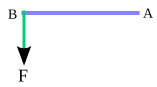
The magnitude of net torque – problems and solutions 1Known :

Force (F) = 10 N

Length of AB (rAB) = 2 m

Force F is perpendicular to the beam.

The lever arm (l) = rAB sin 90o = (2 m)(1) = 2 m

Wanted: The torque about the axis of rotation

Solution :

The torque :

τ = F l = (10 N)(2 m) = 20 N m

The plus sign because the beam rotates counterclockwise rotation.

2. The length of a beam AB is 2 m and the magnitude of force F is 10 N. What is the magnitude of the torque? The axis of rotation at point A.
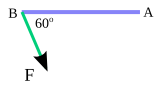
The magnitude of net torque – problems and solutions 2Known :

Force (F) = 10 N

Length of AB (rAB) = 2 m

The lever arm (l) = rAB sin 60o = (2 m)(0.5√3) = √3 m

Wanted: The torque about the axis of rotation

Solution :

The torque :

τ = F l = (10 N)(√3 m) = 10√3 N m

The plus sign because the force F causes the beam rotates counterclockwise rotation.

3. The length of a beam is 2 m. The magnitude of F1 is 10 N and the magnitude of F2 is 15 N. Determine the net torque about the center of the beam.

The axis of rotation at the center of the beam.
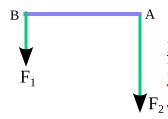
The magnitude of net torque – problems and solutions 3Known :

Force 1 (F1) = 10 N

The distance between F1 and the center of beam (r1) = 1 m

The lever arm 1 (l1) = r1 sin 90o = (1 m)(1) = 1 m

Force F1 is perpendicular to the beam.

Force 2 (F2) = 15 N

The distance between F2 and the center of the beam (r2) = 1 m

Force F2 is perpendicular to the beam.

The lever arm 2 (l2) = r1 sin 90o = (1 m)(1) = 1 m

Wanted : The net torque about the axis of rotation

Solution :

The torque 1 :

τ1 = F1 l1 = (10 N)(1 m) = 10 N m

The plus sign because the force of F1 causes the beam rotates counterclockwise rotation.

The torque 2 :

τ2 = F2 l2 = (15 N)(1 m) = -15 N

The minus sign because the force F2 causes the beam to rotates clockwise.

The net torque :

Στ = τ1 – τ2 = 10 – 15 = – 5 N m

The minus sign because the beam to rotates clockwise.

4. The length beam AB is 2 m, The magnitude of F1 is 10 N and the magnitude of F2 is 10 N. Determine the net torque about the center of the beam.
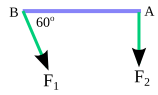
The magnitude of net torque – problems and solutions 4The axis of rotation at the center of the beam.

Known :

Force 1 (F1) = 10 Nn

The distance between F1 and the center of the beam (r1) = 1 m

The lever arm 1 (l1) = r1 sin 60o = (1 m)(0.5√3) = 0.5√3 m

Force 2 (F2) = 10 N

The distance between F2 and the center of the beam (r2) = 1 m

Force F2 is perpendicular to the beam.

The lever arm 2 (l2) = r2 sin 90o = (1 m)(1) = 1 m

Wanted : The net torque about the axis of rotation

Solution :

The torque 1 :

τ1 = F1 l1 = (10 N)(0.5√3 m) = 5√3 = 8.7 N.m

The plus sign because the force F1 causes the beam to rotates clockwise.

The torque 2 :

τ2 = F2 l2 = (10 N)(1 m) = -10 N m

The minus sign because the force F2 causes the beam to rotates clockwise.

The net torque :

Στ = τ1 – τ2 = 8.7 – 10 = – 1.3 N m

The minus sign because the net force causes the beam to rotates clockwise.

5. The length of a beam is 10 m, the magnitude of F1 is 10 N, the magnitude of F2 is 10 N and the magnitude of F3 is 15 N. The distance between point A and point C is 7.5 m. The Force F2 located at the center of the beam. Determine the net torque about the point C located at 2.5 m from the point B.

The axis of rotation located at point C
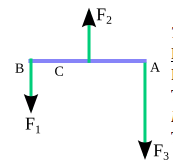
The magnitude of net torque – problems and solutions 5Known :

Force 1 (F1) = 10 N

The distance between F1 and point C (r1) = 2.5 m

Force F1 is perpendicular to the beam.

The lever arm 1 (l1) = r1 sin 90o = (2.5 m)(1) = 2.5 m

Force 2 (F2) = 10 N

The distance between F2 and point C (r2) = 2.5 m

The force F2 is perpendicular to the beam.

The lever arm 2 (l2) = r2 sin 90o = (2.5 m)(1) = 2.5 m

Force 3 (F3) = 15 N

The distance between F3 and point C (r3) = 7.5 m

The force F3 is perpendicular to the beam.

The lever arm 3 (l3) = r3 sin 90o = (7.5 m)(1) = 7.5 m

Wanted : The net torque about the axis of rotation

Solution :

The torque 1 :

τ1 = F1 l1 = (10 N)(2.5 m) = 25 N m

The plus sign because the force F1 causes the beam to rotates clockwise.

The torque 2 :

τ2 = F2 l2 = (10 N)(2.5 m) = 25 N m

The plus sign because the force F2 causes the beam to rotates clockwise.

The torque 3 :

τ3 = F3 l3 = (15 N)(7.5 m) = -112..5 N m

The minus sign because the force F3 causes the beam to rotates clockwise.

The net torque :

Στ = τ1 + τ2 – τ3 = 25 + 25 – 112.5 = – 62.5 N m

The minus sign because the net force causes the beam to rotates clockwise.

6. The length of a beam is 10 m, the magnitude of F1 is 10 N, the magnitude of F2 is 10 N and the magnitude of F3 is 10 N. Determine the net torque about point A, located 5 m from the poiThe magnitude of net torque – problems and solutions 6nt of application of force F1.
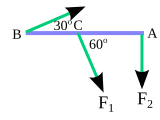
The axis of rotation at point A.

Known :

Force 1 (F1) = 10 N

The distance between F1 and point A (r1) = 5 m

The lever arm 1 (l1) = r1 sin 60o = (5 m)(0.5√3) = 2.5√3 m

Force 2 (F2) = 10 N

The distance between F2 and point A (r2) = 0

The force F2 is perpendicular to the beam.

The lever arm 2 (l2) = r2 sin 90o = (0)(1) = 0

The force 3 (F3) = 10 N

The distance between F3 and point A (r3) = 10 m

The lever arm 3 (l3) = r3 sin 30o = (10 m)(0.5) = 5 m

Wanted : the net torque about the axis of rotation

Solution :

The torque 1 :

τ1 = F1 l1 = (10 N)(2.5√3 m) = 25√3 = 43.3 N m

The plus sign because the force F1 causes the beam to rotates clockwise.

The torque 2 :

τ2 = F2 l2 = (10 N)(0) = 0

The torque 3 :

τ3 = F3 l3 = (10 N)(5 m) = -50 N m

The minus sign because the force F3 causes the beam to rotates clockwise.

The net torque :

Στ = τ1 + τ2 – τ3 = 43.3 + 0 – 50 = – 6.7 N m

The minus sign because the net force causes the beam to rotates clockwise.
Read more

Partially inelastic collisions in one dimension – problems and solutions

1. A 500-gram object, A, moving at 10 m/s and 200-gram object, B, moving at 12 m/s. The objects approach each other and collide. If the speed of object A after the collision is 6 m/s, what is the speed of object B after the collision?

Known :

Mass of object 1 (m1) = 500 gram = 0.5 kg

Mass of object 2 (m2) = 200 gram = 0.2 kg

Initial velocity of object 1 (v1) = -10 m/s

Initial velocity of object 2 (v2) = 12 m/s

The final velocity of object 1 (v1’) = 6 m/s

The plus and minus sign indicates that the objects moves in opposite direction.

Wanted : the final velocity of object 2 (v2’)

Solution :

m1 v1 + m2 v2 = m1 v1’ + m2 v2

(0.5)(-10) + (0.2)(12) = (0.5)(6) + (0.2)(v2’)

-5 + 2.4 = 3 + 0.2 v2

-2.6 = 3 + 0.2 v2

-2.6 – 3 = 0.2 v2

-5.6 = 0.2 v2

v2’ = -5.6 / 0.2

v2’ = -28 m/s

The speed of object 2 after collision is 28 m/s.

The plus and minus sign indicates that the objects move in the opposite direction.

2. Two equal-mass objects approach each other and collide. The speed of object 1 is 6 m/s and the speed of object 2 is 8 m/s. After the collision, object 2 moves leftward with speed of 5 m/s. What is the magnitude and direction of the velocity of object 1 after the collision?

Know :

Mass of object 1 (m1) = m

Mass of object 2 (m2) = m

Initial speed of object 1 (v1) = -6 m/s

initial speed of object 2 (v2) = 8 m/s

The final speed of object 2 (v2’) = -5 m/s

Wanted : the magnitude and direction of object 1 after collision

Solution :

Formula of conservation of linear momentum :

m1 v1 + m2 v2 = m1 v1’ + m2 v2

m v1 + m v2 = m v1’ + m v2

m (v1 + v2) = m (v1’ + v2’)

v1 + v2 = v1’ + v2

-6 + 8 = v1’ – 5

2 = v1’ – 5

2 + 5 = v1

v1’ = 7 m/s

The speed of object 1 after collision (v1’) is 3 m/s.

The plus and minus sign indicates that the objects move in the opposite direction.

3. A 1-kg ball 1 and 2-kg ball 2 have the same direction and collide inelastically. Before the collision, ball 1 moves with speed of 10 m/s and ball 2 moves with speed of 5 m/s. The speed of ball 2 after the collision is 4 m/s. Determine the speed of ball 1 after the collision.

Known :

Mass ball 1 (m1) = 1 kg

Mass ball 2 (m2) = 2 kg

The speed of ball 1 (v1) = 10 m/s

The speed of ball 2 (v2) = 5 m/s

The final speed of ball 2 (v2’) = 4 m/s

The plus sign of the velocity indicates that the balls have the same direction.

Wanted : the final velocity of ball 1 (v1’)

Solution :

m1 v1 + m2 v2 = m1 v1’ + m2 v2

(1)(10) + (2)(5) = (1)(v1’) + (2)(4)

10 + 10 = v1’ + 8

20 – 8 = v1

v1’ = 12 m/s

The speed of ball 1 after collision is 12 m/s.

[wpdm_package id=’1190′]

  1. Linear momentum problems and solutions
  2. Momentum and impulse problems and solutions
  3. Perfectly elastic collisions in one dimension problems and solutions
  4. Perfectly inelastic collisions in one dimension problems and solutions
  5. Inelastic collisions in one dimension problems and solutions

Read more

Inelastic collisions in one dimension – problems and solutions

1. A 30-gram bullet moving at 30 m/s collide a 1-kg block at rest. Determine the speed of the block if the bullet and the block lock together as a result of the collision.

Known :

Mass of bullet (m1) = 30 gram = 0.03 kg

Mass of block (m2) = 1 kg

Initial speed of bullet (v1) = 30 m/s

initial speed of block (v2) = 0 (block at rest)

Wanted : the speed of bullet and block after collision (v’)

Solution :

m1 v1 + m2 v2 = (m1 + m2) v’

(0.03)(30) + (1)(0) = (0.03 + 1) v’

0.9 + 0 = 1.03 v’

0.9 = 1,03 v’

v’ = 0.9 / 1,03

v’ = 0.87 m/s

2. Billiard ball A of mass 2 kg moving with speed vA = 6 m.s−1 collides head-on with ball B of equal mass. If the collision is perfectly inelastic, what are the speeds of the two balls after the collision.

Known :

Mass A (mA) = 2 kg

Mass B (mB) = 2 kg

Initial speed of ball A (vA) = -6 m/s

Initial speed of ball B (vB) = 4 m/s

The plus and minus sign indicates that the objects moves in opposite direction.

Wanted: the speeds of the two balls after the collision. (v’)

Solution :

mA vA + mB vB = (mA’ + mB) v’

(2)(-6) + (2)(4) = (2 + 2) v’

-12 + 8 = 4 v’

-4 = 4 v’

v’ = -4 / 4

v’ = -1 m/s

3. m1 = 3 kg and m2 = 4 kg approach each other in opposite direction with speed of v1 = 10 m/s and v2 = 12 m/s. If the collision is perfectly inelastic, what are the speeds of the two balls after the collision.

Known :

Mass object 1 (m1) = 3 kg

Mass object 2 (m2) = 4 kg

The speed of object 1 (v1) = -10 m/s

The speed of object 2 (v2) = 12 m/s

Wanted : the speed after collision (v’)

Solution :

m1 v1 + m2 v2 = (m1’ + m2) v’

(3)(-10) + (4)(12) = (3 + 4) v’

-30 + 48 = 7 v’

18 = 7 v’

v’ = 18 / 7

v’ = 2.6 m/s

[wpdm_package id=’1157′]

  1. Linear momentum problems and solutions
  2. Momentum and impulse problems and solutions
  3. Perfectly elastic collisions in one dimension problems and solutions
  4. Perfectly inelastic collisions in one dimension problems and solutions
  5. Inelastic collisions in one dimension problems and solutions

Read more

Perfectly elastic collisions in one dimension – problems and solutions

1. A 200-gram ball, A, moving at a speed of 10 m/s strikes a 200-gram ball, B, at rest. What is the speed of ball A and ball B after the collision?

Known :

Mass of ball A (mA) = 200 gram = 0.2 kg

Mass of ball B (mB) = 200 gram = 0.2 kg

Speed of ball A before collision (vA) = 10 m/s

Speed of ball B before collision (vB) = 0

Wanted: speed of ball A (vA’) and speed of ball B (vB’) after a collision

Solution :

vA’ = vB = 0

vB’ = vA = 10 m/s

2. Two equal-mass objects approach each other, collide and then bounce off. The speed of mass A before the collision is 8 m/s and speed of mass B before the collision is 12 m/s. What is the magnitude and direction of the velocity of mass A and mass B after the collision!

Known :

Mass A (mA) = m

Mass B (mB) = m

Speed of mass A before collision (vA) = -8 m/s

Speed of mass B before collision (vB) = 12 m/s

The plus and minus sign indicates that the objects move in opposite direction.

Wanted: the magnitude and direction of the velocity of mass A (vA’) and mass B (vB’) after a collision

Solution :

In a perfectly elastic collision, if the objects of equal mass then the speed of A after the collision (vA’) = the speed of B before collision (vB) and the speed of B after the collision (vB’) = the speed of A before collision (vA).

If before collision, A moving rightward and B moving leftward, then, after collision, A moving leftward and B moving rightward.

The objects have equal mass and the collision is perfectly elastic so the both objects exchanged speed.

vA’ = -vB = -12 m/s

vB’ = vA = 8 m/s

The plus and minus sign indicates that the objects move in opposite direction.

3. A 2-kg object, A, moving at a speed of 10 m/s strikes a 4-kg ball, B, moving at a speed of 20 m/s. If the collision is perfectly elastic, what is the speed of object A and object B after the collision?

Known :

Mass A (mA) = 2 kg

Mass B (mB) = 4 kg

Speed of object A before collision (vA) = 10 m/s

Speed of object B before collision (vB) = 20 m/s

Wanted : the speed of object A (vA’) and the speed of object B (vB’) after collision

Solution :

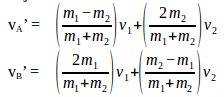
In perfectly elastic collision, if the objects have equal mass and approach each other, the speed of the object after collision calculated using this formula :

Perfectly elastic collisions in one dimension – problems and solutions 1

Speed of object A after collision :

Perfectly elastic collisions in one dimension – problems and solutions 2

4. A 100-gram moving at 20 m/s strikes a wall perfectly elastic collision. What is the magnitude and direction of object’s velocity after collision.

Known :

Mass (mA) = 100 gram = 0.1 kg

Mass of wall (mB) = infinity

The speed of mass before collision (vA) = 20 m/s

The speed of mass after collision (vB) = 0

Wanted : the magnitude and direction of velocity after collision

Solution :

If vB = 0, mA very small and m2 very big then vA’ = -vA and v2’ = 0.

The plus and minus sign indicates that the objects move in the opposite direction.

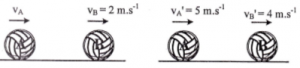
5. Two balls, A with a mass of 2-kg and ball B with a mass of 5-kg, before and after the collision are shown in the figure below. If the collision is perfectly elastic, what is the speed of ball A before the collision?

Known :

Mass of ball A (mA) = 2 kgPerfectly elastic collision – problems and solutions 1

Mass of ball B (mB) = 5 kg

Speed of ball B before collision (vB) = 2 m/s

Speed of ball A after collision (vA‘) = 5 m/s

Speed of ball B after collision (vB‘) = 4 m/s

Both balls are move to the right so their speed signed positive.

Wanted : Speed of ball A before collision (vA)

Solution :

mA vA + mB vB = mA vA‘ + mB vB

2(vA) + (5)(2) = (2)(5) + (5)(4)

2(vA) + 10 = 10 + 20

2(vA) + 10 = 30

2(vA) = 30 – 10

2(vA) = 20

vA = 20/2

vA = 10 m/s

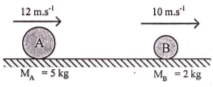
6. Object A and B travel along horizontal plane, as shown in figure below. If the collision is perfectly elastic and the speed of object B after collision is 15 m/s1, what is the speed of object A after collision.

Known :

Mass of object A (mA) = 5 kgPerfectly elastic collision – problems and solutions 2

Mass of object B (mB) = 2 kg

Speed of object A before collision (vA) = 12 m/s

Speed of object B before collision (vB) = 10 m/s

Speed of object B after collision (vB‘) = 15 m/s

Both objects, before and after collision, move to right so their velocity signed positive.

Wanted : Speed of object A after collision (vA‘)

Solution :

mA vA + mB vB = mA vA‘ + mB vB

(5)(12) + (2)(10) = (5)vA‘ + (2)(15)

60 + 20 = (5)vA‘ + 30

80 = (5)vA‘ + 30

80 – 30 = (5)vA

50 = (5)vA

vA‘ = 50/5

vA‘ = 10 m/s

[wpdm_package id=’1156′]

  1. Linear momentum problems and solutions
  2. Momentum and impulse problems and solutions
  3. Perfectly elastic collisions in one dimension problems and solutions
  4. Perfectly inelastic collisions in one dimension problems and solutions
  5. Inelastic collisions in one dimension problems and solutions

Read more

Momentum and impulse – problems and solutions

1. A small ball is thrown horizontally with a constant speed of 10 m/s. The ball hits the wall and reflected with the same speed. What is the change in linear momentum of the ball?

Known :

Mass (m) = 0.2 kg

Initial speed (vo) = -10 m/s

Final speed (vt) = 10 m/s

The plus and minus sign indicates that the objects moves in opposite direction.

Wanted : the change in linear momentum (Δp)

Solution :

Formula of the change in linear momentum :

Δp = m vt – m vo = m (vt – vo)

The change in linear momentum :

Δp = 0.2 (10 – (-10)) = 0.2 (10 + 10)

Δp = 0.2 (20)

Δp = 4 kg m/s

2. A 10-gram ball falls freely from a height, hits the floor at 15 m/s, then reflected upward at 10 m/s. Determine the impulse!

Known :

Mass (m) = 10 gram = 0.01 kg

Initial velocity (vo) = -15 m/s

Final velocity (vt) = 10 m/s

Wanted : Impulse (I)

Solution :

The impulse (I) equals the change in momentum (Δp)

I = m vt – m vo = m (vt – vo)

Impulse :

I = 0.01 (10 – (-15)) = 0.01 (10 + 15)

I = 0.01 (25)

I = 0.25 kg m/s

3. A 200-gram ball thrown horizontally with a speed of 4 m/s, then the ball was hit in the same direction. The duration of the ball in contact with the bat is 2 milliseconds and the ball speed after leaving the bat is 12 m/s. The magnitude of force exerted by the batter on the ball is …

Known :

Mass (m) = 200 gram = 0.2 kg

Initial velocity (vo) = 4 m/s

Final velocity (vt) = 12 m/s

Time interval (t) = 2 milliseconds = (2/1000) seconds = 0.002 seconds

Wanted : The magnitude of the force (F)

Solution :

Formula of impulse :

I = F t

Formula of the change in momentum :

m vt – m vo = m (vt – vo)

The impulse (I) equals the change in momentum (Δp)

I = Δp

F t = m (vt – vo)

F (0.002) = (0.2)(12 – 4)

F (0.002) = (0.2)(8)

F (0.002) = 1.6

F = 1.6 / 0.002

F = 800 Newton

[wpdm_package id=’1155′]

  1. Linear momentum problems and solutions
  2. Momentum and impulse problems and solutions
  3. Perfectly elastic collisions in one dimension problems and solutions
  4. Perfectly inelastic collisions in one dimension problems and solutions
  5. Inelastic collisions in one dimension problems and solutions

Read more

Linear momentum – problems and solutions

1. An object travels at a constant 10 m/s. Calculate the linear momentum of the object.

Known :

Mass (m) = 1 kg

Velocity (v) = 10 m/s

Wanted : linear momentum (p)

Solution :

Formula of the linear momentum :

p = m v

p = linear momentum, m = mass, v = velocity

The linear momentum :

p = m v = (1)(10) = 10 kg m/s2

2. A 2-kg block and a 4-kg blocks moves at a constant 20 m/s. What is the linear momentum of the blocks.

Known :

Mass of block A (mA) = 2 kg

Mass of block B (mB) = 4 kg

Velocity of block A (vA) = 20 m/s

Velocity of block B (vB) = 20 m/s

Wanted : Linear momentum of block A (pA) and linear momentum of block B (pB)

Solution :

Linear momentum of block A :

pA = mA vA = (2)(20) = 40 kg m/s

Linear momentum of block B :

pB = mB vB = (4)(20) = 80 kg m/s

3. A 2-kg block moves at a constant 2 m/s and a 2-kg block moves at a constant 4 m/s. Determine the linear momentum of the blocks.

Known :

Mass of block A (mA) = 2 kg

Mass of block B (mB) = 2 kg

Velocity of block A (vA) = 2 m/s

Velocity of block B (vB) = 4 m/s

Wanted : the linear momentum of blocks

Solution :

Linear momentum of block A :

pA = mA vA = (2)(2) = 4 kg m/s

Linear momentum of block B :

pB = mB vB = (2)(4) = 8 kg m/s

4. A 5-kg object at rest. What is the linear momentum of the momentum.

Known :

Mass (m) = 5 kg

Object’s velocity (v) = 0

Wanted : the linear momentum (p)

Solution :

p = m v = (5)(0) = 0

[wpdm_package id=’1155′]

  1. Linear momentum problems and solutions
  2. Momentum and impulse problems and solutions
  3. Perfectly elastic collisions in one dimension problems and solutions
  4. Perfectly inelastic collisions in one dimension problems and solutions
  5. Inelastic collisions in one dimension problems and solutions

Read more

Power – problems and solutions

Power is the rate at which work is done in a given period. Mathematically, power is the work/time ratio.

P = W/t

Description: P = power (Joule/second = Watt), W = work (Joule), t = time interval (second)

Based on this equation, it can be concluded that the greater the work rate, the greater the power. On the other hand, the smaller the work rate, the smaller the power. Work rate refers to the rate at which work is done.

Power is a scalar. The SI unit of power is the Joule/second. The Joule/second = Watt (abbreviated as W), named so to pay homage to James Watt. The British imperial unit for power is foot-pound per second.

This unit is too small for practical purposes, so the greater unit horsepower (abbreviated as hp) is used. One horsepower = 550 foot-pound per second = 764 Watt = ¾ kilowatt.

The amount of work can also be expressed in power x time units, for instance, kilowatt-hour or kWh. One kWh refers to the work done at a constant rate of 1 kiloWatt for one hour.

1. A 50-kg person runs up the stairs 10 meters high in 2 minutes. Acceleration due to gravity (g) is 10 m/s2. Determine the power.

Known :

Mass (m) = 50 kg

Height (h) = 10 meters

Acceleration due to gravity (g) = 10 m/s2

Time interval (t) = 2 minute = 2 (60) = 120 seconds

Wanted : Power (P)

Solution :

Formula of power :

P = W / t

P = power, W = work, t = time

Formula of Work :

W = F s = w h = m g h

W = work, F = force, w = weight, d = displacement, h = height, m = mass, g = acceleration due to gravity

W = m g h = (50)(10)(10) = 5000 Joule.

P = W / t = 5000 / 120 = 41.7 Joule/second.

2. Calculate the power required of a 60-kg person who climbs a tree 5 meters high in 10 seconds. Acceleration due to gravity is 10 m/s2.

Known :

Mass (m) = 60 kg

Height (h) = 5 meters

Acceleration due to gravity (g) = 10 m/s2

Time interval (t) = 10 seconds

Wanted : Power

Solution :

Work :

W = m g h = (60)(10)(5) = 3000 Joule

Power :

P = W / t = 3000 / 10 = 300 Joule/second.

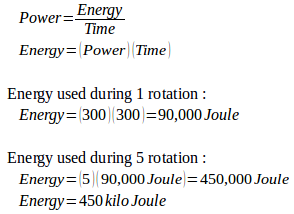
3. A rotary comedy with a power of 300 watts and period of 5 minutes rotates 5 rounds. The energy it uses is ….

A. 15 kJ

B. 75 kJ

C. 90 kJ

D. 450 kJ

Known :

Power (P) = 300 Watt = 300 Joule/second

Period (T) = 5 minutes = 5 (60 seconds) = 300 seconds

Number of rotation = 5

Wanted: Energy used by the rotary comedy

Solution :

Power – problems and solutions

The correct answer is D.

[wpdm_package id=’1190′]

  1. Work was done by force problems and solutions
  2. Work-kinetic energy problems and solutions
  3. Work-mechanical energy principle problems and solutions
  4. Gravitational potential energy problems and solutions
  5. The potential energy of elastic spring problems and solutions
  6. Power problems and solutions
  7. Application of conservation of mechanical energy for free fall motion
  8. Application of conservation of mechanical energy for up and down motion in free fall motion
  9. Application of conservation of mechanical energy for motion on a curved surface
  10. Application of conservation of mechanical energy for motion on an inclined plane
  11. Application of conservation of mechanical energy for projectile motion

Read more

Application of conservation of mechanical energy for motion on inclined plane – problems and solutions

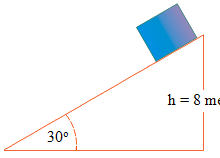
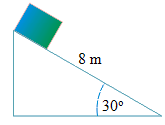
1. A block slides down on smooth inclined plane without friction. What is block’s velocity when hits the ground. Acceleration due to gravity is 10 m/s2

Application of conservation of mechanical energy for motion on inclined plane 1Known :

Height (h) = 8 m

Acceleration due to gravity (g) = 10 m/s2

Wanted : velocity (v)

Solution :

Initial mechanical energy (MEo) = gravitational potential energy (PE)

MEo = PE = m g h = m (10)(8) = 80 m

Final mechanical energy (MEt) = kinetic energy (KE)

MEt = KE = ½ m v2

Principle of conservation of mechanical energy states that the initial mechanical energy = the final mechanical energy :

MEo = MEt

80 m = ½ m v2

80 = ½ v2

160 = v2

v = √160 = √(16)(10) = 4√10 m/s

2. A 1-kg object slides down along 8 meters. Determine kinetic energy after the object moves along 5 meters… Acceleration due to gravity g = 10 m/s2

Application of conservation of mechanical energy for motion on inclined plane 2Known :

Mass (m) = 0.2 kg

d = 5 meters

Acceleration due to gravity (g) = 10 m/s2

Wanted : kinetic energy (KE)

Solution :

sin 30o = h / d

0.5 = h / 5

h = (0.5)(5) = 2.5 meters

The change in height of the object is 2.5 meters.

The initial mechanical energy (MEo) = the gravitational potential energy (PE)

MEo = PE = m g h = (1)(10)(2.5) = 25 Joule

The final mechanical energy (MEt) = kinetic energy (KE)

MEt = KE

The principle of conservation of mechanical energy states that the initial mechanical energy = the final mechanical energy :

MEo = MEt

25 = KE

Kinetic energy = 25 Joule.

[wpdm_package id=’1170′]

  1. Work done by force problems and solutions
  2. Work-kinetic energy problems and solutions
  3. Work-mechanical energy principle problems and solutions
  4. Gravitational potential energy problems and solutions
  5. The potential energy of elastic spring problems and solutions
  6. Power problems and solutions
  7. Application of conservation of mechanical energy for free fall motion
  8. Application of conservation of mechanical energy for up and down motion in free fall motion
  9. Application of conservation of mechanical energy for motion on a curved surface
  10. Application of conservation of mechanical energy for motion on an inclined plane
  11. Application of conservation of mechanical energy for projectile motion

Read more

Application of conservation of mechanical energy for motion on curve surface – problems and solutions

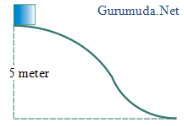
1. A 1-kg block slides down on the smooth curved surface. Determine the kinetic energy and the velocity of the block at the lowest surface. Acceleration due to gravity is 10 m/s2.

Application of conservation of mechanical energy for motion on curve surface 1Known :

Mass (m) = 1 kg

The change in height (h) = 5 m

Acceleration due to gravity (g) = 10 m/s2

Wanted: Kinetic energy (KE) and the velocity of the block.

Solution :

(a) Kinetic energy

The initial mechanical energy = gravitational potential energy

MEo = PE = m g h = (1)(10)(5) = 50 Joule

The final mechanical energy = kinetic energy

MEt = KE = ½ m vt2

Principle of conservation of mechanical energy states that the initial mechanical energy = the final mechanical energy :

MEo = MEt

PE = KE

50 = KE

Kinetic energy (KE) = 50 Joule.

(b) Block’s velocity

The principle of conservation of mechanical energy :

The initial mechanical energy (MEo) = the final mechanical energy (MEt)

The gravitational potential energy (PE) = kinetic energy (KE)

50 = ½ m v2

2(50) / m = v2

100 / 1 = v2

100 = v2

v = √100

v = 10 m/s

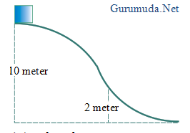
2. A 2-kg object slides down without friction. What is the kinetic energy and the velocity of the object at 2 meters above the ground. Acceleration due to gravity is 10 m/s2

Application of conservation of mechanical energy for motion on curve surface 2Known :

Mass (m) = 2 kg

The change in height (h) = 10 – 2 = 8 m

Acceleration due to gravity (g) = 10 m/s2

Wanted : kinetic energy (KE) and velocity (v) at 2 meters above the ground.

Solution :

(a) Kinetic energy at 2 meters above the ground

The initial mechanical energy = the gravitational potential energy

MEo = PE = m g h = (2)(10)(8) = 160 Joule

The final mechanical energy = kinetic energy

MEt = KE = ½ m vt2

The principle of conservation of mechanical energy states that the initial mechanical energy = the final mechanical energy :

MEo = MEt

PE = KE

160 = KE

Kinetic energy (KE) at 2 meters above the ground is 160 Joule.

(b) Object’s velocity at the lowest surface

Principle of conservation of mechanical energy :

The initial mechanical energy (MEo) = the final mechanical energy (EMt)

The gravitational potential energy (PE) = kinetic energy (KE)

160 = ½ m v2

160 = ½ (2) v2

160 = v2

v = √160 = √(16)(10) = 4√10 m/s

[wpdm_package id=’1167′]

  1. Work done by force problems and solutions
  2. Work-kinetic energy problems and solutions
  3. Work-mechanical energy principle problems and solutions
  4. Gravitational potential energy problems and solutions
  5. Potential energy of elastic spring problems and solutions
  6. Power problems and solutions
  7. Application of conservation of mechanical energy for free fall motion
  8. Application of conservation of mechanical energy for up and down motion in free fall motion
  9. Application of conservation of mechanical energy for motion on a curved surface
  10. Application of conservation of mechanical energy for motion on the inclined plane
  11. Application of conservation of mechanical energy for projectile motion

Read more

Application of conservation of mechanical energy for projectile motion – problems and solutions

1. A kicked football leaves the ground at an angle θ = 30o with the initial velocity of 10 m/s. Ball’s mass = 0.1 kg. Acceleration due to gravity is 10 m/s2. Determine (a) The gravitational potential energy at the highest point (b) The highest point or the maximum height

Known :

Mass (m) = 0.1 kg

The initial velocity (vo) = 10 m/s

Angle = 30o

Acceleration due to gravity (g) = 10 m/s2

Solution :

(a) The gravitational potential energy

Application of conservation of mechanical energy for projectile motion – problems and solutions 1

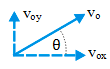
Calculate the horizontal component (vox) and the vertical component (voy) of initial velocity.

Application of conservation of mechanical energy for projectile motion – problems and solutions 2Application of conservation of mechanical energy for projectile motion – problems and solutions 2vox = vo cos θ = (10)(cos 30o) = (10)(0.5√3) = 5√3 m/s

voy = vo sin θ = (10)(sin 30o) = (10)(0.5) = 5 m/s

The initial mechanical energy

The initial mechanical energy (MEo) = kinetic energy (KE)

MEo = KE = ½ m vo2 = ½ (0.1)(10)2 = ½ (0.1)(100) = ½ (10) = 5 Joule

The final mechanical energy

Kinetic energy at the highest point :

KE = ½ m vox2 = ½ (0.1)(5√3)2 = ½ (0.1)((25)(3)) = ½ (0.1)(75) = 3.75 Joule

Principle of conservation of mechanical energy

The initial mechanical energy (MEo) = the final mechanical energy (MEt)

KE = PE + KE

5 = EP + 3.75

PE = 5 – 3.75 = 1.25 Joule

The gravitational potential energy at the highest point is 1.25 Joule.

(b) The highest point or the maximum height

PE = m g h

1.25 = (0.1)(10) h

1.25 = h

The maximum height is 1.25 meters.

2. A 0.1-kg ball projected horizontally with initial velocity vo = 10 m/s from a building 10 meter high. Acceleration due to gravity is 10 m/s2. Determine ball’s kinetic energy when it hits the ground.

Known :

Mass (m) = 0.1 kg

Initial velocity (vo) = 10 m/s

Acceleration due to gravity (g) = 10 m/s2

The change in height (h) = 10 – 2 = 8 m

Wanted: kinetic energy at 2 meters above the ground

Solution :

The gravitational potential energy (PE) = m g h = (0.1)(10)(10) = 10 Joule

The initial kinetic energy (KE)= ½ m vo2 = ½ (0.1)(10)2 = ½ (0.1)(100) = ½ (10) = 5 Joule

The final kinetic energy = the initial gravitational potential energy + the initial kinetic energy = 10 + 5 = 15 Joule

[wpdm_package id=’1173′]

  1. Work done by force problems and solutions
  2. Work-kinetic energy problems and solutions
  3. Work-mechanical energy principle problems and solutions
  4. Gravitational potential energy problems and solutions
  5. The potential energy of elastic spring problems and solutions
  6. Power problems and solutions
  7. Application of conservation of mechanical energy for free fall motion
  8. Application of conservation of mechanical energy for up and down motion in free fall motion
  9. Application of conservation of mechanical energy for motion on a curved surface
  10. Application of conservation of mechanical energy for motion on an inclined plane
  11. Application of conservation of mechanical energy for projectile motion

Read more