Electric potential at the conductor of ball – problems and solutions

Electric potential at the conductor of ball – problems and solutions

1. A 4-μC hollow ball conductor has radius of 8-cm. Determine the electric potential at the surface of the ball. (k = 9.109 N.m2.C-2)

Known :

The electric charge (Q) = 4 μC = 4 x 10⁻⁶ C Electric potential at the conductor of ball – problems and solutions 1
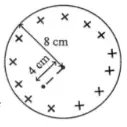
The radius of ball (r) = 8 cm = 8 x 10⁻² m

Coulomb’s constant (k) = 9.109 N.m2.C-2

Wanted : The electric potential at the surface of the ball (V)
Read more

Series and parallel capacitors circuits – problems and solutions

Series and parallel capacitors circuits – problems and solutions

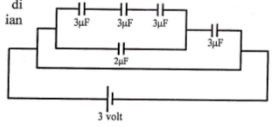
1. What is the total charges in the capacitor circuits below (1 μF = 10-6 F)

Known :

Capacitor 1 (C1) = 3 μFSeries and parallel capacitors circuits – problems and solutions 1

Capacitor 2 (C2) = 3 μF

Capacitor 3 (C3) = 3 μF

Capacitor 4 (C4) = 2 μF

Capacitor 5 (C5) = 3 μF

Voltage (V) = 3 Volt

Read more

Magnetic induction – problems and solutions

Magnetic induction – problems and solutions

1. The following factors influence the magnetic induction on the conductor wire.

(1) the current flowing in the wire

(2) permittivity

(3) wire density

(4) the distance of a point from the wire

Which statements are correct

Read more

Special theory of relativity – problems and solutions

Special theory of relativity – problems and solutions

1. An object whose length is 60 m moves at a speed of 0.6 c (c = the speed of light). According to a stationary observer, what is the length of the object?

Known :

The proper length (Lo) = 60 meters

Object’s speed (v) = 0.6 c

Wanted : The length contraction (L)

Read more

Standing waves – problems and solutions

Standing waves – problems and solutions

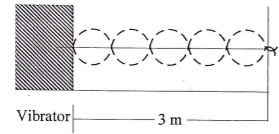
1. The 3-m string tied at one end and the other end is connected to the vibrator. When the vibrator is vibrated, the string formed a stationary wave, as shown in the figure below.

Standing waves – problems and solutions 1Determine the position of the 5th antinode from the fixed end.
Solution :

Distance between two nodes = 3 meters / 5 = 3/5 meters.

The distance between the first node and the fixed end = 3/5 meters

Read more

Magnetic force between two parallel wires – problems and solutions

Magnetic force between two parallel wires – problems and solutions

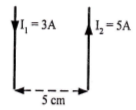
1. Two parallel conductors carrying currents I1 and I2, as shown in the figure below. What is the magnitude and direction of the magnetic force experienced by both conductors? (μo = 4π. 10-7 Wb.A-1.m-1)

Known :

The electric current 1 (I1) = 3 AmpereMagnetic force – problems and solutions 1

The electric current 2 (I2) = 5 Ampere

The permeability of free space (µo) = 4π x 10-7 wb A-1 m-1

Distance between both conductors (L) = 5 cm = 5 x 10⁻² meters

Read more

Kirchhoff’s rules – problems and solutions

Kirchhoff’s rules – problems and solutions

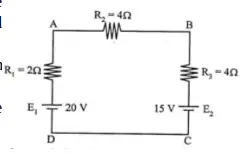
1. What is the terminal voltage of the battery in the circuit below?

Solution

emf = electromotive force = the potential difference between the terminals when no current flow to an external circuit.Kirchhoff's rules – problems and solutions 1

The terminal voltage (V) = the potential difference between the terminals when a current flows from the battery.

If no current is drawn from the battery, the terminal voltage equals the emf.

Known :

Read more

Vertical motion – problems and solutions

Vertical motion – problems and solutions

1. Ball A threw vertically upward with the speed of 10 m/s. 1 second later, from the same position, Ball B is thrown vertically upward at the same path, with the speed of 25 m/s. What is the height of ball B when it encounters ball A.

Solution :

In solving the problem of vertical motion, the vector quantity which direction upward is given a positive sign, the vector quantity that direction downward is given a negative sign.

Read more

Electrostatic force – problems and solutions

Electrostatic force – problems and solutions

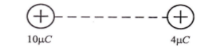
1. If the static electric force is 144 N, what is the distance between both charges… (1 μC = 10-6 C and k = 9.109 N.m2.C-2)

Electrostatic force - problems and solutions 1

Known :

Electric force (F12) = 144 N

Charge 1 (q1) = 10 μC = 10 x 10-6 C

Charge 2 (q2) = 4 μC = 4 x 10⁻⁶ C

Constant (k) = 9 x 10⁹ N.m2.C-2

C = Coulomb, N = Newton, m = meter

Read more

Double slit interference – problems and solutions

Double slit interference – problems and solutions

1. Yellow light passes through two slits and an interference pattern is observed on a screen.

(1) The bright fringes will increase in width if the yellow light is replaced blue

(2) The bright fringes will increase in width if the distance between slits minimized

(3) The intensity of light decreases if it is far from the central fringe

(4) The intensity of light is constant if it is far from the central fringe

Read more