Electrical energy in capacitor circuits – problems and solutions

Electrical energy in capacitor circuits – problems and solutions

1. Determine the electrical energy in the circuit shown in the figure below (1 µF = 10-6 F)

Known :

Capacitor 1 (C1) = 3 µF Electric energy in capacitor circuits – problems and solutions 1
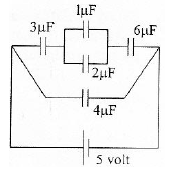
Capacitor 2 (C2) = 1 µF

Capacitor 3 (C3) = 2 µF

Capacitor 4 (C4) = 6 µF

Capacitor 5 (C5) = 4 µF

Electric voltage (V) = 5 volts
Read more

The direction of magnetic induction – problems and solutions

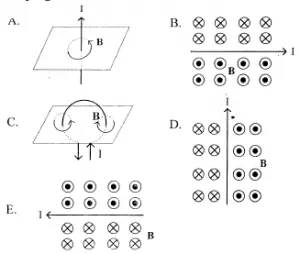
1. Which of the following figures shows the correct direction of magnetic induction due to the wire carrying the electric current

The direction of magnetic induction - problems and solutions 1

Read more

Electric charges Magnetic field and Magnetic forces – Problems and Solutions

3 Electric charges Magnetic field and Magnetic forces – Problems and Solutions

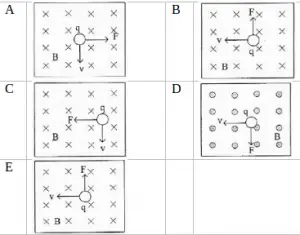
1. If q is the positive electric charge, v is the charge motion, B is the magnetic field and F is the direction of the magnetic force, then the right figure for a charge across the magnetic field is …

Electric charges, magnetic field and magnetic forces – problems and solutions 1

Read more

Two parallel conductors carrying currents – problems and solutions

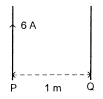
1. Wire P carrying current 6-A upward as shown in the figure below. If µo = 4π.10-7 wb A-1 m-1 and there is a repulsive force between wire P and Q 1.2.10-5 N.m1. Determine the magnitude and direction of electric current on wire Q.

Known :Two parallel conductors carrying currents – problems and solutions 1

IP = 6 Ampere

µo = 4π x 10-7 wb A-1 m-1

F/l = 1,2 x 10⁻⁵ N m-1

L = 1 meter

Read more

Wheels connected by belts – problems and solutions

Wheels connected by belts – problems and solutions

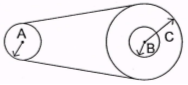
1. Three wheels are connected as shown in the figure below.

If RA = 10 cm, RB = 4 cm, and RC = 40 cm, then the ratio of the angular velocity of wheel A and wheel C is …

Known :Wheels connected by belts - problems and solutions 1

Radius of wheel A (rA) = 10 cm

Radius of wheel B (rB) = 4 cm

Radius of wheel C (rC) = 40 cm

Read more

Applications of Bernoulli’s principle

Applications of Bernoulli’s principle

1. Statements based on Bernoulli’s principle are …

(1) lifting force on an aircraft

(2) hydraulic pump

(3) mosquito sprayers

(4) hot air balloon

Read more

Photoelectric effect – problems and solutions

Photoelectric effect – problems and solutions

1. The correct statement about the photoelectric effect is …

A. Can be explained by considering light as a wave

B. Electrons released by the metal surface will decrease if the light frequency increased

C. The intensity of light does not affect the energy of electrons coming out of the metal surface

D. The photoelectric effect occurs in the infrared region

E. The photoelectric effect will occur when the light intensity of the metal is large

Read more

Atomic theory of Rutherford Thomson Bohr – Problems and Solutions

5 Atomic theory of Rutherford Thomson Bohr – problems and solutions

1. The weakness of Rutherford’s atomic theory is …
A. The electrons surrounding the atomic nucleus will absorb energy
B. Electrons spread evenly on the surface of the spherical atom
C. Electrons rotate around the core like the solar system
D. Electrons surround the nucleus emitting electromagnetic waves
E. An atom consists of positive and negative charges
Solution
The correct answer is C.

Read more

Transformer and electric energy – problems and solutions

Transformer and electric energy – problems and solutions

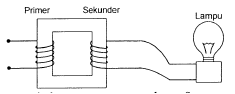
1. The primary coil of an ideal transformer connected to a voltage source and the secondary coil is connected to the lamp as shown below.

Transformer and electric energy – problems and solutions 1A. The lamp will dim if the primary loops are reduced

B. The lamp will be brighter if the secondary loops are increased

C. The lamp will be dimmer if the primary voltage is increased

D. The lamp will be lighter if the primary loops are reduced

E. The light will be the same if loops are changed

Read more

The characteristics of waves – problems and solutions

The characteristics of waves – problems and solutions

1. The general properties of the wave are as follows:

(1) can not propagate in a vacuum

(2) moving straight in a different medium

(3) experiencing reflection

(4) experiencing diffraction

(5) experience interference

Read more