Application of the first law of thermodynamics in some thermodynamic processes (Isobaric Isothermal Isochoric)

30 Application of the first law of thermodynamics in some thermodynamic processes (Isobaric Isothermal Isochoric) 1. The graph below shows the thermodynamic cycle experienced by a gas. The work done by gas on the process ABCD is … Known : Pressure 1 (P1) = 2 x 10⁵ Pa Pressure 2 (P2) = 4 x 10⁵ … Read more

The first law of thermodynamics – problems and solutions

30 The first law of thermodynamics – problems and solutions 1. 3000 J of heat is added to a system and 2500 J of work is done by the system. What is the change in internal energy of the system? Known : Heat (Q) = +3000 Joule Work (W) = +2500 Joule Wanted: the change … Read more

Kinetic theory of gases – problems and solutions

1. Ideal gases in a closed container initially have volume V and pressure P. If the final pressure is 4P and the volume is kept constant, what is the ratio of the initial kinetic energy with the final kinetic energy.

Known :

Initial pressure (P1) = P

Final pressure (P2) = 4P

Initial volume (V1) = V

Final volume (V2) = V

Wanted: The ratio of the initial kinetic energy with the final kinetic energy (KE1 : KE2)

Solution :

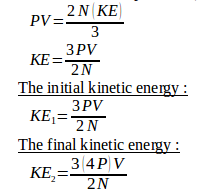
The relation between pressure (P), volume (V) and kinetic energy (KE) of ideal gases :
Kinetic theory of gases - problems and solutions 18

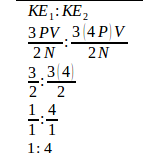
The ratio of the initial kinetic energy with the final kinetic energy :
Kinetic theory of gases - problems and solutions 19

2. What is the average translational kinetic energy of molecules in an ideal gas at 57oC.

Known :

Temperature of gas (T) = 57oC + 273 = 330 Kelvin

Boltzmann‘s constant (k) = 1.38 x 10⁻²³ Joule/Kelvin

Wanted: The average translational kinetic energy

Solution :

The relation between kinetic energy (KE) and the temperature of the gas (T) :
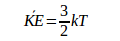
Kinetic theory of gases - problems and solutions 3

The average translational kinetic energy :
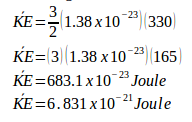
Kinetic theory of gases - problems and solutions 4

3. A gas at 27oC in a closed container. If the kinetic energy of the gas increases 2 times the initial kinetic energy, thus the final temperature of the gas is…

Known :

Initial temperature (T1) = 27oC + 273 = 300 K

Initial kinetic energy = KE

Final kinetic energy = 4 KE

Wanted: The final temperature (T2)

Solution :
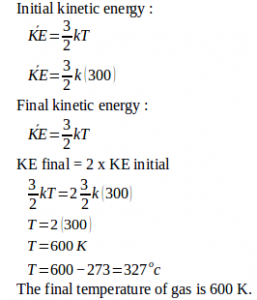
Kinetic theory of gases - problems and solutions 5

4. An ideal gas is in a closed container, is heated so that the final average velocity of particles of gas increases by 3 times the initial average velocity. If the initial gas temperature is 27oC, then the final temperature of the ideal gas is…

Known :

Initial temperature = 27oC + 273 = 300 Kelvin

Initial velocity = v

Final velocity = 2v

Wanted : The final temperature of ideal gas

Solution :
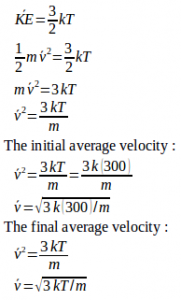
Kinetic theory of gases - problems and solutions 20

The final average velocity = 2 x the initial average velocity
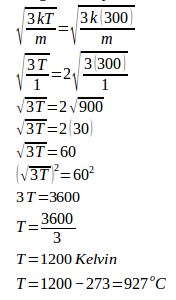
Kinetic theory of gases - problems and solutions 7

5. Three moles of gas are in a 36 liters volume space. Each gas molecule has a kinetic energy of 5 x 10-21 Joule. Universal gas constant = 8.315 J/mole.K and Boltzmann’s constant = 1.38 x 10⁻²³ J/K. What is the gas pressure in the container.

Known :

Number of moles (n) = 3 moles

Volume = 36 liters = 36 dm3 = 36 x 10-3 m3

Boltzmann’s constant (k) = 1.38 x 10⁻²³ J/K

Kinetic energy (KE) = 5 x 10–21 Joule

Universal gas constant (R) = 8.315 J/mole.K

Wanted : Gas pressure (P)

Solution :

Calculate the temperature using the equation of kinetic energy of gas.
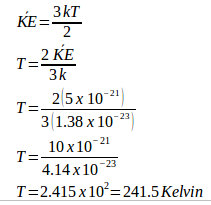
Kinetic theory of gases - problems and solutions 8

Calculate the gas pressure using th equation of ideal gas law (in number of moles, n) :

P V = n R T

P (36 x 10-3) = (3)(8.315)(241.5)

P (36 x 10-3) = 6024.22
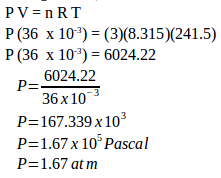
Kinetic theory of gases - problems and solutions 9

The gas pressure is 1.67 x 10⁵ Pascal or 1.67 atmospheres.
Read more

Ideal gas law – problems and solutions

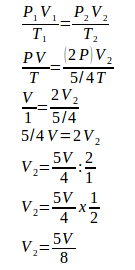
1. Ideal gases in a closed container initially have volume V and temperature T. The final temperature is 5/4T and the final pressure is 2P. What is the final volume of the gas?

Known :

Initial volume (V1) = V

Initial temperature (T1) = T

Final temperature (T2) = 5/4 T

Initial pressure (P1) = P

Final pressure (P2) = 2P

Wanted: Final volume (V2)

Solution :

Ideal gas law - problems and solutions 1

2. Determine the volume of 2.00 moles of gases (ideal gas) at STP. STP = Standard Temperature and Pressure.

Known :

Moles of gas (n) = 2 moles

Standard temperature (T) = 0 oC = 0 + 273 = 273 Kelvin

Standard pressure (P) = 1 atm = 1.013 x 10⁵ Pa

Universal gas constant (R) = 8.315 Joule/mole.Kelvin

Wanted : Volume of gases (V)

Solution :

Equation of Ideal gas law (in the number of moles, n)

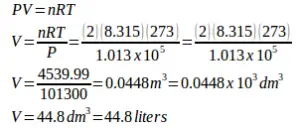
Ideal gas law - problems and solutions 2

Volume 2 moles of gases is 44.8 liters.

Volume 1 mol of gases is 45.4 liters / 2 = 22.4 liters.

Volume 1 mol of any gases is 22.4 liters.

3. 4 liters of oxygen gas has a temperature of 27°C and pressure of 2 atm (1 atm = 105 Pa) in a closed container. Universal gas constant (R) = 8.314 J.mole−1.K−1 and Avogadro’s number (NA) = 6.02 x 10²³ molecules/mole. What are the molecules of oxygen gases in the container?

Known :

Volume of gases (V) = 4 liters = 4 dm3 = 4 x 10⁻³ m3

Temperature of gases (T) = 27oC = 27 + 273 = 300 Kelvin

Pressure of gases (P) = 2 atm = 2 x 10⁵ Pa

Universal gas constant (R) = 8.314 J.mole−1.K−1

Avogadro’s number (NA) = 6.02 x 10²³

Wanted : What is the molecules of oxygen gases in the container (N)

Solution :

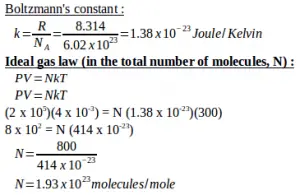
Ideal gas law - problems and solutions 3

In 1 mole oxygen gases, there are 1.93 x 10²³ oxygen molecules.

4. A container containing a neon gas (Ne, atomic mass = 20 u) at standard temperature and pressure (STP) has a volume of 2 m3. Determine the mass of the neon gas!

Known :

Atomic mass of neon = 20 gram/mole = 0,02 kg/mole

Standard temperature (T) = 0oC = 273 Kelvin

Standard pressure (P) = 1 atm = 1.013 x 10⁵ Pascal

Volume (V) = 2 m3

Wanted : mass (m) of neon gas

Solution :

At standard temperature and pressure (STP), 1 mole of any gases, include neon gas, have volume 22.4 liters = 22.4 dm3 = 0.0448 m3.

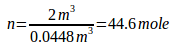
Ideal gas law - problems and solutions 4

In the volume of 2 m3there are 44.6 moles of neon gas.

Relative atomic mass of neon gas is 20 gram/mole.

This means that in 1 mole there are 20 grams or 0.02 kg of neon gas. Because in 1 mol there are 0.02 kg of neon gas then in 44.6 mole there are 44.6 moles x 0.02 kg/mole = 0.892 kg = 892 gram of neon gases.

Read more

Gay-Lussac’s law (constant volume) – problems and solutions

1. Ideal gases initially have pressure P and temperature T. The gas undergoes the isochoric process so that the final pressure becomes 4 times the initial pressure. What is the final temperature of the gas?

Known :

Initial pressure (P1) = P

Final pressure (P2) = 4P

Initial temperature (T1) = T

Wanted: Final temperature (T2)

Solution :

The formula of Gay-Lussac’s law :

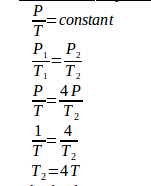
Gay-Lussac's law (constant volume) - problems and solutions 1

The final temperature becomes 4 times the initial temperature.

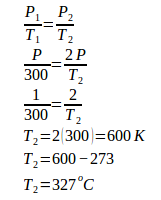
2. In a closed container, ideal gases initially have a temperature of 27oC. If the final pressure becomes 2 times the initial pressure, what is the final temperature?

Known :

Initial pressure (P1) = P

Final pressure (P2) = 2P

Initial temperature (T1) = 27oC + 273 = 300 K

Wanted: Final temperature (T2)

Solution :

Gay-Lussac's law (constant volume) - problems and solutions 2

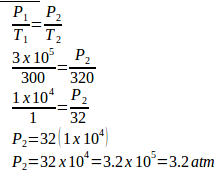
3. A tire is filled to a gauge pressure of 2 atm at 27°C. After a drive, the temperature within the tire rises to 47°C. What is the pressure within the tire now?

Known :

The atmospheric pressure = 1 atm = 1 x 10⁵ Pa

The initial gauge pressure = 2 atm = 2 x 10⁵ Pa

The initial absolute pressure (P1) = 1 atm + 2 atm = 3 atm = 3 x 10⁵ Pa

The initial temperature (T1) = 27oC + 273 = 300 K

The final temperature (T1) = 47oC + 273 = 320 K

Wanted : The final gauge temperature

Solution :

Gay-Lussac's law (constant volume) - problems and solutions 3

The final gauge pressure = final absolute pressure – atmospheric pressure

The final gauge pressure = 3.2 atm – 1 atm

The final gauge pressure = 2.2 atm

Read more

Charles’s law (constant pressure) – problems and solutions

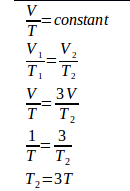
1. In a closed container, the gas expands so that the final volume becomes 3 times the initial volume (V = initial volume, T = initial temperature). What is the final temperature?

Known :

Initial volume (V1) = V

Final volume (V2) = 3V

Initial temperature (T1) = T

Wanted: Final temperature (T2)

Solution :

The formula of Charles’s law :

Charles's law (constant pressure) - problems and solutions 1

The final temperature of gases becomes 3 times the initial temperature.

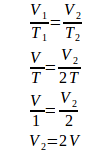
2. Ideal gases initially have volume V and temperature T. If the gas undergoes the isobaric process so that the temperature becomes 2 times the initial temperature then the final volume of gases is…

Known :

Initial volume (V1) = V

Initial temperature (T1) = T

Final temperature (T2) = 2T

Wanted: final volume (V2)

Solution :

Charles's law (constant pressure) - problems and solutions 2

The final volume of gases becomes 2 times the initial volume.

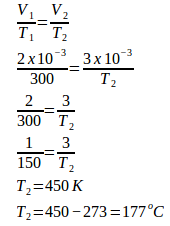
3. In a closed container, ideal gases initially have a volume of 2 liters and temperature of 27oC. If the final volume of gases becomes 3 liters then the final temperature is…

Known :

Initial volume (V1) = 2 liters = 2 dm3 = 2 x 10⁻³ m3

Final volume (V2) = 3 liters = 3 dm3 = 3 x 10⁻³ m3

Initial temperature (T1) = 27oC + 273 = 300 K

Wanted : Final temperature (T2)

Solution :

Charles's law (constant pressure) - problems and solutions 3

The final temperature is 177oC or 177 + 273 = 450 Kelvin.

Read more

Boyle’s law (constant temperature) – problems and solutions

1. Some ideal gases initially have pressure P and volume V. If the gas undergoes isothermal process so that the final pressure becomes 4 times the initial pressure, then the final volume of gas is…

Known :

Initial pressure (P1) = P

Final pressure (P2) = 4P

Initial volume (V1) = V

Wanted: Final volume (V2)

Solution :

The formula of Boyle’s law :

P V = constant

P1 V1 = P2 V2

(P)(V) = (4P)(V2)

V = 4 V2

V2 = V / 4 = ¼ V

The final volume of gases is ¼ times the initial volume.

2. In a closed container, the gas expands so that the final volume becomes 2 times the initial volume (V = initial volume, P = initial pressure). The final pressure of gases is…

Known :

Initial pressure (P1) = P

Initial volume (V1) = V

Final volume (V2) = 2V

Wanted : Final pressure (P2)

Solution :

P1 V1 = P2 V2

P V = P2 (2V)

P = P2 (2)

P2 = P / 2 = ½ P

The gases pressure becomes ½ times the initial pressure.

3. In a closed container, gases having a pressure of 2 atm and a volume of 1 liter. If gas pressure becomes 4 atm then gas volume becomes …

Known :

Initial pressure (P1) = 2 atm = 2 x 10⁵ Pa

Final pressure (P2) = 4 atm = 4 x 10⁵ Pa

Initial volume (V1) = 1 liter = 1 dm3 = 1 x 10⁻³ m3

Wanted : Final volume (V2)

Solution :

P1 V1 = P2 V2

(2 x 10⁵)(1 x 10⁻³) = (4 x 10⁵) V2

(1)(1 x 10⁻³) = (2) V2

1 x 10-3 = (2) V2

V2 = ½ x 10-3

V2 = 0.5 x 10⁻³ m3 = 0.5 dm3 = 0.5 liters

Read more

Capacitors in series and parallel โ€“ problems and solutions

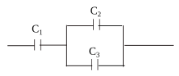
1. Three capacitors, C1 = 2 μF, C2 = 4 μF, C3 = 4 μF, are connected in series and parallel. Determine the capacitance of a single capacitor that will have the same effect as the combination.

Capacitors in series and parallel – problems and solutions 1Known :

Capacitor C1 = 2 μF

Capacitor C2 = 4 μF

Capacitor C3 = 4 μF

Wanted : The equivalent capacitance (C)

Solution :

Capacitor C2 and C3 connected in parallel. The equivalent capacitance :

CP = C2 + C3 = 4 + 4 = 8 μF

Capacitor C1 and Cp connected in series. The equivalent capacitance :

1/C = 1/C1 + 1/CP = 1/2 + 1/8 = 4/8 + 1/8 = 5/8

C = 8/5 μF

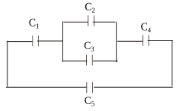
2. Five capacitors, C1 = 2 μF, C2 = 4 μF, C3 = 6 μF, C4 = 5 μF, C5 = 10 μF, are connected in series and parallel. Determine the capacitance of a single capacitor that will have the same effect as the combination.

Known :

Capacitors in series and parallel – problems and solutions 2Capacitor C1 = 2 μF

Capacitor C2 = 4 μF

Capacitor C3 = 6 μF

Capacitor C4 = 5 μF

Capacitor C5 = 10 μF

Wanted : The equivalent capacitance (C)

Solution :

Capacitor C2 and C3 are connected in parallel. The equivalent capacitance :

CP = C2 + C3

CP = 4 + 6

CP = 10 μF

Capacitor C1, CP, C4 and C5 are connected in series. The equivalent capacitance :

1/C = 1/C1 + 1/CP + 1/C4 + 1/C5

1/C = 1/2 + 1/10 + 1/5 + 1/10

1/C = 5/10 + 1/10 + 2/10 + 1/10

1/C = 9/10

C = 10/9 μF

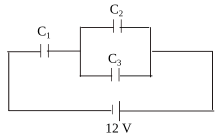
3. C1 = 3 μF, C2 = 4 μF and C3 = 3 μF, are connected in series and parallel. Determine the electric energy on the circuits.

Known :

Capacitor C1 = 3 μFCapacitors in series and parallel – problems and solutions 3

Capacitor C2 = 4 μF

Capacitor C3 = 3 μF

Wanted : The equivalent capacitance (C)

Solution :

Capacitor C2 and C3 are connected in parallel. The equivalent capacitance :

CP = C2 + C3

CP = 4 + 3

CP = 7 μF

Capacitor C1 and CP are connected in series. The equivalent capacitance :

1/C = 1/C1 + 1/CP

1/C = 1/3 + 1/7

1/C = 7/21 + 3/21

1/C = 10/21

C = 21/10

C = 2.1 μF

C = 2.1 x 10⁻⁶ F

The electric energy on the circuits :

E = ½ C V2

E = ½ (2.1 x 10⁻⁶)(122)

E = ½ (2.1 x 10⁻⁶)(144)

E = (2.1 x 10⁻⁶)(72)

E = 151.2 x 10⁻⁶ Joule

E = 1.5 x 10⁻⁴ Joule

Read more

Capacitors in series โ€“ problems and solutions

1. Four capacitors, C1 = 2 μF, C2 = 1 μF, C3 = 3 μF, C4 = 4 μF, are connected in series. Determine the capacitance of a single capacitor that will have the same effect as the combination.

Known :

Capacitor C1 = 2 μF

Capacitor C2 = 1 μF

Capacitor C3 = 3 μF

Capacitor C3 = 4 μF

Wanted : The equivalent capacitance

Solution :

The equivalent capacitance :

1/C = 1/C1 + 1/C2 + 1/C3 + 1/C4

1/C = 1/2 + 1/1 + 1/3 + 1/4

1/C = 6/12 + 12/12 + 4/12 + 3/12

1/C = 25/12

C = 12/25

C = 0.48

The equivalent capacitance of the entire combination is 0.48 μF.

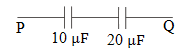
2. Determine the charge on capacitor C1 if the potential difference between P and Q is 12 Volt…

Capacitors in series – problems and solutions 1Known :

Capacitor C1 = 10 μF = 10 x 10-6 F

Capacitor C2 = 20 μF = 20 x 10-6 F

Potential difference (V) = 12 Volt

Wanted : the charge on capacitor C1 (Q1)

Solution :

The equivalent capacitance :

1/C = 1/C1 + 1/C2

1/C = 1/10 + 1/20 = 2/20 + 1/20 = 3/20

C = 20/3 μF = (20/3) x 10-6 F

Electric charge on the equivalent capacitor :

Q = (C)(V) = (20/3)(12)(10-6) = 80 x 10-6 C

Q = 80 μC

Capacitors are connected in series so that electric charge on the equivalent capacitors = electric charge on capacitor C1 = electric charge on capacitor C2.

The electric charge on capacitor C1 is 80 μC.

3. Two capacitors, C1 = 2 μF and C2 = 4 μF, are connected in series. The capacitors are charged. The potential difference on capacitor C1 is 2 Volt. The electric charge on capacitor C2 is…

Known :

Capacitor C1 = 2 μF = 2 x 10⁻⁶ F

Capacitor C2 = 4 μF = 4 x 10⁻⁶ F

The potential difference on capacitor C1 (V1) = 2 Volt

Wanted : Electric charge on capacitor C2.

Solution :

Electric charge on capacitor C1 :

Q1 = C1 V1 = (2 x 10⁻⁶)(2) = 4 x 10⁻⁶ C

Q1 = 4 μC

Capacitors are connected series so that electric charge on capacitor C1 = electric charge on capacitor C2.

The charge on capacitor C2 is 4 μC.

Read more

Capacitors in parallel โ€“ problems and solutions

1. Four capacitors, C1 = 2 μF, C2 = 1 μF, C3 = 3 μF, C4 = 4 μF, are connected in parallel. Determine the capacitance of a single capacitor that will have the same effect as the combination.

Known :

Capacitor C1 = 2 μF

Capacitor C2 = 1 μF

Capacitor C3 = 3 μF

Capacitor C3 = 4 μF

Wanted : The equivalent capacitance

Solution :

The equivalent capacitance :

C = C1 + C2 + C3

C = 4 μF + 2 μF + 3 μF = 9 μF

The equivalent capacitance of the entire combination is 9 μF.

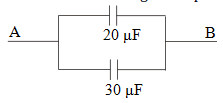
2. Determine the charge on capacitor C2 if the potential difference between point A and B is 9 Volt…

Capacitors in parallel – problems and solutions 1

Known :

Capacitor C1 = 20 μF = 20 x 10-6 F

Capacitor C2 = 30 μF = 30 x 10-6 F

Potential difference between point A and B (VAB) = 9 Volt

Wanted : the charge on capacitor C2 (Q2)

Solution :

Potential difference :

Capacitors are connected in parallel so that the potential difference between A and B (VAB) = the potential difference on capacitor C1 (V1) = the potential difference on capacitor C2 (V2) = 9 Volt.

Electric charge on capacitor C2 :

Q2 = C2 V2 = (30 x 10-6)(9) = 270 x 10-6 C

Q2 = 270 μC

The electric charge on capacitor C2 is 270 μC.

3. Three capacitors, C1 = 4 μF, C2 = 2 μF, C3 = 3 μF, are connected in parallel. The capacitor are charged. The potential difference on capacitor C2 is 4 Volt. Determine

(a) Electric charge on capacitor C1, C2 and C3

(b) Electric charge on the equivalent capacitor of the entire combination

Known :

Capacitor C1 = 4 μF = 4 x 10⁻⁶ F

Capacitor C2 = 2 μF = 2 x 10⁻⁶ F

Capacitor C3 = 3 μF = 3 x 10⁻⁶ F

Potential difference on capacitor C2 (V2) = 4 Volt

Wanted : Electric charge on capacitor C3 (Q3)

Solution :

(a) Electric charge on capacitor C3

The potential difference on capacitor C3 :

Capacitors are connected in parallel so that the potential difference on capacitor C3 (V3) = the potential difference on capacitor C2 (V2) = the potential difference on capacitor C1 (V1) = the potential difference on equivalent capacitor (V) = 4 Volt

Electric charge on capacitor C1 :

Q1 = C1 V1 = (4 x 10⁻⁶)(4) = 16 x 10-6 C

Q1 = 16 μC

Electric charge on capacitor C2 :

Q2 = C2 V2 = (2 x 10⁻⁶)(4) = 8 x 10⁻⁶ C

Q2 = 8 μC

Electric charge on capacitor C3 :

Q3 = C3 V3 = (3 x 10⁻⁶)(4) = 12 x 10-6 C

Q3 = 12 μC

(b) Electric charge on equivalent capacitor

Q = Q1 + Q2 + Q3

Q = 16 μC + 8 μC + 12 μC = 36 μC

Alternative solution :

The equivalent capacitance :

C = C1 + C2 + C3

C = 4 μF + 2 μF + 3 μF = 9 μF

C = 9 x 10⁻⁶ F

The potential difference on the equivalent capacitor :

V1 = V2 = V3 = V = 4 Volt

The electric charge on the equivalent capacitor :

Q = C V = (9 x 10⁻⁶)(4) = 36 x 10-6 C

Q = 36 μC

Read more