Loupe magnifying glass

Definition of Loupe magnifying glass

A loupe or magnifying glass is a convex lens that is used to help the eye see an object that is difficult to observe directly using the eye. The loupe is called a simple magnifier because it has limited ability to magnifying the image of an object. In the next lesson, you will learn about non-simple magnifiers such as microscopes, etc.

Read more

Contact lens Farsightedness Nearsightedness

Article about Contact lens Farsightedness Nearsightedness

Nearsightedness eyes can be normalized using eyeglass lenses and contact lenses. Eyeglass lenses are affixed to the eyeglass, while contact lenses are attached to the eyeball. Eyeglass has a certain distance from the eye, while contact lenses stick to the eye so that the distance between the contact lens and the eye can be ignored.

An example of problems experienced by a person with nearsightedness and farsightedness is explained, what types of lenses are used to normalize the eyes, what is the focal length and power of the lens. This focuses on the use of contact lenses in normalizing nearsightedness and farsightedness.

Read more

Eyeglass Farsightedness Nearsightedness

Article about Eyeglass Farsightedness Nearsightedness

Nearsightedness can be normalized using eyeglass lenses and contact lenses. Eyeglass lenses are affixed to the eyeglass, while contact lenses are attached to the eyeball. Eyeglass has a certain distance from the eye while the contact lenses stick to the eye so that the distance between the contact lens and the eye can be ignored.

In this paper, we explain examples of problems experienced by sufferers of nearsightedness and farsightedness, the type of lens used to normalize the eye, and the focal length and the power of the lens. This focuses on the use of glasses to normalize nearsightedness and farsightedness.

Read more

Nearsightedness eye

Definition of the nearsightedness eye

Nearsightedness or hyperopia is an optical eye abnormality in which the eye cannot see the near point or the near point looks blurred. The average normal-eyed human has a near point of 25 cm.

The cause of the nearsightedness eye

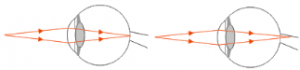
Nearsighted eye 1Based on the previous explanation, it can be concluded that the cause of farsightedness is the cornea and the lens of the eye is less curved,

so that the focal length of the cornea-eye lens system is more significant, causing the beam of light from the near point to be focused behind the retina.

Read more

Farsighted eye

Definition of the farsighted eye

Nearsightedness or hyperopia is an optical eye abnormality in which the eye cannot see a near point clearly, or the near point looks blurred. Although it is difficult to observe a near point, people with nearsightedness can see the far point. The near point is the closest distance that can be seen by the normal eye. The average normal-eye has a point near 25 cm. The far point is the farthest distance that can be seen by normal eyes. The average normal-eye person has an infinite point. Infinite is a term used to describe the length of a very distant object.

Read more

Optical instrument human eye

Article Optical instrument human eye

Parts of the eye

The cornea is a transparent, hard membrane covering the front of the eye. The cornea refracts the beam of light entering the eye.

The pupil is black parts of the eye. The pupil is black, therefore absorb almost all the light. A pupil is a hole through which light passes into the eye. The larger the diameter of the pupil, the more light enters the eye and the smaller the size of the pupil, the less light comes to the eye.

The iris controls the size of the pupil. When the environment around the eye is very bright, the iris minimizes the pupil. Conversely, when the environment around the eyes is less bright, the iris enlarges the pupil so that the amount of light entering the eye is large. If you have observed the difference between the cat’s eye during the day and night, then you can easily understand the function of the iris.

Read more
Properties of image formed by converging lens

The object distance is smaller than the focal length of the convex lens (do < f)

Based on the calculation of the image formation by the convex lens, it can be concluded that the object distance (do) is smaller than the focal length (f) of the convex lens, the image properties are:

– Virtual means the beam of light does not pass through the image

– Upright

– The farther the object is from the convex lens, the greater the image size

– The farther the object is from the convex lens, the image farther away from the convex lens

Read more

Equation of converging (convex) lens

Article about Equation of converging (convex) lens

Before learning the equation of the convex lens, understand the sign rules of the convex lens below.

Sign rules of the convex lens

The object distance (do)

If an object is passed through a beam of light, then the object distance is positive.

The image distance (di)

If the beam of light passes the image, then the image distance is positive (real image). If the beam of light does not pass through the image, the image distance is negative (virtual image).

Read more

Image formation by converging (convex) lens

Article about Image formation by converging (convex) lens

To understand the image formation by the convex lens, learn example problems and solution below. In this case, the object is assumed to be at a certain distance from the convex lens,

then draw the image formation by the convex lens, the image distance from the convex lens and the magnification of the image by the convex lens.

The convex lens has a focal length of 20 cm. Objects with a height of 10 cm are located to the left of the lens. Determine the image distance, the magnification of the image and the image height, if:

Read more

Ray diagrams for converging (convex) lens

Article about Ray diagrams for converging (convex) lens

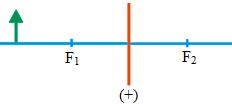
If an object is on one side of the convex lens, the convex lens can form the image of the object. If the position of the object on one side of the convex lens is known, how to draw the image formation of the object? Suppose an object is on the left side of the convex lens, as shown below.

Ray diagrams for converging lens 1Orange line = convex lens

Blue line = principal axis

Arrow (green) = object

F1 = focal length 1 and F2 = focal length 2

Read more