Vectoren optellen met behulp van componenten – problemen en oplossingen
1. Drie vectoren zoals weergegeven in de onderstaande afbeelding.
V1 = 30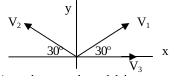
V 2 = 30
V 3 = 40
Wat zijn de resulterende vectoren?
Bekend:
V 1 = 30, hoek tussen V 1 en de x-as = 30 °
V 2 = 30, hoek tussen V 2 en de x-as = 30 °
V 3 = 40, hoek tussen V 3 en de x-as = 0 °
Gezocht: De resulterende vectoren
oplossing:
V 1x = (V 1 )(cos 30 o ) = (30)(0.5√3) = 15√3. Positief omdat deze vectorcomponent langs de positieve x-as wijst (naar rechts).
V 1y = (V 1 )(sin 30 o ) = (30)(0.5) = 15. Positief omdat deze vectorcomponent langs de positieve y-as wijst (omhoog).
V 2x = (V 2 )(cos 30 o ) = (30)(0.5√3) = -15√3. Negatief omdat deze vectorcomponent langs de negatieve x-as wijst (naar links).
V 2y = (V 2 )(sin 30 o ) = (30)(0.5) = 15. Positief omdat deze vectorcomponent langs de positieve y-as wijst (omhoog).
V 3x = (V 3 )(cos 0 o ) = (40)(1) = 40. Positief omdat deze vectorcomponent langs de positieve x-as wijst (naar rechts).
V 3y = (V 3 )(zonde 0 o ) = (40)(0) = 0
De componenten van de resulterende vectoren:
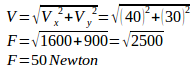
V x = V 1x – V 2x + V 3x = 15√3 – 15√3 + 40 = 40
V y = V 1y + V 2y + V 3y = 15 + 15 = 30
2. Twee krachten staan loodrecht op elkaar, F₁ = 12 N en F₂ = 5 N. Wat is de resultante van beide krachten?
Bekend:
Kracht 1 (F 1 ) = 12 Newton
Kracht 2 (F 2 ) = 5 Newton
Gevraagd: De resulterende vectoren ( ΣF)
oplossing:
ΣF 2 = F 1 2 + F 2 2 = 12 2 + 5 2 = 144 + 25 = 169
ΣF = √ 169 = 13 Newton
3. Drie vectoren,
V1 = 30
V 2 = 30
V 3 = 40
Bepaal de resulterende vectoren.
Bekend:
v 1 = 30, maakt een draai van 30 ° om de negatieve x-as.
v 2 = 30, maakt 30 ° ten opzichte van de positieve x-as
v 3 = 40, maakt 0 ° ten opzichte van de positieve x-as
Gezocht: De resulterende vectoren
oplossing:
De componenten van vectoren:
v 1x = v 1 cos 30 o = (30)(0.5 √ 3) = -15 √ 3 ( Negatief omdat deze vectorcomponent langs de negatieve x-as wijst (naar links) )
v 1y = v 1 sin 30 o = (30)(0.5) = 15 ( Positief omdat deze vectorcomponent langs de positieve y-as wijst (naar boven) )
v 2x = v 2 cos 30 o = (30)(0.5 √ 3) = 15 √ 3 ( Positief omdat deze vectorcomponent langs de positieve x-as wijst (naar rechts ) )
v 2y = v 2 sin 30 o = (30)(0.5) = 15 ( Positief omdat deze vectorcomponent langs de positieve y-as wijst (naar boven). )
v 3x = v 3 cos 0 o = (40)(1) = 40 ( Positief omdat deze vectorcomponent langs de positieve x-as wijst (naar rechts). )
v 3y = v 3 zonde 0 o = (40)(0) = 0
De componenten van de resulterende vectoren:
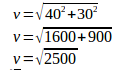
v x = – v 1x + v 2x + v 3x = -15 √ 3 + 15 √ 3 + 40 = 40
v y = v 1y + v 2y + v 3y = 15 + 15 = 30
De resulterende vector:
4. Wat is de resultante van de drie vectoren zoals weergegeven in de onderstaande figuur?
Bekend:
F1 = 3 Newton, merken 60o rond de positieve x-as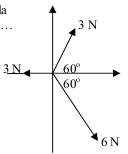
F 2 = 3 Newton, maakt 0 ° ten opzichte van de negatieve x-as
F 3 = 6 Newton , maakt een hoek van 60 ° om de negatieve y-as.
Gezocht: De resulterende vector
oplossing:
De componenten van vectoren:
F 1x = F 1 cos 60 ° = (3)(0.5) = 1.5 N ( Positief omdat deze vectorcomponent langs de positieve x-as wijst (naar rechts ) )
F 1y = F 1 sin 60 o = (3)(0.5√3) = 1.5√3 N ( Positief omdat deze vectorcomponent langs de positieve y-as wijst (naar boven) )
F 2x = F 2 cos 0 o = (3)(1) = -3 N ( Negatief omdat deze vectorcomponent langs de negatieve x-as wijst (naar links) )
F 2y = F 2 zonde 0 o = (3)(0) = 0
F 3x = F 3 cos 60 ° = (6)(0.5) = 3 N ( Positief omdat deze vectorcomponent langs de positieve x-as wijst (naar rechts ) )
F 3y = F 3 sin 60 o = (6)(0.5√3) = -3√3 N ( Negatief omdat deze vectorcomponent langs de negatieve y- as wijst ( naar beneden) )
De componenten van de resulterende vectoren:
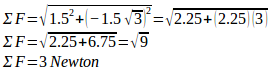
ΣF x = F 1x – F 2x + F 3x = 1.5 N – 3 N + 3 N = 1.5 N
ΣF y = F 1y + F 2y – F 3y = 1.5√3 N + 0 N – 3√3 N = -1.5√3 N
De resulterende vector:
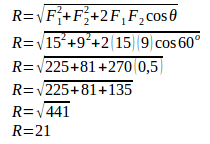
5. Twee krachten, F₁ = 15 N en F₂ = 9 N. De hoek tussen beide vectoren is 60°. Wat is de resultante van de vectoren?
Gewild :
Kracht 1 (F 1 ) = 15 Newton
Kracht 2 (F 2 ) = 9 Newton
Hoek ( θ) = 60 °
Gezocht: De resulterende vector
oplossing:
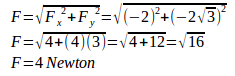
6. Wat is de resultante van de drie vectoren zoals weergegeven in de onderstaande figuur?
Bekend:
F1 = 20 Newton, hoek tussen F1 en de x-as = 0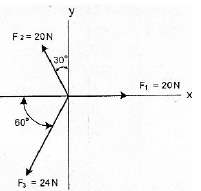
F 2 = 20 Newton, hoek tussen F 2 en de x-as = 60
F 3 = 24 Newton, hoek tussen F 3 en de x-as = 60
Gezocht: De resulterende vector
oplossing:
De componenten van vectoren:
F 1x = (F 1 )(cos 0) = (20)(1) = 20. Positief omdat deze vectorcomponent langs de positieve x-as wijst (naar rechts ).
F 1y = (F 1 )(zonde 0) = (20)(0) = 0
F 2x = (F 2 )(cos 60) = (20)(0.5) = -10. Negatief omdat deze vectorcomponent langs de negatieve x-as wijst (naar links).
F 2y = (F 2 )(sin 60) = (20)(0.5√3) = 10√3. Positief omdat deze vectorcomponent langs de positieve y-as wijst (omhoog).
F 3x = (F 3 )(cos 60) = (24)(0.5) = -12. Negatief omdat deze vectorcomponent langs de negatieve x-as wijst (naar links).
F 3y = (F 3 )(sin 60) = (24)(0.5√3) = -12√3. N is negatief omdat deze vectorcomponent langs de negatieve y- as wijst ( naar beneden).
De componenten van de resulterende vectoren:
F x = F 1x – F 2x – F 3x = 20 – 10 – 12 = -2
F y = F 1y + F 2y – F 3y = 0 + 10√3 – 12√3 = -2√3
De resulterende vector: