Resistivity

Tusitusiga e uiga i le Resistivity

E tusa ai ma le tafe eletise, ua talanoaina le mafiafia o le tafe eletise, o lea ua faʻamatalaina ai foʻi le fanua eletise i le autu e uiga i le fanua eletise. O le fanua eletise ma le tafe eletise o loʻo i totonu o se avetaʻavale pe afai e iai se eseesega o le gafatia i le avetaʻavale, ae afai e leai se eseesega o le gafatia, ona leai foʻi lea o se fanua eletise ma le tafe eletise.

I toetoe lava o uamea uma e fa'a'ave'a ai le eletise, e tutusa lelei lava le fanua eletise ma le mafiafia o le tafe eletise, lea e tumau ai le fua fa'atatau o le fanua eletise i le mafiafia o le tafe eletise. O le tau o le fa'atusatusaga o le fanua eletise i le mafiafia o le tafe e ta'ua o le resistivity. I le fa'amatematika, o le sootaga i le va o le fanua eletise, le mafiafia o le tafe, ma le resistivity o lo'o ta'ua i le fua fa'atatau:
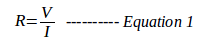
faitau atili

Code lanu tetee

Article about the Resistor color code

le tetee is one component of an electrical circuit that functions to control the number of electric currents. In general, there are two types of resistors, namely wire coil resistors and carbon resistors. Wire roll resistors are usually used in the laboratory, made by wrapping fine wire on the surface of the insulator tube. Carbon resistors are typically used in electronic circuits, cylindrical, and have wires at both ends. The value of the carbon resistor resistance is expressed in color code and displayed on the surface of the resistor.

The resistance value of a resistor can be known by interpreting the resistor color code. To understand this, first look at the following table, then study the example problem to determine the resistor resistance value.

faitau atili

Resistors i le faasologa

Resistors in series 1

Article about the Resistors in series

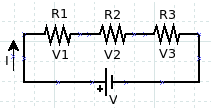
If the resistors are connected as shown in the figure, the resistors are arranged in series. Resistor or electrical resistance in question can be in the form of resistor components, lights, or other electrical resistance.

The electric charge moves through resistance 1 (R1) = le tau eletise moves through resistance 2 (R2) = the electric charge moves through resistance 3 (R3). Eletise o loʻo i ai nei (I) is an electric charge that flows during a certain time interval (I = Q / t), hence the electric current through resistance 1 (I1) = electric current through resistance 2 (I2) = electric current through resistance 3 (I3). Mathematically, the total electric current (I) = I1 = Ou2 = Ou3.

faitau atili

Tete'e eletise

Equation of the Electric resistance

In the topic of Ohm’s law, a formula that states the relationship between the volitiga (V), eletise nei (I), and tete'e eletise (R) has been derived. Mathematically expressed through equations:

Electric resistance 1

This equation shows that the electrical resistance (R) is directly proportional to the electric voltage (V) and inversely proportional to the electric current (I). If the mains voltage is greater than the electrical resistance is getting bigger, on the contrary, if the stronger the electric current gets bigger than the electrical resistance will be greater. This equation explains Ohm’s law only when the electrical resistance (R) is constant. If the electrical resistance is not constant, then this equation does not explain Ohm’s law, but explains the resistance of a conductor.

faitau atili

Resistors i le tutusa

Resistors i le parallel 1

Mataupu e uiga i Resistors i le parallel

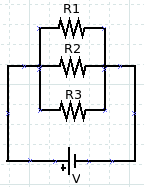
Afai e feso'ota'i ia resistors e pei ona i ai i le ata, e feso'ota'i fa'atasi ia resistors.

le eletise nei (tafe eletise = le eletise e tafe i se taimi) e ulufale atu i le nofoaga e feso'ota'i ai e tutusa ma le tafe eletise e alu ese mai le nofoaga e feso'ota'i ai. E tele ni feso'ota'iga ina ia tutusa ai le aofa'i o le tafe eletise = le aofa'i o le tafe eletise o lo'o tafe i feso'ota'iga ta'itasi. I le fa'amatematika, I = I1 + I2 + I3. E ui o le eseesega o le gafatia eletise po'o eletise eletise e tutusa lava i fetaulaiga taʻitasi.

I = V/R o lea ua suia ai le fua faatatau o loʻo i luga i le I = V/R1 + V/R2 + V/R3. E tutusa le voltage eletise, o lea e suia ai lenei fua fa'atatau i le I = V (1/R1 + 1/R2 + 1/R3). Afai o le tete'e tutusa o le 1/R ona I = V (1/R). O lea la, 1/R = 1/R1 + 1/R2 + 1/R3.

faitau atili

Puna o le malosiaga eletise emf Teteega i totonu Voltage fa'ai'u

Article about Source of electromotive force emf Internal resistance Terminal voltage

Eletise o loʻo i ai nei flows in a closed circuit, from high potential to low potential. When an electric current moves through a component of electrical resistance, there is a reduction in malosi fa'aeletise because electrical energy is used on this resistance. In order for the electric current to continue to flow from high potential to low potential,

there must be a device to add electrical potential energy, the tool is an electromotive force (emf) or more accurately called an electric voltage source. Emf or a voltage source is a component that converts a type of energy into electrical energy, such as batteries, solar cells, or electricity generators.

faitau atili

EMF i le faasologa ma le tutusa

EMFs in series and parallel 1

EMF i le faasologa ma le tutusa

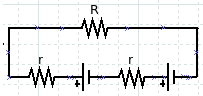
If there are two or more sources of electromotive (emf) connected as shown in the figure, the emf is arranged in series.

Le tutusa volitiga source (ε) is:

ε = ε1 + ε2 + εn

The equivalent internal resistance (r) is:

r = r1 +r2 +rn

The electric current flowing through the external resistance (R) is:

faitau atili

O le tulafono muamua a Kirchhoff

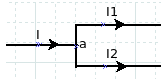
Tulafono muamua a Kirchhoff 1O le tulafono muamua a Kirchhoff e taʻua foʻi o le tulafono o le tulaga fesoʻotaʻiga e faʻapea o le tafe eletise e ulufale atu i se tulaga fesoʻotaʻiga e tutusa ma le tafe eletise e alu ese mai lea tulaga fesoʻotaʻiga. O le tulaga fesoʻotaʻiga i se matagaluega eletise o le tulaga lea e feiloaʻi ai ni avetaʻavale se lua pe sili atu, e pei o le tulaga a i le ata i le itu.
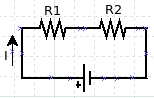
O le I o le tafega eletise e ulufale atu i le nofoaga e feso'ota'i ai, a'o le I1 ma aʻu2 o tafega eletise ia e alu ese mai le nofoaga e feso'ota'i ai, I = I1 + I2. O le isi faʻataʻitaʻiga, matau le ata o loʻo i lalo.

faitau atili

Le tulafono lona lua a Kirchhoff

O le tulafono lona lua a Kirchhoff e taʻu mai ai o le suiga o le malosiaga eletise i luga o le liʻo o se matagaluega tapuni e leai se mea. O le tulafono lona lua a Kirchhoff e faʻavae i luga o le tulafono o le faʻasaoina o le malosi, lea e taʻu mai ai o le malosi e faʻavavau.

Tulafono lona lua a Kirchhoff 1Ina ia malamalama atili i lenei mea, mafaufau i le eletise o loʻo fealuaʻi i totonu o se matagaluega tapuni, e pei o le ata. A ui atu se eletise i totonu o se tete'e eletise (R), le malosi fa'aeletise e fa'aitiitia ona e fa'aaogaina i nei tete'ega. Afai e ui atu le eletise i se isi tete'ega eletise, e toe fa'aitiitia le malosi o le eletise ona e toe fa'aaogaina i le tete'ega. E le gata i lea, pe a ui atu le eletise i le puna o le voltage mai se malosiaga maualalo i se malosiaga maualuga, e fa'ateleina le malosi o le eletise. A toe fo'i i lona tulaga muamua, e tutusa lava le malosi o le eletise ma le taimi muamua, lea e leai se suiga i le malosi o le eletise. Pe a fa'aogaina KirchhoffO le tulafono lona lua a le Tusi Paia i se matagaluega eletise, tatou te faʻaaogaina le suiga o le voltage eletise, ae le o le suiga i le malosiaga gafatia eletise.

faitau atili

Pule eletise

Definition of electric power

The power learned in the work and Energy is defined as the work done during a certain time interval. Work is a process of energy change so that power can be understood as a change in energy that occurs during a certain time interval.

Electric power is a change in electrical energy during a certain time interval. In a review of electrical potential, it is explained that changes in electric potential energy occur when an electric charge passes through an malosiaga eletise eseʻesega

faitau atili