Wavefront Ray Beam of light

Article Wavefront Ray Beam of light

Definition of wavefront

If you throw a stone into a pool of water, circular water waves moving away from the center of the circle. In the water waves, there are crests and troughs. Wave peaks or waves valleys that move away from the center of the circle can be said as a wavefront.

Two adjacent wavefronts are two parts of the wave that has the same phase and are separated by one wavelength. Wave peaks or wave valleys that have the same phase and are separated by one or more wavelengths are referred to as wavefront. In addition to water waves, sound waves or light waves also have a wavefront. In contrast to water waves that move only in a plane or area, sound waves and light waves move in space.
Read more

Poiseuilles equation

Article about Poiseuilles equation

Poiseuille equation was discovered by Jean Louis Marie Poiseuille (1799-1869). As explained, each fluid can be considered as an ideal fluid. The ideal fluid does not have viscosity. If we assume an ideal fluid flows in a pipe, each part of the fluid moves at the same rate (v). Unlike the ideal fluid, the real fluid we encounter in everyday life has viscosity. Because it has a viscosity, then when flowing in a pipe, for example, the rate of each part of the fluid varies. The fluid layer that is in the middle moves faster (deep v), on the contrary, the fluid layer attached to the pipe does not move (v = 0). So from the middle to the edge of the pipe, every part of the fluid moves at different rates. To facilitate your understanding, observe the picture below.

Read more

Viscosity

Fluid, both liquid and gas substances of different types, have different viscosity levels. Viscosity is a friction between the molecules that make up a fluid. So, the molecules make up fluid friction when the fluid flows. In liquids, the viscosity is caused by cohesion forces (pulling forces between similar molecules). Whereas in gas substances, the viscosity is caused by collisions between molecules.

Liquid fluid is easier to flow, for example, water. Conversely, thick fluid is more difficult to flow, for example, lubricant. You can prove by pouring water and lubricant on an inclined surface. Water flows faster than oil. The level of viscosity of fluid also depends on temperature. The higher the temperature of the liquid, the less viscous the liquid is. For example, when a mother fry fish in the kitchen, cooking oil which initially thickens becomes more liquid when heated. Conversely, the higher the temperature of a gas substance, the thicker the gas substance is.

Read more

Capillarity

Force of Cohesion and Adhesion

Cohesion force is an attraction force between molecules in a similar substance, while an attraction force between molecules of an unequal substance is called the Adhesion Force. For example, we pour water into a glass. Cohesion occurs when water molecules attract each other, while adhesion occurs when water molecules and glass molecules pull each other.

Read more

Surface tension

Have you ever played soap bubbles? Soap bubble round. Funny. Can be blown. After flying, soap bubbles burst. Wow, it’s fun, a childhood game. Why is soap bubble round?

Please wake up in the morning, then notice the leaves around the house. Observe the droplets of dew attached to the leaves. It’s strange; dew drops are round. How can it be like that?

Surface tension occurs because the surface of the liquid tends to tighten so that the surface looks like a thin membrane. This is influenced by the cohesion force between water molecules. To better understand this explanation, consider the following illustration. We review the liquid in a container.

Read more

Archimedes principle

Article about Archimedes principle

A ship with a huge mass does not sink, while a stone that has a small size can sink. Why is that? The answer is straightforward if you understand the concept of buoyancy and Archimedes’ principle.

In everyday life, we will find that objects that are inserted into a fluid, like a rock, have a smaller weight than when objects are not in the liquid. You may find it difficult to lift a stone from the ground, but the same stone is effortlessly raised from the bottom of the seawater. This is due to the buoyant force. Buoyancy occurs due to differences in fluid pressure at different depths. The fluid pressure increases with depth, the thicker the fluid, the greater the pressure of the fluid. When an object is inserted into the fluid, there will be a difference in pressure between the fluid at the top of the object and fluid at the bottom of the object. Fluid located at the bottom of the object has a pressure higher than the fluid at the top of the object.

Read more

Pascals principle

Article about Pascals principle

How is the working principle of a hydraulic lift used to lift a car? What is the working principle of hydraulic brakes when used to reduce the car’s speed? Please learn Pascal’s Principle to understand this.

Every fluid is always exerting pressure on all objects that in contact with it. The water we put in the glass will exert pressure on the glass wall. Likewise, if we take a bath in a swimming pool or seawater, the pool water or seawater also exerting pressure on our entire body.

Read more

Pressure in fluids

Article about Pressure in fluids

In physics, the pressure is defined as force per unit area, where the direction of the force is perpendicular to the surface area. Mathematically, pressure is expressed by the equation P = F / A, where P = pressure, F = force and A = surface area. Force unit (F) is Newton (N), the unit of area is the square meter (m2). Because pressure is the force per unit area, the pressure unit is N/m2. Another name for N/m2 is Pascal (Pa). Pascal was used as a pressure unit to honor Blaise Pascal.

Read more

Density and specific gravity

Article about Density and specific gravity

Density

One important characteristic of a substance is density. Density is the ratio of mass to volume. Mathematically written:

ρ = m / V

ρ (rho) is a Greek letter commonly used to express density, m is mass and V is volume. The density of the homogeneous fluid is different from the density of a homogeneous solid. Iron, for example, have the same density in each part. In the Earth’s atmosphere, the higher the atmosphere from the surface of Earth, the smaller its density, while for seawater, the deeper the seawater, the greater its density. The density of a homogeneous fluid can depend on environmental factors such as temperature and pressure.

Read more

The applications of Bernoullis principle and Bernoullis equation

Article about The applications of Bernoullis principle and Bernoullis equation

Torricelli’s theorem

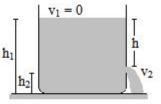
The application of Bernoulli's principles and Bernoulli's equations 1One of the uses of Bernoulli’s equation is to calculate the speed of a liquid exit from the bottom of a container (see figure).

We apply Bernoulli’s equation at point 1 (surface of the container) and point 2 (surface of the hole). Because the diameter of the hole in the bottom of the container is much smaller than the diameter of the container, the speed of the liquid on the surface of the container is considered zero (v1 = 0). The surface of the container and the surface of the hole are open so that the pressure is equal to atmospheric pressure (P1 = P2). Thus, Bernoulli’s equation for this case is:

Read more