Collisions – problems and solutions

Collisions – problems and solutions

1. Object A (3 kg) moves at a speed of 8 m/s and object B (5 kg) moves at a speed of 4 m/s. If the collision between the object A and B is perfectly elastic, what is the velocity of object A and B after the collision?

Known :

Mass of object A (m1) = 3 kg

Mass of object B (m2) = 5 kg

The speed of object A (v1) = 8 ms–1

The speed of object B (v2) = 4 ms–1
Read more

Unit vector – problems and solutions

Unit vector – problems and solutions

1. An object moves at a velocity of v = (2i − 1.5j) m/s. What is the displacement of the object after 4 seconds?

Known :

The horizontal component of the velocity (vx) = 2 m/s

The vertical component of the velocity (vy) = 1.5 m/s

Time interval (t) = 4 seconds

Wanted : Displacement

Read more

Vector displacement – problems and solutions

Vector displacement – problems and solutions

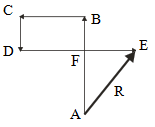
1. A person walks from point A to point B, 600 meters north; then to point C, 400 meters west; then to point D, 200 meters south; and then finish at point E, 700 meters east. What is the magnitude of the displacement?

Solution :

Vector displacement – problems and solutions 1

Known :

AF = AB – BF = AB – CD = 600 – 200 = 400 m

EF = DE – DF = DE – BC = 700 – 400 = 300 m

Read more

Adding vectors using components – problems and solutions

Adding vectors using components – problems and solutions

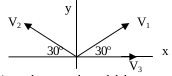
1. Three vectors as shown in the figure below.

V1 = 30Adding vectors using components – problems and solutions 1

V2 = 30

V3 = 40

What is the resultant vectors.

Known :

V1 = 30, angle between V1 and x axis = 30o

Read more

Graphical of linear motion – problems and solutions

Graphical of linear motion – problems and solutions

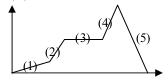
1. Graph distance (vertical) versus time (horizontal) as shown in the figure below. An object at rest shown by number…

Solution :

Graphical of linear motion – problems and solutions 1

Number 3, shown by a straight line.

Read more

Average velocity – problems and solutions

Average velocity – problems and solutions

1. Someone rounds a rectangle with a length of 400 m and width of 100 m, 12 times in 1 hour. What are the average velocity and the average speed?

Known :

Length of rectangle = 400 meters

Width of rectangle = 100 meters

Circumference of the rectangle = (2 x 400 meters) + (2 x 100 meters) = 800 meters + 200 meters = 1000 meters

Distance = 12 x 1000 meters = 12,000 meters = 12 kilometers

Read more

Projectile motion – problems and solutions

27 Projectile motion – problems and solutions 1. A bullet fired at an angle θ = 60o with a velocity of 20 m/s. Acceleration due to gravity is 10 m/s2. What is the time interval to reach the maximum height? Known : The initial velocity of bullet (vo) = 20 m/s Angle (θ) = 60oC … Read more

Black principle – problems and solutions

Black principle – problems and solutions

1. 200-gram water at 30°C mixed with 100-gram water at 90°C. The specific heat of water = 1 cal.gram−1°C−1. Determine the final temperature of the mixture!

Known :

Mass of water 2 (m1) = 200 gram

Temperature of water 1 (T1) = 30oC

Mass of water 2 (m2) = 100 gram

Read more

Dynamics Object connected by cord over pulley Atwood machine – Problems and Solutions

10 Dynamics Object connected by cord over pulley Atwood machine – Problems and Solutions

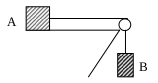
1. Block A with a mass of 5 kg, placed on a smooth horizontal plane. Block B with a mass of 3 kg hanging at one end of the cord connected with block A over a pulley. Acceleration due to gravity is 10 m/s2. What is the acceleration of both blocks?

Known :

Mass of block A (mA) = 5 kgDynamics, object connected by cord over pulley, atwood machine - problems and solutions 1

Mass of block B (mB) = 3 kg

Acceleration due to gravity (g) = 10 m/s2

Read more

Circular motion – problems and solutions

Circular motion – problems and solutions

1. A 10-kg object moves in a circle at constant speed 4 m/s. If the radius of the circle is 0.5 meters, then :

1) The frequency of circle is 4/π Hz

2) The centripetal acceleration is 32 m.s-2

3) The centripetal force is 320 N

4) The period is 4π s.

Which are the true statements?

Read more