1.
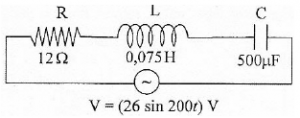
Bepaal de elektrische stroomsterkte in het circuit (1 µF = 10⁻⁶ F ).
Bekend:
Weerstand (R) = 12 Ohm
Inductor (L) = 0.075 H
Condensator (C) = 500 µF = 500 x 10⁻⁶ F = 5 x 10⁻⁴ Farad
Spanning (V) = V o sin ω t = V o sin 2πf t = 26 sin 200t
Gezocht: elektrische stroom
oplossing:
Impedantie (Z):
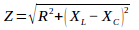
De inductieve reactantie (X L ) = ωL = (200)(0,075) = 15 Ohm
De capacitieve reactantie (X C ) = 1 / ωC = 1 / (200)(5 x 10 -4 ) = 1 / (1000 x 10 -4 ) = 1 / 10 -1 = 10 1 = 10 Ohm
Weerstand (R) = 12 Ohm
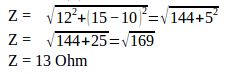
Elektrische stroom (I) :
I = V / Z = 26 Volt / 13 Ohm
I = 2 Volt/Ohm
I = 2 Amp
2. Als de impedantie van het circuit 250 Ω is, bepaal dan de weerstandswaarde van weerstand R.
Bekend: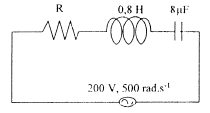
De impedantie van het circuit (Z) = 250 Ω
Condensator (C) = 8 mF = 8 x 10⁻⁶ F
Inductor (L) = 0.8 H
Spanning (V) = 200 Volt
w = 500 rad/s
Gevraagd: Weerstand van de weerstand (R)
oplossing:
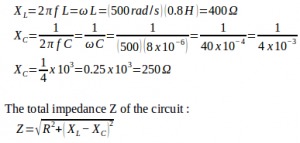
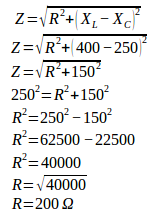
3. Bepaal het potentiaalverschil tussen beide randen van de inductor.
Bekend: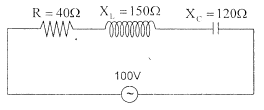
R = 40 W
X L = 150 W
X C = 120 W
V = 100 Volt
Gezocht: het potentiële verschil
oplossing:
De totale impedantie Z van het circuit:
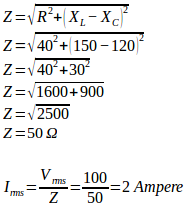
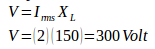
Het potentiaalverschil tussen beide randen van de inductor: