Dynamics of particles – problems and solutions

Dynamics of particles – problems and solutions

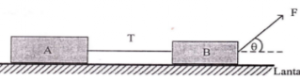
1. Object A with a mass of 6-kg and object B with a mass of 4-kg connected by a cord and pulled by a force of F = 60 N, as shown in the figure below. The coefficient of kinetic friction between the floor and both objects is 0.5 (tan θ = ¾). Acceleration due to gravity is 10 m/s2. What is the magnitude of the tension force?

Known :

Mass of object A (mA) = 6 kgDynamics of particles – problems and solutions 1
Mass of object B (mB) = 4 kg

Force (F) = 60 Newton
Read more

Density and floating in equilibrium – problems and solutions

Density and floating in equilibrium – problems and solutions

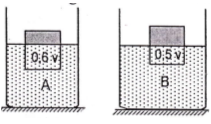
1. A block placed into two liquids with different types. In liquids A, 0.6 part of an object is in the liquid. In liquids B, 0.5 part of an object is in the liquid. Determine the ratio of the density of liquid A to liquid B.

Known :

Density of block = xDensity and floating in equilibrium – problems and solutions 1

Part of the object in liquid A = 0.6

The density of liquid A = y

Part of object in liquid B = 0.5

Read more

Conservation of mechanical energy on curve surface – problems and solutions

Conservation of mechanical energy on curve surface – problems and solutions

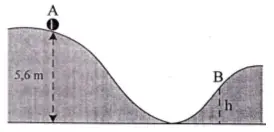
1. If ball’s speed at point A is 6 m/s, ball’s speed at point B is √92 m/s, and acceleration due to gravity is g = 10 m/s2. What is the height of point B (h)?

Known :

Speed of ball at point A (vA) = 6 m/sConservation of mechanical energy on curve surface – problems and solutions 1

Speed of ball at point B (vB) = √92 m/s

Acceleration due to gravity (g) = 10 m/s2

The height of A (hA) = 5.6 meters

Read more

Center of gravity – problems and solutions

Center of gravity – problems and solutions

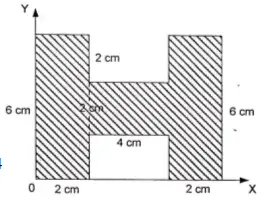
1. Determine the coordinate of the center of gravity of the object as shown in the figure below.

Solution :Center of gravity – problems and solutions 1

Divide the object into three parts.

Area of part 1 (A1) = (2)(6) = 12 cm2

The center point lies on the x axis (x1) = 1/2 (2) = 1 cm

The center point lies on the y axis (y1) = 1/2 (6) = 3 cm

Read more

Torricelli’s theorem – problems and solutions

Torricelli’s theorem – problems and solutions

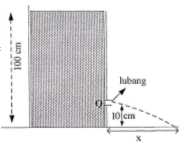
1. A tube with the height of 100 cm filled with water. A hole Q located at 10 cm above the ground. What is the horizontal distance (x)?

Known :Torricelli's theorem – problems and solutions 1

Distance between hole and the surface of the water (h) = 100 cm – 10 cm = 90 cm = 0.9 m

Acceleration due to gravity (g) = 10 m/s2

Read more

Vector – problems and solutions

Vector – problems and solutions

Vector and Scalar

1. Among the following options, which are scalar-vector pairs…

A. Force – acceleration

B. Pressure – force

C. Displacement – speed

D. Electric current – pressure

Read more

Compound microscope – problems and solutions

Compound microscope – problems and solutions

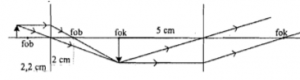
1.

Compound microscope – problems and solutions 1

Based on the figure above, what is the overall magnification? Assume a normal eye so the near point (N) = 25 cm.

Known :

Read more

Physical quantities Units Dimensions – Problems and Solutions

Physical quantities Units Dimensions – Problems and Solutions

1.

Physical quantities, units, dimensions – problems and solutions 1

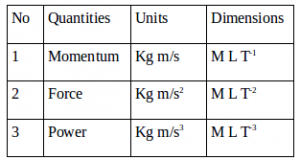
Based on the above table, which quantities have true units and dimensions.

Read more

Radial acceleration – problems and solutions

Radial acceleration – problems and solutions

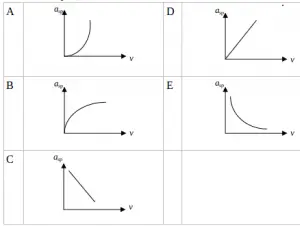
1. Which graph below shows the relation between centripetal acceleration or radial acceleration (aR) and linear velocity (v) in uniform circular motion.

Radial acceleration – problems and solutions 1

Solution :

Read more

Potential energy – problems and solutions

Potential energy – problems and solutions

Gravitational potential energy

1. Energy 4900 Joule used to raise an object with mass of 50 kg to a height of h. What is the height of h? Acceleration due to gravity (g) = 9.8 ms-2.

Known :

Change of potential energy (ΔPE) = 4900 Joule

Mass of object (m) = 50 kg

Acceleration due to gravity (g) = 9.8 m/s2

Read more