Żieda ta' vetturi bl-użu ta' komponenti – problemi u soluzzjonijiet
1. Tliet vetturi kif muri fil-figura t'hawn taħt.
V1 = 30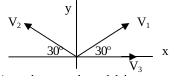
V2 = 30
V3 = 40
X'inhuma l -vetturi riżultanti?
Magħruf:
V 1 = 30, angolu bejn V 1 u l-assi x = 30 °
V 2 = 30, angolu bejn V 2 u l-assi x = 30 °
V3 = 40, angolu bejn V3 u l -assi x = 0 °
Meħtieġa: Il-vetturi riżultanti
Soluzzjoni:
V 1x = (V 1 )(cos 30 o ) = (30)(0.5√3) = 15√3. Pożittiv għaliex dan il-komponent vettorjali jipponta tul l-assi pożittiv x (lejn il-lemin).
V 1y = (V 1 )(sin 30 o ) = (30)(0.5) = 15. Pożittiv għaliex dan il-komponent vettorjali jipponta tul l-assi y pożittiva ('il fuq).
V 2x = (V 2 )(cos 30 o ) = (30)(0.5√3) = -15√3. Negattiv għaliex dan il-komponent vettorjali jipponta tul l-assi x negattiv (lejn ix-xellug).
V 2y = (V 2 )(sin 30 o ) = (30)(0.5) = 15. Pożittiv għaliex dan il-komponent vettorjali jipponta tul l-assi y pożittiva ('il fuq).
V 3x = (V 3 )(cos 0 o ) = (40)(1) = 40. Pożittiv għaliex dan il-komponent vettorjali jipponta tul l-assi pożittiv x (lejn il-lemin).
V 3y = (V 3 )(sin 0 o ) = (40)(0) = 0
Il-komponenti tal-vetturi riżultanti:
Vx = V1x – V2x + V3x = 15√3 – 15√3 + 40 = 40
V y = V 1y + V 2y + V 3y = 15 + 15 = 30
2. Żewġ forzi perpendikolari għal xulxin, F1 = 12 N u F2 = 5 N. X'inhi r-riżultanti taż-żewġ forzi.
Magħruf:
Forza 1 (F1 ) = 12 Newton
Forza 2 (F2 ) = 5 Newton
Meħtieġa: Il-vetturi riżultanti ( ΣF)
Soluzzjoni:
ΣF2 = F12 + F22 = 122 + 52 = 144 + 25 = 169
ΣF = √ 169 = 13 Newton
3. Tliet vettori,
V1 = 30
V2 = 30
V3 = 40
Iddetermina l-vetturi riżultanti.
Magħruf:
v 1 = 30, jagħmel 30 o madwar l-assi x negattiv
v 2 = 30, jagħmel 30 o madwar l-assi pożittiv x
v 3 = 40, jagħmel 0 o madwar l-assi pożittiv x
Meħtieġa: Il-vetturi riżultanti
Soluzzjoni:
Il-komponenti tal-vetturi:
v 1x = v 1 cos 30 o = (30)(0.5 √ 3) = -15 √ 3 ( Negattiv għax dan il-komponent vettorjali jipponta tul l-assi x negattiv (lejn ix-xellug) )
v 1y = v 1 sin 30 o = (30)(0.5) = 15 ( Pożittiv għaliex dan il-komponent vettorjali jipponta tul l-assi y pożittiva ('il fuq) )
v 2x = v 2 cos 30 o = (30)(0.5 √ 3) = 15 √ 3 ( Pożittiv għaliex dan il-komponent vettorjali jipponta tul l-assi pożittiv x (lejn il-lemin ) )
v 2y = v 2 sin 30 o = (30)(0.5) = 15 ( Pożittiv għaliex dan il-komponent vettorjali jipponta tul l-assi y pożittiva ('il fuq). )
v 3x = v 3 cos 0 o = (40)(1) = 40 ( Pożittiv għaliex dan il-komponent vettorjali jipponta tul l-assi pożittiv x (lejn il-lemin). )
v 3y = v 3 sin 0 o = (40)(0) = 0
Il-komponenti tal-vetturi riżultanti:
vx = – v1x + v2x + v3x = -15 √3 + 15 √3 + 40 = 40
v y = v 1y + v 2y + v 3y = 15 + 15 = 30
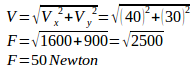
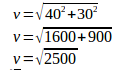
Il-vettur riżultanti:
4. X'inhu r-riżultanti ta' tliet vetturi kif muri fil-figura t'hawn taħt :
Magħruf:
F1 = 3 Newtons, jagħmel 60o madwar l-assi pożittiva x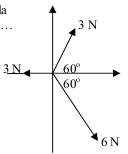
F2 = 3 Newtons, jagħmel 0 o madwar l - assi x negattiv
F3 = 6 Newtons , jagħmel 60 ° madwar l - assi y negattiva
Meħtieġ: Il-vettur riżultanti
Soluzzjoni:
Il-komponenti tal-vetturi:
F 1x = F 1 cos 60 o = (3)(0.5) = 1.5 N ( Pożittiv għaliex dan il-komponent vettorjali jipponta tul l-assi pożittiv x (lejn il-lemin ) )
F 1y = F 1 sin 60 o = (3)(0.5√3) = 1.5√3 N ( Pożittiv għaliex dan il-komponent vettorjali jipponta tul l-assi y pożittiva ('il fuq) )
F 2x = F 2 cos 0 o = (3)(1) = -3 N ( Negattiv għax dan il-komponent vettorjali jipponta tul l-assi x negattiv (lejn ix-xellug) )
F 2y = F 2 sin 0 o = (3)(0) = 0
F 3x = F 3 cos 60 o = (6)(0.5) = 3 N ( Pożittiv għaliex dan il-komponent vettorjali jipponta tul l-assi pożittiv x (lejn il-lemin ) )
F 3y = F 3 sin 60 o = (6)(0.5√3) = -3√3 N ( Negattiv għaliex dan il-komponent vettorjali jipponta tul l- assi y negattiv ( 'l isfel) )
Il-komponenti tal-vetturi riżultanti:
ΣFx = F1x – F2x + F3x = 1.5 N – 3 N + 3 N = 1.5 N
ΣF y = F 1y + F 2y – F 3y = 1.5√3 N + 0 N – 3√3 N = -1.5√3 N
Il-vettur riżultanti:
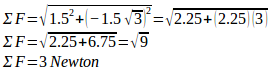
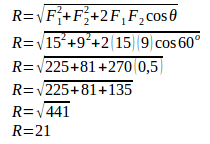
5. Żewġ forzi, F1 = 15 N u F2 = 9 N. L-angolu bejn iż-żewġ vetturi huwa ta ' 60°. X'inhu r-riżultanti tal-vetturi?
Meħtieġ:
Forza 1 (F1 ) = 15 Newton
Forza 2 (F2 ) = 9 Newton
Angolu ( θ) = 60 °
Meħtieġ: Il-vettur riżultanti
Soluzzjoni:
6. X'inhu r-riżultanti ta' tliet vetturi kif muri fil-figura t'hawn taħt?
Magħruf:
F1 = 20 Newton, angolu bejn F1 u l-assi x = 0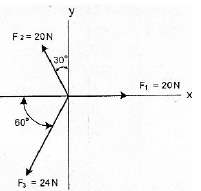
F2 = 20 Newton, angolu bejn F2 u l -assi x = 60
F3 = 24 Newton, angolu bejn F3 u l -assi x = 60
Meħtieġ: Il-vettur riżultanti
Soluzzjoni:
Il-komponenti tal-vetturi:
F 1x = (F 1 )(cos 0) = (20)(1) = 20. Pożittiv għaliex dan il-komponent vettorjali jipponta tul l-assi pożittiv x (lejn il-lemin )
F 1y = (F 1 )(sin 0) = (20)(0) = 0
F 2x = (F 2 )(cos 60) = (20)(0.5) = -10. Negattiv għax dan il-komponent vettorjali jipponta tul l-assi x negattiv (lejn ix-xellug)
F 2y = (F 2 )(sin 60) = (20)(0.5√3) = 10√3. Pożittiv għaliex dan il-komponent vettorjali jipponta tul l-assi y pożittiva ('il fuq)
F 3x = (F 3 )(cos 60) = (24)(0.5) = -12. Negattiv għax dan il-komponent vettorjali jipponta tul l-assi x negattiv (lejn ix-xellug)
F 3y = (F 3 )(sin 60) = (24)(0.5√3) = -12√3. N negattiv għaliex dan il-komponent vettorjali jipponta tul l- assi y negattiv ( 'l isfel)
Il-komponenti tal-vetturi riżultanti:
Fx = F1x – F2x – F3x = 20 – 10 – 12 = -2
F y = F 1y + F 2y – F 3y = 0 + 10√3 – 12√3 = -2√3
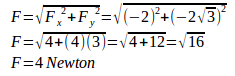
Il-vettur riżultanti: