Durch Riemen verbundene Räder – Probleme und Lösungen
1. Drei Räder sind wie in der folgenden Abbildung gezeigt miteinander verbunden.
Wenn R<sub> A</sub> = 10 cm, R<sub> B</sub> = 4 cm und R<sub> C </sub> = 40 cm, dann ist das Verhältnis der Winkelgeschwindigkeiten von Rad A und Rad C …
Bekannt: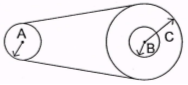
Radius des Rades A (r A ) = 10 cm
Radius des Rades B (r B ) = 4 cm
Radius des Rades C (r C ) = 40 cm
Gesucht: das Verhältnis der Winkelgeschwindigkeiten von Rad A und Rad C
Lösung:
Die Winkelgeschwindigkeit der Räder A und C
Der Umfang von Rad A ist wesentlich größer als der Umfang von Rad C. Während Rad C sich im gleichen Zeitraum einmal (360 ° ) gedreht hat, hat sich Rad A noch nicht einmal (360 ° ) gedreht. Daher ist die Winkelgeschwindigkeit von Rad A nicht gleich der Winkelgeschwindigkeit von Rad C.
Da Rad A und Rad C jedoch durch Seile miteinander verbunden sind, ist die im gleichen Zeitintervall von der Kante des Rades A zurückgelegte Strecke gleich der von der Kante des Rades C zurückgelegten Strecke. Daher ist die Bahngeschwindigkeit der Kante des Rades C (v<sub> C</sub> ) gleich der Bahngeschwindigkeit der Kante des Rades A (v<sub> A</sub> ).
v A = v C
r A ω A = r C ω C
10 ω A = 40 ω C
ω A / ω C = 40 / 10
ω A / ω C = 4 / 1
[irp]
2. Die Räder B und C haben dieselbe Drehachse, und Rad A berührt Rad B. Wenn der Radius von Rad A gleich dem Radius von Rad C ist (30 cm) und der Radius von Rad B 60 cm beträgt, bestimmen Sie das Verhältnis der Bahngeschwindigkeiten der Räder A, B und C.
Bekannt:
Radius des Rades A (rA) = 30 cm = 0.3 Meter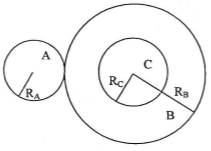
Radius des Rades B (r B ) = 60 cm = 0.6 Meter s
Radius des Rades C (r C ) = 30 cm = 0.3 Meter s
Gesucht: Verhältnis der linearen Geschwindigkeit zwischen den Rädern A, B und C.
Lösung:
Die lineare Geschwindigkeit der Kante A des Rades :
Rad A und Rad B sind, wie in der Abbildung unten dargestellt, miteinander verbunden. Daher ist die Winkelgeschwindigkeit von Rad A nicht gleich der Winkelgeschwindigkeit von Rad B. Dies liegt daran, dass der Umfang von Rad B größer ist als der von Rad A. Während Rad A im gleichen Zeitintervall eine Umdrehung (360 ° ) vollführt , hat Rad B noch keine Umdrehung (360 ° ) abgeschlossen. Die von den Rändern von Rad A zurückgelegte Strecke ist jedoch im gleichen Zeitintervall gleich der von den Rändern von Rad B zurückgelegten Strecke. Somit ist die Bahngeschwindigkeit des Randes von Rad A (v<sub> A</sub> ) gleich der Bahngeschwindigkeit des Randes von Rad B (v<sub> B</sub> ).
Die lineare Geschwindigkeit der Kante von Rad A:
v A = r A ω A = 0.3 ω A
Die lineare Geschwindigkeit der Kante B des Rades :
Rad B und Rad C sind miteinander verbunden, daher drehen sich Rad B und Rad C gemeinsam. Wenn Rad B eine Umdrehung (360 ° ) durchläuft, durchläuft Rad C im gleichen Zeitintervall ebenfalls eine Umdrehung (360 ° ). Da sie sich gemeinsam drehen, ist die Winkelgeschwindigkeit von Rad B (ω<sub> B</sub> ) gleich der Winkelgeschwindigkeit von Rad C (ω<sub> C </sub> ) = ω. Die Bahngeschwindigkeit von Rad B (v<sub>B</sub>) ist jedoch nicht gleich der Bahngeschwindigkeit von Rad C (v<sub> C</sub> ).
Die lineare Geschwindigkeit der Kante von Rad B:
v B = r B ω B = 0.6 ω B = 0.6 ω
Die lineare Geschwindigkeit der Kante des Rades C:
v C = r C ω C = 0.3 ω C = 0.3 ω
Die lineare Geschwindigkeit der Kante von Rad A (v A ) ist gleich der linearen Geschwindigkeit der Kante von Rad B ( v B ).
v A = v B
0.3 ω A = 0.6 ω
ω A = 0.6 ω / 0.3
ω A = 2 ω
Die lineare Geschwindigkeit der Kante von Rad A (v A ) :
v A = 0.3 ω A = 0.3 ( 2 ω) = 0.6 ω
Das Verhältnis der linearen Geschwindigkeit zwischen den Rädern A, B und C.
vA: vB: v C
0.6 ω : 0.6 ω : 0.3 ω
0.6: 0.6: 0.3
6: 6 : 3
2: 2: 1
[irp]
