單位向量-問題與解答

單位向量-問題與解答

1. An object moves at a 速度 of v = (2i − 1.5j) m/s. What is the 移位 of the object after 4 seconds?

已知:

The horizontal component of the velocity (vx) = 2 公尺/秒

The vertical component of the velocity (vy) = 1.5 公尺/秒

時間間隔 (t) = 4 秒

招募: 移位

解決方案:

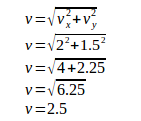
The resultant of the velocity (v) :

Unit vector – problems and solutions 1

位移:

s = v t = (2.5 m/s)(4 s)

s = 10 米

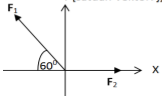
2. 向量 F1 = 14 N 和 F2 = 10 N. Determine the resultant vector if stated in R = i + j.

Unit vector – problems and solutions 2

解決方案:

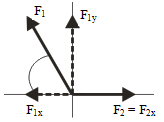
Unit vector – problems and solutions 3The components of vectors :

F1x = (F1)(cos 60o) = (14)(0.5) = -7 N (Negative because this vector component points along the negative x axis (leftward))

F1y = (F1)(sin 60o) = (14)(0.5√3) = 7√3 N (Positive because this vector component points along the positive y axis (rightward))

F2x = 10牛

F2y = 0

The components of the resultant vectors :

Fx =F1x + F2x + F3x = -7 + 10 = 3 N

Fy =F1y + F2y + F3y = 7√3 + 0 = 7√3 N

The resultant vector in unit vector :

也可以看看  電場方程

R = 3i + 7√3j

  1. What is a unit vector? 回答: A unit vector is a vector that has a magnitude of 1. It typically represents direction without conveying any information about magnitude.
  2. Why are unit vectors important in vector mathematics and physics? 回答: Unit vectors are essential because they provide a standardized way to describe directions. They can be scaled by a magnitude to produce a vector with a desired length in a specific direction.
  3. How do you obtain a unit vector from a given vector? 回答: A unit vector in the direction of a given vector can be obtained by dividing the vector by its magnitude.
  4. What are the standard unit vectors in Cartesian coordinates, and what are their directions? 回答: The standard unit vectors in Cartesian coordinates are i, j以及 k. i points in the direction of the x-axis, j points in the direction of the y-axis, and k points in the direction of the z-axis.
  5. Can a unit vector have components other than 1 or -1? 回答: Yes. The components of a unit vector depend on its direction. Only the unit vectors aligned with the coordinate axes (like i, j, k in Cartesian coordinates) will have components of 1, -1, or 0.
  6. Is the sum of two unit vectors necessarily a unit vector? 回答: No. The sum of two unit vectors is not generally a unit vector unless the two vectors are collinear and oppositely directed.
  7. Can a unit vector be scaled to represent a vector with a different magnitude but the same direction? 回答: Yes. Multiplying a unit vector by a scalar will change its magnitude while keeping its direction the same.
  8. What is the magnitude of the cross product of two unit vectors? 回答: The magnitude of the cross product of two unit vectors is equal to the sine of the angle between them. The maximum value is 1 when the vectors are perpendicular, and the minimum is 0 when the vectors are parallel.
  9. Why is it that the dot product of two unit vectors gives the cosine of the angle between them? 回答: The dot product formula for two vectors is given by the product of their magnitudes and the cosine of the angle between them. When both vectors are unit vectors, their magnitudes are 1, so the dot product simplifies to just the cosine of the angle.
  10. How is the concept of a unit vector extended into non-Cartesian coordinate systems? 回答: In non-Cartesian coordinate systems, like spherical or cylindrical coordinates, there are different unit vectors corresponding to each coordinate direction. For example, in spherical coordinates, the unit vectors are r (radial direction), θ (polar angle direction), and φ (azimuthal direction).