Work-energy principle Nonconservative force Motion on inclined plane with friction – Problems and Solutions

2 Work-energy principle Nonconservative force Motion on inclined plane with friction – Problems and Solutions

1. A block slides down an inclined plane with friction. What is the block’s velocity when the block hits the ground? The coefficient of kinetic friction is 0.4. Acceleration due to gravity is 10 m/s2.

Known :

Initial height (ho) = 6 mWork-energy principle, nonconservative force, motion on inclined plane with friction - problems and solutions 1
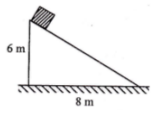
Final height (ht) = 0 m

Initial speed (vo) = 0 (block initially at rest)

Coefficient of kinetic friction (μk) = 0.4
Read more

Collision and conservation of mechanical energy – probems and solutions

Collision and conservation of mechanical energy – probems and solutions

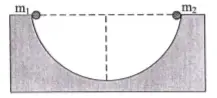
1. Two objects have the same mass, m1 = m2 = 0.5 kg dropped from the same height as shown in the figure below. The radius of the circle is 1/5 m. The collision between both objects is perfectly elastic. Determine the velocity of each object after the collision. Acceleration due to gravity is 10 m/s2.

Known :

Mass of object (m) = m1 = m2 = 0.5 kgCollision and conservation of mechanical energy – probems and solutions 1

Initial height (h1) = 1/5 m

Final height (h2) = 0 (base of path)

Read more

Momentum Impulse and Projectile motion – Problems and Solutions

Momentum Impulse and Projectile motion – Problems and Solutions

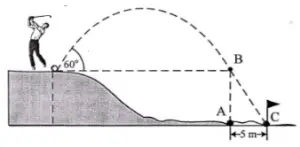
1. A 0.2-kg ball will be inserted into hole C, as shown in the figure below. Hitter strikes the ball in 0.01 second and the path of B-C traveled in 1 second. Determine the magnitude of the force so the ball can be inserted into hole C. Acceleration due to gravity is 10 m/s2.

Known :Momentum, impulse and projectile motion - problems and solutions 1

Angle (θ) = 60o

Mass of ball (m) = 0.2 kg

Acceleration due to gravity (g) = 10 m/s2

Time interval (Δt) = 0.01 second

Read more

Kinetic theory of gas and first law of thermodynamics – problems and solutions

Kinetic theory of gas and first law of thermodynamics – problems and solutions

1. Ideal gases are in a container with a volume of 4 liters and its pressure is 3 atm (1 atm = 105 N.m-2). The ideal gases heated at a constant pressure from 27oC to 87oC. The heat capacity of the gas is 9 J.K-1. What is the final volume of gases and the change of internal energy of gases?

Solution

Isobaric process (constant pressure)

Known :

The initial volume of gas (V1) = 4 liters

Read more

Springs in series and parallel – problems and solutions

Springs in series and parallel – problems and solutions

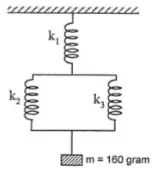
1. A 160-gram object attaches at one end of a spring and the change in length of the spring is 4 cm. What is the change in length of three springs connected in series and parallel, as shown in the figure below?

Known :

The change in length of a spring (Δx) = 4 cm = 0.04 mSprings in series and parallel – problems and solutions 1

Mass (m) = 160 gram = 0.16 kg

Acceleration due to gravity (g) = 10 m/s2

Read more

Dynamics of particles – problems and solutions

Dynamics of particles – problems and solutions

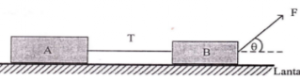
1. Object A with a mass of 6-kg and object B with a mass of 4-kg connected by a cord and pulled by a force of F = 60 N, as shown in the figure below. The coefficient of kinetic friction between the floor and both objects is 0.5 (tan θ = ¾). Acceleration due to gravity is 10 m/s2. What is the magnitude of the tension force?

Known :

Mass of object A (mA) = 6 kgDynamics of particles – problems and solutions 1

Mass of object B (mB) = 4 kg

Force (F) = 60 Newton

Read more