To find out how to increase the efficiency of the heat engine, a French scientist named Sadi Carnot (1796-1832) examined an ideal theoretical caloric machine in 1824. At that time, the first law of thermodynamics had not been formulated, nor the second law of thermodynamics. The first law has not been formulated because scientists do not yet know that heat is energy. After Joule and his colleagues experimented in the 1830s, scientists discovered heat is energy that moves due to temperature differences. So, the first law of thermodynamics was formulated after 1830. Sadi Carnot had been researching the theoretical ideal caloric engine in 1824. His research was actually to increase the efficiency of the steam engine. Most steam engines of that time were less efficient.
Second law of thermodynamics
To explain the irreversible thermodynamic processes, the scientists formulated the second law of thermodynamics. The second law of thermodynamics explains what processes can occur in the universe and what processes cannot happen. One scientist named R. J. E. Clausius (1822-1888) made the following statement:
Naturally, heat moves from high-temperature objects to low-temperature objects; naturally, heat does not proceed from low-temperature object to high-temperature object (Second law of thermodynamics—Clausius’s statement).
Clausius’s statement is one of the special statements of the second law of thermodynamics. It is called special statement because it only applies to one process just, related to heat transfer. Since this statement is not related to other processes, we need a more general statement. The development of a general statement of the second law of thermodynamics is based on the study about heat engine. Therefore, we discuss heat engine first.
Thermodynamic processes : Isothermal Adiabatic Isochoric Isobaric
Article Thermodynamic processes : Isothermal Adiabatic Isochoric Isobaric
There are four thermodynamic processes, namely Isothermal, isochoric, isobaric and adiabatic processes.
Isothermal Process (constant temperature)
In an isothermal process, system temperature is kept constant. Theoretically, the analyzed system is an ideal gas. Ideal gas temperature is directly proportional to ideal internal gas energy (U = 3/2 n R T). T does not change, so U also does not change. Thus, if applied to the isothermal process, the first law of the thermodynamic equation becomes:
First law of thermodynamics
Thermodynamic process
Heat (Q) is the energy that moves from one object to another because of the temperature difference. About systems and environments, heat is energy moving from system to environment or energy moving from environment to system, due to the temperature difference. If the system temperature is higher than the ambient temperature, heat will flow from the system to the environment. If the ambient temperature is higher than the system temperature, then heat flows from the environment to the system.
Heat (Q) is energy that moves due to the temperature difference, whereas work (W) is related to energy transfer through work. For example, if the system does work on the environment, then energy moves from system to environment. Conversely, if the environment does work on the system, then energy moves from environment to system.
Speed of the mechanical waves – problems and solutions
1. The speed of the transverse wave on a 25 meters rope is 50 m/s. The tension force of the rope is 200 N. Determine the mass of rope.
A. 0.08 kg
B. 0.5 kg
C. 0.8 kg
D. 2.0 kg
Known :
Simple harmonic motion – problems and solutions
1. An object vibrates with a frequency of 5 Hz to rightward and leftward. The object moves from equilibrium point to the maximum displacement at rightward. Determine the time interval required to reach the maximum displacement at rightward eleven times.
A. 2.05
B. 2.20
C. 2.25
D. 2.50
Known :
Simple pendulum – problems and solutions
1. Two simple pendulums are in two different places. The length of the second pendulum is 0.4 times the length of the first pendulum, and the acceleration of gravity experienced by the second pendulum is 0.9 times the acceleration of gravity experienced by the first pendulum. Determine the comparison of the frequency of the first pendulum to the second pendulum.
A. 2/3
B. 3/2
C. 4/9
D. 9/4
Resonance of sound wave – problems and solutions
1. After the tuning fork A is vibrated, the tuning fork B is vibrated. The tuning fork B is vibrated because…..
A. The tuning fork A has the same amplitude as the tuning fork B
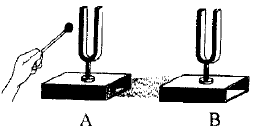
B. Both tuning forks use the same resonance box
C. The tuning fork B has the same frequency as the tuning fork A
D. The timbre of the sounds caused by both tuning forks are the same
Solution
Pressure of fluids – problems and solutions
1.
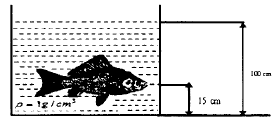
Acceleration due to gravity is 10 N/kg. The surface area of fish pressed by the water above it is 6 cm2. Determine the force of water above fish that acts on fish.
Known :