Artikel over de vergelijking van de bolle spiegel
Begrijp allereerst de tekenregels van de bolle spiegel.
De tekenregels voor de bolle spiegel
– Afstand tot het object (do)
Als een object zich voor een spiegeloppervlak bevindt dat licht reflecteert, waarbij het licht door het object heen gaat, dan is de objectafstand (do) positief.
– Beeldafstand (di)
Als het beeld zich vóór een spiegeloppervlak bevindt dat licht reflecteert, en het licht dus door het beeld heen gaat, dan is de beeldafstand (di) positief (reëel beeld). Als het beeld zich achter het spiegeloppervlak bevindt dat licht reflecteert, en het licht dus niet door het beeld heen gaat, dan is de beeldafstand negatief (virtueel beeld).
– De kromtestraal (R)
Het krommingsmiddelpunt van de bolle spiegel bevindt zich achter het spiegeloppervlak dat licht reflecteert, waar het licht er niet doorheen gaat, waardoor de kromtestraal van de bolle spiegel negatief is. Omdat de kromtestraal negatief is, is de brandpuntsafstand (f) ook negatief.
– Hoogte van het object (h)
Als het object zich boven de hoofdas van de bolle spiegel bevindt, is de objecthoogte (h) positief (het object staat rechtop). Omgekeerd, als het object zich onder de hoofdas van de bolle spiegel bevindt, is de objecthoogte negatief (het object staat ondersteboven).
– Afbeeldingshoogte (h')
Als het beeld zich boven de hoofdas van de bolle spiegel bevindt, is de beeldhoogte (h') positief (het beeld staat rechtop). Als het beeld zich onder de hoofdas van de bolle spiegel bevindt, is de beeldhoogte negatief (het beeld is omgekeerd).
– Vergroting van het beeld (m)
Als de vergroting van het beeld > 1 is, dan is de grootte van het beeld groter dan de grootte van het object. Als de vergroting van het beeld = 1 is, dan is de grootte van het beeld gelijk aan de grootte van het object. Als de vergroting van het beeld < 1 is, dan is de grootte van het beeld kleiner dan de grootte van het object.
De vergelijking van een bolle spiegel
Op basis van de onderstaande afbeelding zijn er twee lichtbundels die op een bolle spiegel vallen, en de bolle spiegel weerkaatst de lichtbundels.
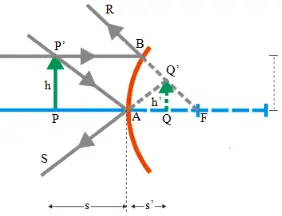
do = objectafstand, di = beeldafstand, h = P P' = objecthoogte, h' = Q Q' = beeldhoogte, F = het brandpunt van de bolle spiegel.
De driehoek P'AP is gelijkvormig aan de driehoek Q'AQ. Daarom:
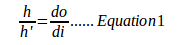
De BFA-driehoek is gelijkvormig aan de Q'FQ-driehoek, waarbij de afstand AB gelijk is aan de hoogte van het object (h) en de afstand FA gelijk is aan de brandpuntsafstand (f) van de bolle spiegel. Daarom:
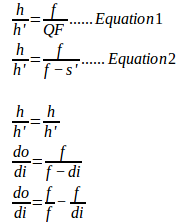
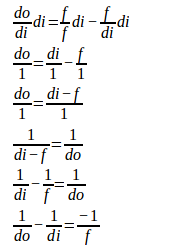
Op basis van de tekenregels voor een bolle spiegel kan deze vergelijking worden omgezet in de vergelijking voor een holle spiegel, als de beeldafstand (di) een negatief teken krijgt.
Omdat de lichtstraal het beeld niet passeert en de brandpuntsafstand (f) ook een negatief teken krijgt, omdat het brandpunt van de bolle spiegel niet door het licht wordt gepasseerd (zie de afbeelding van de beeldvorming hierboven). Volgens deze bewering verandert de vergelijking van de bolle spiegel in:
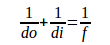
do = de objectafstand, di = de beeldafstand, f = de brandpuntsafstand
Houd altijd rekening met de tekenregels van de bolle spiegel wanneer je deze vergelijking gebruikt om problemen met de bolle spiegel op te lossen.
Vergroting van het beeld (m)
Bekijk de afbeelding van de beeldvorming hierboven. De driehoeken P'AP en Q'AQ zijn gelijkvormig, waardoor we de relatie tussen de objectafstand en de beeldafstand kunnen afleiden met behulp van de objecthoogte en de beeldhoogte:

Deze vergelijking wordt hieronder opnieuw geschreven door m toe te voegen:
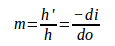
m = Vergroting van de afbeelding
h = de objecthoogte (positief als het object zich boven de hoofdas van de bolle spiegel bevindt of rechtop staat. Negatief als het object omgekeerd is)
h' = de beeldhoogte (positief als het beeld zich boven de hoofdas van de bolle spiegel bevindt of als het beeld rechtop staat. Negatief als het beeld omgekeerd is).
do = de objectafstand (positief als de lichtstraal door het object heen gaat)
di = de beeldafstand (positief als de lichtstraal door het beeld gaat en negatief als de lichtstraal niet door het beeld gaat)
