불균일 선형 운동 – 문제점 및 해결책
1.
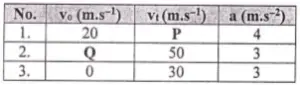
위 표는 일정한 가속도 로 동일한 거리를 이동하는 세 물체의 데이터를 보여줍니다.
물체 P의 최종 속도와 물체 Q의 초기 속도는 얼마입니까?
솔루션 :
먼저, 물체 3이 이동한 거리를 구하십시오.
물체 3이 이동한 거리 :
알려진 바에 따르면 :
초기 속도(vo ) = 0 m/s
최종 속도(v t ) = 30 m/s
가속도(a) = 3 m/ s²
원하는 것 : 거리
솔루션 :
v t 2 = v o 2 + 2 as
v t 2 – v o 2 = 2 as
30 2 – 0 2 = 2 (3) s
900 – 0 = 6초
900 = 6초
s = 900 / 6
s = 150미터
물체 1의 최종 속도 :
알려진 바에 따르면:
초기 속도(vo ) = 20 m/s
가속도(a) = 4 m/ s²
거리(초) = 150미터
구하는 값: 최종 속도 (v t )
솔루션 :
v t 2 = v o 2 + 2 as
v t 2 = 20 2 + 2 (4)(150)
v t 2 = 400 + 1200
v t 2 = 1600
v t = 40 m/s
물체 2의 초기 속도:
알려진 바에 따르면:
최종 속도(v t ) = 50 m/s
가속도(a) = 3 m/ s²
거리(초) = 150미터
구하는 값: 초기 속도 ( vo )
솔루션 :
v t 2 = v o 2 + 2 as
v t 2 – 2 as = v o 2
50 2 – 2(3)(150) = v o 2
2500 – 900 = v o 2
1600 = v o 2
v o = 40 m/s
2. 세 물체가 수평면 위에서 일정한 가속도로 움직이고 있습니다. 세 물체의 가속도는 모두 같습니다. 아래 그림은 10초 동안 움직이는 세 물체의 데이터를 보여줍니다.

P와 Q를 구하세요.
솔루션 :
먼저 물체 1의 가속도를 구하십시오.
물체 1의 가속도:
알려진 바에 따르면:
초기 속도(vo ) = 2 m/s
최종 속도(v t ) = 22 m/s
거리(초) = 120미터
원하는 것: 거리
솔루션 :
v t 2 = v o 2 + 2 as
v t 2 – v o 2 = 2 as
22 2 – 2 2 = 2 a (120)
484 – 4 = 240
480 = 240 a
a = 480/240
a = 2 m/ s²
물체 2의 초기 속도 :
알려진 바에 따르면:
가속도(a) = 2 m/ s²
최종 속도(v t ) = 24 m/s
거리(초) = 140미터
구하는 값: 초기 속도( vo )
솔루션 :
v t 2 = v o 2 + 2 as
24 2 = v o 2 + 2 (2)(140)
576 = v o 2 + 560
576 – 560 = v o 2
16 = v o 2
v o = 4 m/s
물체 3의 거리:
알려진 바에 따르면:
초기 속도(vo ) = 0 m/s
최종 속도(v t ) = 20 m/s
가속도(a) = 2 m/ s²
원하는 거리 ( 초)
솔루션 :
v t 2 = v o 2 + 2 as
20 2 = 0 2 + 2 (2) s
20 2 = 2 (2) s
400 = 4초
s = 400/4
s = 100미터 s
3. 물체가 40초 동안 이동한 거리를 구하세요.
솔루션 :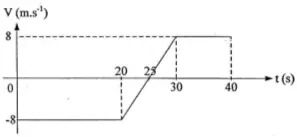
면적 1 = 직사각형의 면적 = (20-0)(8-0) = (20)(8) = 160미터
면적 2 = 삼각형의 면적 = ½(25-20)(8-0) = ½(5)(8) = (5)(4) = 20미터
면적 3 = 삼각형의 면적 = ½(30-25)(8-0) = ½(5)(8) = (5)(4) = 20미터
면적 4 = 직사각형의 면적 = (40-30)(8-0) = (10)(8) = 80미터
40초 동안 이동한 거리 = 160 + 20 + 20 + 80 = 280미터
4. 아래 그래프는 2초 동안 물체의 속도 변화를 나타냅니다. 물체가 이동한 거리를 구하세요.
솔루션 :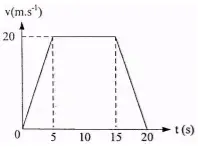
면적 1 = 삼각형의 면적 = ½(5-0)(20-0) = ½(5)(20) = (5)(10) = 50미터
면적 2 = 직사각형의 면적 = (15-5)(20-0) = (10)(20) = 200미터
면적 3 = 삼각형의 면적 = ½(20-15)(20-0) = ½(5)(20) = (5)(10) = 50미터
20초 동안 이동한 거리 = 50 + 200 + 50 = 300미터
- 불균일 직선 운동과 균일 직선 운동의 차이점은 무엇입니까?
- 답변 : 불균일 직선 운동은 시간에 따라 속도가 변하는 운동으로, 가속도가 작용하는 운동입니다. 반면, 등속 직선 운동은 물체가 일정한 속도로 움직이며 가속도가 없는 운동을 의미합니다.
- 불규칙 직선 운동을 하는 물체의 이동 거리는 속도-시간 그래프 아래 면적과 어떤 관계가 있을까요?
- 답변 : 불규칙적인 직선 운동을 하는 물체가 이동한 거리는 속도-시간 그래프 아래 면적과 같습니다.
- 물체의 가속도-시간 그래프가 시간축 위에 수평으로 곧게 뻗어 있다면, 이는 물체의 운동에 대해 무엇을 나타내는가?
- 답변 : 이는 물체가 일정한 양의 가속도를 받고 있음을 나타냅니다. 물체의 속도는 일정한 비율로 지속적으로 증가하고 있습니다.
- 불균일 운동에서 평균 속도를 초기 속도와 최종 속도의 평균으로 간단히 계산할 수 없는 이유는 무엇입니까?
- 답변 : 불균일 운동의 경우 속도가 일정하지 않으므로 실제 변위는 초기 속도와 최종 속도를 단순히 평균하여 예측한 값보다 크거나 작을 수 있습니다. 불균일 운동을 정확하게 계산하는 방법은 주어진 시간 간격 동안 속도를 적분하거나 가속도를 고려한 운동학 방정식을 사용하는 것입니다.
- 속도-시간 그래프가 아래쪽으로 기울어진 직선인 물체의 운동을 어떻게 설명하시겠습니까?
- 답변 : 속도-시간 그래프에서 아래쪽으로 기울어진 직선은 물체가 일정한 음의 가속도로 움직이고 있음을 나타냅니다. 즉, 초기 속도가 양수였다면 감속하고 있거나 속도가 줄어들고 있다는 뜻입니다.
- 불규칙 운동에서 특정 순간의 순간 속도는 그 순간의 변위-시간 그래프의 기울기와 어떤 관계가 있습니까?
- 답변 : 불규칙 운동에서 특정 순간의 순간 속도는 해당 지점에서의 변위-시간 그래프의 기울기로 나타낼 수 있습니다.
- 변위-시간 그래프의 곡선은 물체의 운동 특성에 대해 무엇을 시사하는가?
- 답변 : 변위-시간 그래프에서 곡선은 불균일한 운동을 나타내며, 이는 물체의 속도가 시간에 따라 변하고 있음을 의미합니다(증가하거나 감소함).
- 물체의 변위-시간 그래프가 포물선 모양이고 위쪽으로 열려 있다면, 그 물체의 가속도에 대해 무엇을 추론할 수 있을까요?
- 답변 : 변위-시간 그래프가 위쪽으로 열린 포물선이면, 물체가 일정한 양의 가속도를 받고 있음을 나타냅니다.
- 불규칙 운동을 하는 물체의 가속도는 속도-시간 그래프 아래 면적과 어떤 관계가 있을까요?
- 답변 : 불규칙 운동을 하는 물체의 속도 변화량(질량을 곱하면 운동량 변화량이 됨)은 가속도-시간 그래프 아래 면적과 같습니다. 여기서 중요한 것은 속도-시간 그래프가 가속도가 아닌 속도 변화량을 직접적으로 나타낸다는 점입니다.
- 불규칙 운동을 하는 물체의 속도에 음의 가속도(감속)는 어떤 영향을 미칠까요?
- 답변 : 음의 가속도, 즉 감속은 물체의 속도를 감소시키는 결과를 초래합니다. 물체가 처음에는 양의 속도를 가지고 있다가 음의 가속도를 받으면 속도가 감소하고, 감속이 계속되면 물체는 운동 방향을 바꿀 수 있습니다.
