운동량, 충격량 및 포물체 운동 – 문제 및 해법
1. 아래 그림과 같이 0.2kg의 공을 구멍 C에 넣으려고 합니다. 타자가 공을 치는 데 0.01초가 걸렸고, 공이 굴절된 선 BC가 이동하는 데 1초가 걸렸습니다. 공을 구멍 C에 넣기 위해 필요한 힘의 크기를 구하세요. 중력 가속도는 10m/s² 입니다.
알려진 바에 따르면: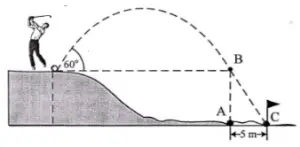
각도(θ) = 60 °
공의 질량 (m) = 0.2 kg
중력 가속도(g) = 10 m/ s²
시간 간격(Δt) = 0.01초
경로 BC를 이동하는 데 걸리는 시간 간격(t) = 1초
구함 : 힘 (F)
솔루션 :
충격량 방정식 : I = F Δt
운동량 변화 방정식 : Δp = m (v t – v o ).
I = Δp
F Δt = m (v t – v o )
F = m (v t – v o ) / Δt
알려진 바에 따르면:
Δt = 0.01초
m = 0.2kg
v t = 충격량-운동량 방정식에서 최종 속도 = 포물체 운동에서 공의 초기 속도 ( vo )
v₀ 는 충격량-운동량 방정식에서 초기 속도를 나타내며, 초기 속도는 0 m/s입니다 (공이 처음에는 정지해 있음).
F = m (v t – v o ) / Δt
F = 0.2 (v t – 0) / 0.01
F = 0.2 v t / 0,01
계속 ...
포물체 운동에서 공의 초기 속도 (vo ) 를 구하십시오.
공이 B 지점에 도달할 때까지 타격이 계속되므로 이는 포물체 운동 의 1단계에 해당합니다.
공이 B 지점에서 C 지점으로 이동합니다. 이는 포물선 운동의 2단계입니다.
포물선 운동의 2부:
포물체 운동은 운동의 수평 성분과 수직 성분을 각각 분석함으로써 이해할 수 있습니다. x축 방향으로는 일정한 속도로, y축 방향으로는 일정한 중력 가속도로 운동합니다.
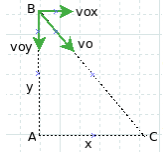 알려진 바에 따르면:
수평 거리(x) = 5미터
공중 체류 시간(t) = 1초
x와 t가 알려져 있으므로 등속 직선 운동 방정식을 사용하여 v ox를 계산할 수 있습니다 . v ox 는 공의 초기 속도의 수평 성분입니다.
v ox = x / t = 5미터 / 1초 = 5m/s.
포물선 운동의 1부:
수평 방향 속도 성분 v ox는 항상 동일하므로 포물체 운동 1부의 v ox는 포물체 운동 2부의 v ox 와 같으며, 따라서 5m/s입니다.
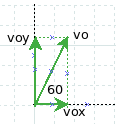 알려진
알려진
v ox = 5 m/s
θ = 60 °
v ox 와 θ가 알려져 있으므로 초기 속도(vo ) 를 계산할 수 있습니다.
cos θ = adj / hyp
cos θ = v ox / v o
v o = v ox / cos θ = 5 / cos 60 o = 5 / 0.5 = 10m/s
초기 속도(vo ) 는 10m/s입니다.
포물체 운동에서 공의 초기 속도 (vo ) 는 충격량-운동량 방정식에서 공의 최종 속도 (vt ) 와 같습니다 .
힘 (F) 의 크기를 구하십시오 .
F = 0.2 v t / 0.01
F = 0.2 (10) / 0.01
F = 2 / 0.01
F = 200 뉴턴
- 충격량과 운동량 변화량 사이의 관계는 무엇인가요?
- 답변 : 충격량은 힘과 힘이 작용하는 시간의 곱이며, 물체의 운동량 변화량과 같습니다. 수학적으로는, 어디로 운동량의 변화입니다.
- 자동차의 크럼플 존처럼 충격 지속 시간이 증가하면 충돌 시 발생하는 충격력에 어떤 영향을 미칠까요?
- 답변 : 충돌 시간을 늘리면 충돌 시 발생하는 평균 충격력이 감소합니다. 이는 주어진 충돌에서 충격량(운동량의 변화)은 일정하지만, 시간이 증가함에 따라 충격력이 더 긴 시간 동안 분산되어 평균 충격력이 감소하기 때문입니다.
- 중력의 영향만 받는 운동 상태에서 발사체에 대해 일정하게 유지되는 것은 무엇일까요?
- 답변 : 중력만 작용할 때 발사체의 수평 속도는 일정하게 유지됩니다. 하지만 수직 속도는 중력 가속도 때문에 변화합니다.
- 중력의 영향을 받는 발사체의 궤적이 포물선인 이유는 무엇일까요?
- 답변 : 수평 속도는 일정하게 유지되는 반면, 중력 가속도에 의해 수직 속도가 지속적으로 변화하기 때문에 궤적이 포물선 형태를 띠며, 이로 인해 수평 변위와 수직 변위 사이에 이차 함수 관계가 발생합니다.
- 외부 힘이 작용하지 않는 고립계의 운동량은 어떻게 될까요?
- 답변 : 고립된 시스템에 외부 힘이 작용하지 않으면 시스템의 전체 운동량은 보존됩니다. 이를 운동량 보존 법칙이라고 합니다.
- 야구 방망이로 공을 쳐서 홈런을 칠 때와 가볍게 쳤을 때, 공에 가해지는 충격량은 어떻게 다를까요?
- 답변 : 야구공이 홈런을 칠 때 가해지는 충격량은 가볍게 쳤을 때보다 훨씬 큰데, 이는 홈런 상황에서 공의 운동량 변화(정지 상태에서 배트에서 날아가는 순간까지)가 훨씬 크기 때문입니다.
- 지면에서 비스듬한 각도로 발사된 물체가 다시 지면으로 떨어질 때, 발사 속도와 착지 속도는 어떻게 비교될까요?
- 답변 : 공기 저항이 없다고 가정하면, 발사체의 착지 속도는 발사 속도와 같습니다. 이는 에너지 보존 법칙 때문입니다.
- 공기 저항이 없다고 가정할 때, 발사 각도와 발사 거리는 어떤 관계가 있을까요?
- 답변 : 주어진 초기 속도에서 발사체의 최대 사거리는 45도의 발사 각도에서 달성됩니다. 45도보다 작거나 큰 각도로 발사하면 사거리가 짧아집니다.
- 손으로 달걀을 살짝 잡아채는 것처럼 물체에 힘이 작용하는 시간을 늘리면 물체가 깨지거나 손상될 가능성이 줄어드는 이유는 무엇일까요?
- 답변 : 힘이 작용하는 시간을 늘리면 충격량(운동량의 변화)이 더 긴 시간 동안 분산되어 물체가 받는 평균 힘이 줄어듭니다. 손을 살짝 움직여 달걀을 잡으면 잡는 힘이 분산되어 달걀이 깨질 가능성이 줄어듭니다.
