Nambahake vektor nggunakake komponen - masalah lan solusi
1. Three vectors as shown in the figure below.
V1 = 30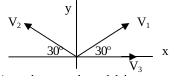
V2 = 30
V3 = 40
What is the resultant vektor.
Dikenal:
V1 = 30, angle between V1 lan sumbu x = 30o
V2 = 30, angle between V2 lan sumbu x = 30o
V3 = 40, angle between V3 lan sumbu x = 0o
Dikarepake: The resultant vectors
Solusi:
V1x = (V1)(cos 30o) = (30)(0.5√3) = 15√3. Positive because this vector component points along the positive x axis (rightward).
V1y = (V1)(dosa 30o) = (30)(0.5) = 15. Positive because this vector component points along the positive y axis (upward).
V2x = (V2)(cos 30o) = (30)(0.5√3) = -15√3. Negative because this vector component points along the negative x axis (leftward).
V2y = (V2)(dosa 30o) = (30)(0.5) = 15. Positive because this vector component points along the positive y axis (upward).
V3x = (V3)(cos 0o) = (40)(1) = 40. Positive because this vector component points along the positive x axis (rightward).
V3y = (V3)(dosa 0o) = (40)(0) = 0
The components of the resultant vectors :
Vx =V1x - V2x +V3x = 15√3 – 15√3 + 40 = 40
Vy =V1y +V2y +V3y 15 + 15 = 30
2. Two forces perpendicular each other, F1 = 12 N lan F2 = 5 N. What is the resultant of both forces.
Dikenal:
Pasukan 1 (F1) = 12 Newton
Pasukan 2 (F2) = 5 Newton
Dikarepake: The resultant vectors (ΣF)
Solusi:
ΣF2 = F12 +F22 = 122 + 52 144 + 25 = 169
ΣF = √169 = 13 Newton
3. Three vectors,
V1 = 30
V2 = 30
V3 = 40
Determine the resultant vectors.
Dikenal:
v1 = 30, makes 30o about the negative x axis
v2 = 30, makes 30o about the positive x axis
v3 = 40, makes 0o about the positive x axis
Dikarepake: The resultant vectors
Solusi:
The components of vectors :
v1x = v1 kosok 30o = (30)(0.5√3) = -15√3 (Negative because this vector component points along the negative x axis (leftward))
v1y = v1 dosa 30o = (30)(0.5) = 15 (Positive because this vector component points along the positive y axis (upward))
v2x = v2 kosok 30o = (30)(0.5√3) = 15√3 (Positive because this vector component points along the positive x axis (rightward))
v2y = v2 dosa 30o = (30)(0.5) = 15 (Positive because this vector component points along the positive y axis (upward).)
v3x = v3 kosok 0o = (40)(1) = 40 (Positive because this vector component points along the positive x axis (rightward).)
v3y = v3 dosa 0o = (40)(0) = 0
The components of the resultant vectors :
vx = – v1x +v2x +v3x = -15√3 + 15√3 + 40 = 40
vy = v1y +v2y +v3y 15 + 15 = 30
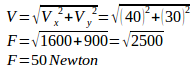
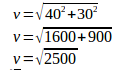
Vektor sing diasilake:
4. What is the resultant of three vectors as shown in figure below :
Dikenal:
F1 = 3 Newton, makes 60o about the positive x axis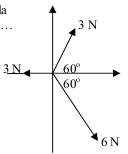
F2 = 3 Newton, makes 0o about the negative x axis
F3 = 6 Newton, makes 60o about the negative y axis
Dikarepake: The resultant vector
Solusi:
The components of vectors :
F1x = F1 kosok 60o = (3)(0.5) = 1.5 N (Positive because this vector component points along the positive x axis (rightward))
F1y = F1 dosa 60o = (3)(0.5√3) = 1.5√3 N (Positive because this vector component points along the positive y axis (upward))
F2x = F2 kosok 0o = (3)(1) = -3 N (Negative because this vector component points along the negative x axis (leftward))
F2y = F2 dosa 0o = (3)(0) = 0
F3x = F3 kosok 60o = (6)(0.5) = 3 N (Positive because this vector component points along the positive x axis (rightward))
F3y = F3 dosa 60o = (6)(0.5√3) = -3√3 N (Negative because this vector component points along the negative y axis (mudhunward))
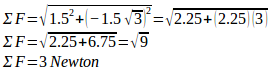
The components of the resultant vectors :
ΣFx = F1x - F2x +F3x = 1.5 N – 3 N + 3 N = 1.5 N
ΣFy = F1y +F2y - F3y = 1.5√3 N + 0 N – 3√3 N = -1.5√3 N
Vektor sing diasilake:
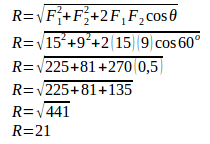
5. Two forces, F1 = 15 N lan F2 = 9 N. The angle between both vectors is 60°. What is the resultant of vectors.
Dikarepake:
Angkatan 1 (F1) = 15 Newton
Pasukan 2 (F2) = 9 Newton
Angle (θ) = 60o
Dikarepake: The resultant vector
Solusi:
6. What is the resultant of three vectors as shown in the figure below?
Dikenal:
F1 = 20 Newton, angle between F1 lan sumbu x = 0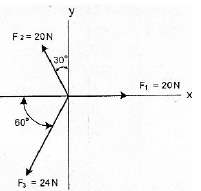
F2 = 20 Newton, angle between F2 lan sumbu x = 60
F3 = 24 Newton, angle between F3 lan sumbu x = 60
Dikarepake: The resultant vector
Solusi:
The components of vectors :
F1x = (F1)(cos 0) = (20)(1) = 20. Positive because this vector component points along the positive x axis (rightward)
F1y = (F1)(sin 0) = (20)(0) = 0
F2x = (F2)(cos 60) = (20)(0.5) = -10. Negative because this vector component points along the negative x axis (leftward)
F2y = (F2)(sin 60) = (20)(0.5√3) = 10√3. Positive because this vector component points along the positive y axis (upward)
F3x = (F3)(cos 60) = (24)(0.5) = -12. Negative because this vector component points along the negative x axis (leftward)
F3y = (F3)(sin 60) = (24)(0.5√3) = -12√3. Negative because this vector component points along the negative y axis (mudhunward)
The components of the resultant vectors :
Fx = F1x - F2x - F3x = 20 – 10 – 12 = -2
Fy = F1y +F2y - F3y = 0 + 10√3 – 12√3 = -2√3
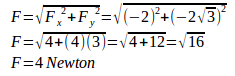
Vektor sing diasilake: