Campos eléctricos: problemas y soluciones.
1. El punto A se encuentra en el centro entre dos cargas. Ambas cargas tienen la misma magnitud pero signo opuesto y están separadas por una distancia a. La magnitud del campo eléctrico en el punto A es de 36 N/C. Si el punto A se acerca 1/2a a una de las cargas , ¿cuál es la magnitud del campo eléctrico en el punto A?
Conocido :
Carga 1 (q 1 ) = +Q
Carga 2 (q 2 ) = -Q
La distancia entre la carga 1 y el punto A (r 1A ) = ½ a
La distancia entre la carga 2 y el punto A (r 2A ) = ½ a
La magnitud del campo eléctrico en el punto A (E A ) = 36 NC -1
Se busca: La magnitud del campo eléctrico
solución:
Paso 1.
El campo eléctrico es producido por una carga +Q en el punto A :
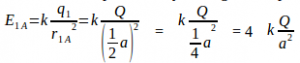
La carga de prueba es positiva y la carga 1 es positiva, de modo que la dirección del campo eléctrico apunta hacia la carga 2.
La carga eléctrica producida por una carga -Q en el punto A :
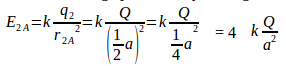
La carga de prueba es positiva y la carga 2 es negativa, de modo que la dirección del campo eléctrico apunta hacia la carga 2.
La resultante del campo eléctrico en el punto A:
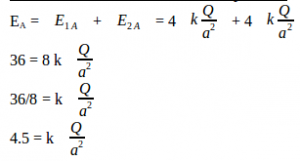
Paso 2:
Si el punto A se mueve cerca de la carga 1, entonces:
La distancia entre la carga 1 y el punto A (r 1A ) = ¼ a
La distancia entre la carga 2 y el punto A (r 2A ) = ¾ a
El campo eléctrico producido por la carga +Q en el punto A :

La carga de prueba es positiva y la carga 1 es positiva, de modo que la dirección del campo eléctrico apunta hacia la carga 2.
El campo eléctrico producido por la carga -Q en el punto A :
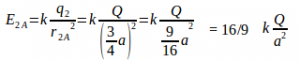
La carga de prueba es positiva y la carga 2 es negativa, de modo que la dirección del campo eléctrico apunta hacia la carga 2.
La resultante del campo eléctrico en el punto A:

2. Dos cargas q A = 1 μC y q B = 4 μC están separadas por una distancia de 4 cm (k = 9 x 10 9 N m 2 C −2 ). ¿Cuál es la magnitud del campo eléctrico en el punto medio entre q A y q B?
Conocido :
Carga A (q A ) = 1 μC = 1 x 10 −6 C
Carga B (q B ) = 4 μC = 4 x 10 −6 C
k = 9 x 10 9 N m 2 C −2
Distancia entre las cargas A y B (r AB ) = 4 cm = 0.04 metros
Distancia entre la carga A y el punto central (r A ) = 0.02 metros s
Distancia entre la carga B y el punto central (r B ) = 0.02 metros s
Conocido: La magnitud del campo eléctrico
solución:
El campo eléctrico producido por la carga A en el punto central:

La carga de prueba es positiva y la carga A es positiva, de modo que la dirección del campo eléctrico apunta hacia la carga B.
El campo eléctrico producido por la carga B en el punto central:

La carga de prueba es positiva y la carga B es positiva, de modo que la dirección del campo eléctrico apunta hacia la carga A.
La resultante del campo eléctrico en el punto central:
E A y E B tienen direcciones opuestas.
E = E B – E A = 9 x 10 7 – 2.25 x 10 7 = 6.75 x 10 7 NC -1
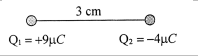
3. Según la figura siguiente, ¿ dónde se encuentra el punto P de modo que la magnitud del campo eléctrico en el punto P = 0? ( k = 9 x 10⁹ Nm² C⁻² , 1 μC = 10⁻⁶ C )
Solución
Si el punto P se encuentra a la izquierda de Q1 , el campo eléctrico producido por Q1 en el punto P apunta hacia la izquierda ( alejándose de Q1 ) y el campo eléctrico producido por Q2 en el punto P apunta hacia la derecha (hacia Q1 ) . La dirección del campo eléctrico es opuesta, de modo que el campo eléctrico en el punto P = 0.
Conocido :
Q 1 = +9 μC = +9 x 10 −6 C
Q 2 = -4 μC = -4 x 10 −6 C
k = 9 x 10 9 Nm 2 C −2
Distancia entre la carga 1 y la carga 2 = 3 cm
Distancia entre Q 1 y el punto P (r 1P ) = a
Distancia entre Q 2 y el punto P (r 2P ) = 3 + a
Se busca: Posición del punto P
solución:
El punto P está situado a la izquierda de Q 1.
El campo eléctrico producido por Q 1 en el punto P:

La carga de prueba es positiva y Q 1 es positiva, por lo que la dirección del campo eléctrico es hacia la izquierda.
El campo eléctrico producido por Q 2 en el punto P :

La carga de prueba es positiva y Q2 es negativa, de modo que la dirección del campo eléctrico es hacia la derecha.
Resultante del campo eléctrico en el punto A:
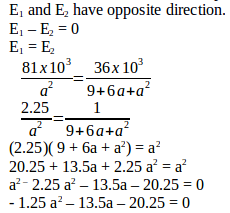
Utilice la fórmula cuadrática para hallar a:
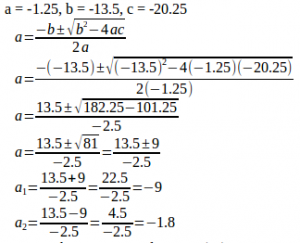
Distancia entre Q 2 y el punto P (r 2P ) = 3 + a = 3 – 1.8 = 1.2 cm o 3 + a = 3 – 9 = -6 cm.
Distancia entre Q 1 y el punto P (r 1P ) = a = -9 cm o -1.8 cm.
El punto P está situado a 1.2 cm a la derecha de Q 2.
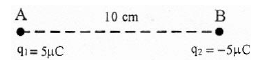
4. La carga q3 se encuentra a 5 cm a la derecha de q2 , como se muestra en la figura siguiente. ¿Cuál es la magnitud del campo eléctrico en la carga q3 ( 1 µC = 10⁻⁶ C )?
solución:

La carga q3 es positiva, por lo que la dirección del campo eléctrico en la carga q3 apunta hacia la carga negativa q2 ( E2 ) y se aleja de la carga positiva q1 ( E1 ) . La resultante del campo eléctrico es la suma de los campos eléctricos E1 y E2.
Conocido :
Carga q 1 = 5 µC = 5 x 10 -6 culombios
Carga q 2 = 5 µC = -5 x 10 -6 culombios
Distancia entre la carga q1 y la carga q3 ( r1 ) = 15 cm = 0.15 m = 15 x 10⁻² metros
Distancia entre la carga q2 y la carga q3 ( r2 ) = 5 cm = 0.05 m = 5 x 10⁻² metros
k = 9 x 10⁹ N m² C⁻²
Se busca: El campo eléctrico en la carga q3
solución:
El campo eléctrico 1:
E 1 = kq 1 / r 1 2
E 1 = (9 x 10 9 )(5 x 10 -6 ) / (15 x 10 -2 ) 2
E 1 = (45 x 10 3 ) / (225 x 10 -4 )
E 1 = 0.2 x 10 7 N/C
El campo eléctrico 2:
E 2 = kq 2 / r 2 2
E 2 = (9 x 10 9 )(5 x 10 -6 ) / (5 x 10 -2 ) 2
E 2 = (45 x 10 3 ) / (25 x 10 -4 )
E 2 = 1.8 x 10 7 N/C
Resultante del campo eléctrico:
La resultante del campo eléctrico en la carga q 3 :
E = E 2 – E 1 = (1.8 x 10 7 ) – (0.2 x 10 7 ) = 1.6 x 10 7 N/C
La dirección del campo eléctrico apunta hacia la izquierda (la misma dirección que E 2 ).
5. Dos cargas están separadas como se muestra en la figura siguiente. ¿Cuál es el campo eléctrico en el punto P (k = 9 x 10⁹ N m² C⁻² )?
Solución
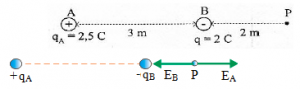
Conocido :
Carga q A = +2.5 C
Carga q B = -2 C
Distancia entre la carga q A y el punto P (r A ) = 5 m
Distancia entre la carga q B y el punto P (r B ) = 2 m
k = 9 x 10⁹ N m² C⁻²
Se busca: la magnitud del campo eléctrico en el punto P.
solución:
El campo eléctrico A:
E A = kq A / r A 2
E A = (9 x 10 9 )(2.5) / (5) 2
E A = (22.5 x 10 9 ) / 25
EA = 0.9 x 10⁹ N / C
El campo eléctrico B:
E B = kq B / r B 2
E B = (9 x 10 9 )(2) / (2) 2
E B = (18 x 10 9 ) / 4
E B = 4.5 x 10⁹ N /C
Resultante del campo eléctrico:
Resultante del campo eléctrico en el punto P:
E = E B – EA = (4.5 – 0.9) x 10 9 = 3.6 x 10 9 N/C
La dirección hacia la izquierda (la misma dirección que E B ).
6. Dos cargas Q 1 = -40 µC y Q 2 = +5 µC como se muestra en la figura siguiente (k = 9 x 10 9 Nm 2 .C -2 y 1 µC = 10 -6 C). ¿Cuál es la magnitud del campo eléctrico en el punto P?
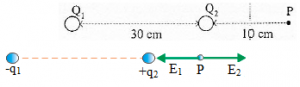
Conocido :
Carga q 1 = -40 µC = -40 x 10 -6 C
Carga q 2 = +5 µC = +5 x 10 -6 C
Distancia entre q 1 y el punto P (r 1 ) = 40 cm = 0.4 m = 4 x 10 -1 m
Distancia entre q 2 y el punto P (r 2 ) = 10 cm = 0.1 = 1 x 10 -1 m
k = 9 x 10⁹ N m² C⁻²
Se busca: la magnitud del campo eléctrico en el punto P.
solución:
El campo eléctrico 1:
E 1 = kq 1 / r 1 2
E 1 = (9 x 10 9 )(40 x 10 -6 ) / (4 x 10 -1 ) 2
E 1 = (360 x 10 3 ) / (16 x 10 -2 )
E 1 = 22.5 x 10 5 N/C
El campo eléctrico 2:
E 2 = kq 2 / r 2 2
E 2 = (9 x 10 9 )(5 x 10 -6 ) / (1 x 10 -1 ) 2
E 2 = (45 x 10 3 ) / 1 x 10 -2
E 2 = 45 x 10 5 N/C
Resultante del campo eléctrico:
La resultante del campo eléctrico en el punto P:
E = E 2 – E1 = (45 – 22.5) x 10 5 = 22.5 x 10 5 N/C
E = 2.25 x 10⁶ N /C
La dirección del campo eléctrico apunta hacia la derecha (la misma dirección que E 2 ).
7. Dos cargas puntuales como se muestra en la figura siguiente.
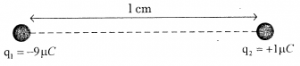
¿Dónde se ubica el punto P de modo que la magnitud del campo eléctrico en el punto P = 0? k = 9.10 9 Nm 2 .C -2 , 1 µC = 10 -6 C.
Conocido :
Carga 1 (q 1 ) = -9 µC = -9.10 -6 culombios
Carga 2 (q 2 ) = 1 µC = 1.10 -6 Coulomb
Distancia entre q 1 y q 2 (r 12 ) = 1 cm
k = 9.10 9 Nm 2 .C -2
Se busca: Posición del punto P
solución:
E 1 = la magnitud del campo eléctrico producido por q 1 en el punto P
La dirección de E 1 hacia q 1 porque q 1 es negativo.
E 2 = la magnitud del campo eléctrico producido por q 2 en el punto P
La dirección de E 2 se aleja de q 2 porque q 2 es positivo.
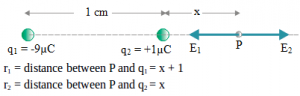
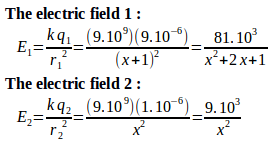
El campo eléctrico en el punto = 0.
Utilice la fórmula cuadrática:
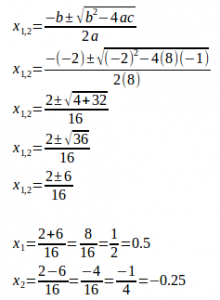
Distancia entre P y q 2 = x = 0.5 cm.
El punto P está ubicado a 0.5 cm a la derecha de q 2 o a 0.25 cm a la izquierda de q 1.
8. Según la figura siguiente, si la magnitud del campo eléctrico en el punto P = k Q/x 2 , entonces x = ….
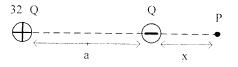
Conocido :
EP = k Q / x 2
Se busca: x
solución:
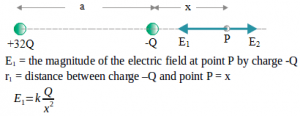
E 2 = La magnitud del campo eléctrico en el punto P debido a la carga +32Q
r 2 = Distancia entre la carga +32Q y el punto P = a + x
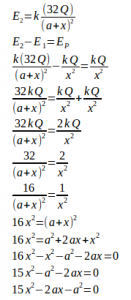
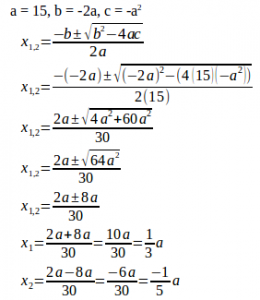
Utilice la fórmula cuadrática:
- ¿Qué es un campo eléctrico?
- RespuestaUn campo eléctrico es una región alrededor de un objeto cargado donde otros objetos cargados pueden experimentar fuerzas eléctricas. Es un campo vectorial, lo que significa que tiene magnitud y dirección en cada punto.
- ¿Cómo se determina la intensidad de un campo eléctrico?
- Respuesta: La fuerza o magnitud de un campo eléctrico en un punto se define como la fuerza experimentado por un cargo de prueba positivo colocado en ese punto, dividido por la magnitud de la carga de prueba misma: .
- ¿Cómo varía el campo eléctrico debido a una carga puntual con la distancia?
- Respuesta: El campo eléctrico debido a un cargo puntual es inversamente proporcional al cuadrado de la distancia de la carga. La relación viene dada por , donde es la constante de Coulomb.
- ¿Cuál es la dirección del campo eléctrico debido a una carga positiva?
- RespuestaEl campo eléctrico debido a una carga positiva apunta radialmente hacia afuera desde la carga. Para una carga negativa, el campo apunta radialmente hacia adentro, hacia la carga.
- ¿Cómo se pueden representar gráficamente los campos eléctricos?
- RespuestaLos campos eléctricos pueden representarse gráficamente mediante líneas de campo (o líneas de fuerza). La dirección del campo en cualquier punto es tangente a la línea de campo en ese punto, y la densidad de las líneas indica la magnitud del campo.
- ¿Qué ocurre con el campo eléctrico dentro de un conductor en equilibrio electrostático?
- RespuestaDentro de un conductor en equilibrio electrostático, el campo eléctrico es cero. Esto se debe a que cualquier campo externo provoca la redistribución de los electrones libres en el conductor, neutralizando así el campo externo interno.
- ¿Cómo se comportan las líneas de campo eléctrico cerca del borde afilado de un conductor?
- RespuestaCerca de un borde afilado o una punta afilada de un conductor, las líneas de campo eléctrico se concentran más, lo que genera un campo eléctrico más intenso en esa región. Este es el principio de funcionamiento de dispositivos como el pararrayos.
- ¿Cómo se aplican los principios de superposición a los campos eléctricos?
- RespuestaEl campo eléctrico generado por múltiples cargas en un punto es simplemente la suma vectorial de los campos eléctricos generados por cada carga individual. Esto se conoce como el principio de superposición.
- ¿Cómo se relaciona el trabajo realizado por un agente externo con el campo eléctrico al mover una carga dentro de dicho campo?
- Respuesta: La obra realizado por un agente externo al mover una carga de un punto a otro en un campo eléctrico es igual al negativo del cambio en la energía potencial eléctrica, que es , donde es el cambio en el potencial eléctrico.
-
¿Pueden las líneas de campo eléctrico cruzarse alguna vez?
- RespuestaNo, las líneas de campo eléctrico no pueden cruzarse. Si lo hicieran, implicaría que en el punto de intersección existen dos direcciones diferentes del campo eléctrico, lo cual no es posible.
