1. Two masses m1 = 2 kg lan m2 = 5 kg are on inclined plane and are connected together by a string as shown in the figure. The coefficient of the kinetic friction between m1 and incline is 0.2 and the coefficient of the gesekan kinetik between m2 and incline is 0.1.
(a) Determine their percepatan
(b) Determine the tension force
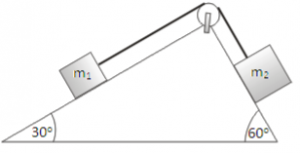
Dikenal:
Massa 1 (m1) = 2 kg
Massa 2 (m2) = 4 kg
Coefficient of the kinetic friction between m1 lan bidang miring (μk1) = 0.2
Coefficient of the kinetic friction between m2 and inclined plane (μk2) = 0.1
Akselerasi amarga gravitasi (g) = 9.8 m/s2
a) The magnitude and direction of the acceleration
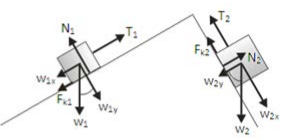
w1 = bobot 1 = m1 g = (2 kg)(9.8 m/s)2) = 19.6 Newton
w1x = w1 dosa 30o = (19.6 N)(0.5) = 9.8 Newton
w1y = w1 kosok 30o = (19.6 N)(0.87) = 17 Newton
N1 = The kekuatan normal on m1 = w1y = 17 Newton
Fk1 = The force of the kinetic friction on m1 = μk1 N1 = (0.2)(17 N) = 3.4 Newton
---
w2 = weight 2 = m2 g = (4 kg)(9.8 m/s)2) = 39.2 Newton
w2x = w2 dosa 60o = (39.2 N)(0.87) = 34.1 Newton
w2y = w2 kosok 60o = (39.2 N)(0.5) = 19.6 Newton
N2 = The normal force on m2 = w2y = 19.6 Newton
Fk2 = The force of the kinetic friction on m2 = μk2 N2 = (0.1)(19.6 N) = 1.96 Newton
---
Gedhene percepatan:
∑Fx = max
w2x > w1x so direction of the acceleration is the same as direction of w2x.
Forces which points along acceleration is positive and forces which has opposite direction with acceleration is negative.
w2x - Fk2 - T2 +T1 – w1x - Fk1 = (m1 +m2) lanx
w2x - Fk2 – w1x - Fk1 = (m1 +m2 ) lanx
34.1 N – 1.96 N – 9.8 N – 3.4 N = (2 kg + 4 kg) ax
18.94 N = (6 kg) ax
ax = 18.94 N : 6 kg
ax = 3.16 m/s2
Magnitudo percepatan = 3.16 m/s2 . Direction of the acceleration = direction of T1 = direction of w2x
b) Magnitude of the tension force
Apply Newton’s second law on the object 2 :
w2x - Fk2 - T2 = m2 ax
34.1 N – 1.96 N – T2 = (4kg)(3.16m/s2)
32.14 N – T2 = 12.64 N
T2 = 32.14 N – 12.64 N = 19.5 Newton
The tension force = T = T1 = T2 = 19.5 Newton
2. m1 = 4 kg, m2 = 2 kg. Determine (a) magnitude and direction of the acceleration (b) Magnitude of the tension force which connecting m1 lan m2 (c) magnitude of the tension force which connecting pulley and roof.
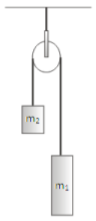
solusi
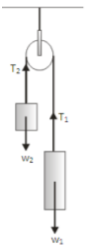
w1 = m1 g = (4 kg)(9.8 m/s)2) = 39.2 Newton
w2 = m2 g = (2 kg)(9.8 m/s)2) = 19.6 Newton
a) Magnitude and direction of the acceleration
∑Fy = may
w1 > w2 so the direction of the object is same as the direction of the weight 1 (w1). Forces which has the same direction with acceleration is positive and forces which has opposite direction with acceleration is negative.
w1 - T1 +T2 – w2 = (m1 +m2) lany
w1 – w2 = (m1 +m2) lany
39.2 N – 19.6 N = (4 kg + 2 kg) ay
19.6 N = (6 kg) ay
ay = 19.6 N : 6 kg
ay = 3.26 m/s2
Magnitude of acceleration = 3.26 m/s2. Direction of acceleration = direction of w1 .
b) Magnitude of tension force which connecting m1 lan m2
aplikasi Hukum kapindho Newton on m2 :
∑Fy = may
w1 - T1 = m1 ay
39.2 N – T1 = (4 kg)( 3.26 m/s2)
39.2 N – T1 = 13.04 N
T1 = 39.2 N – 13.04 N
T1 = 26.16 Newton
Magnitude of the tension force which connection objects = T = T1 = T2 = 26.16 Newton
c) Magnitude of the tension force which connecting pulley and roof.
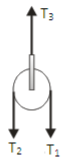 Pulley is at rest :
∑Fy = may —— ay = 0
∑Fy = 0
Upward force are positive, downward forces are negative :
T3 - T1 - T2 = 0
T3 = T1 +T2
T1 lan T2 have the same magnitude, T1 = T2 = T = 26.16 N :
T3 = 2T = 2(26.16 N) = 52.32 Newton
3. Block 1 (m1 = 10 kg) and block 2 (m2 = 15 kg) connected by a cord over frictionless pulley. Coefficient of the static friction between the block 2 with incline = 0.6. The coefficient of the kinetic friction between the block 2 with incline = 0.42. Determine (a) The magnitude of the minimum force F exerted on the objects so the objects accelerated upward (b) Determine the magnitude of the tension force.
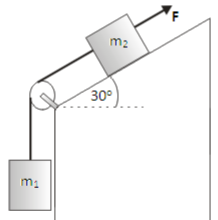
solusi
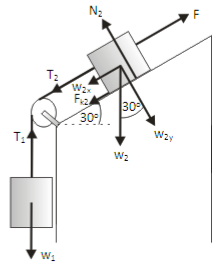
w1 = The weight of the block 1 = m1 g = (10 kg)(9.8 m/s)2) = 98 Newton
w2 = The weight of the block 2 = m2 g = (15 kg)(9.8 m/s)2) = 147 Newton
w2y = w2 kosok 30o = (147 N)(0.87) = 127.89 Newton
w2x = w2 dosa 30o = (147 N)(0.5) = 73.5 Newton
N2 = The normal force on the block 2 = w2y = 127.89 Newton
Fk2 = The force of the kinetic friction on the block 2 = μk2 N2 = (0.42)(127.89 N) = 53.7 Newton
Fs2 = The force of the static friction on the block 2 = μs2 N2 = (0.6)(127.89 N) = 76.7 Newton
a) The magnitude of the minimum force F exerted on the objects so the objects accelerated upward
∑Fx = max —— ax = 0
∑Fx = 0
Upward forces and rightward forces are positive, downward forces and leftward forces are negative.
F – Fk2 – w2x – w1 - T2 +T1 = 0
F – Fk2 – w2x – w1 = 0
F = Fk2 +w2x +w1
F = 53.7 N + 73.5 N + 98 N
F = 225.2 Newton
b) The magnitude of the tension force
Apply Newton’s law of the motion on the block 1 :
∑Fy = may —— ay = 0
∑Fy = 0
T1 – w1 = 0
T1 = w1 = 98 Newton
Apply Newton’s law of the motion on the block 2 :
F – Fk2 – w2x - T2 = 0
T2 = F – Fk2 – w2x
T2 = 225.2 N – 53.7 N – 73.5 N
T2 = 98 Newton
Magnitudo gaya tarik = T1 = T2 = T = 98 Newton
4. Block 1 (m1 = 16 kg) lies on a horizontal surface and the block 2 (m2 = 12 kg) lies on a smooth inclined plane, connected by a cord that passes over a small, frictionless pulley. Block 3 (m3 = 5 kg) lies on the block 2. The coefficient of the kinetic friction between the block 2 and the horizontal surface is 0,4. The coefficient of the static friction between the block 2 with the block 3 is 0,3.
(a) When the system is released from rest, the block 3 and the block 2 still slide together ?
(B) If there is no block 3, what is the acceleration of the block 1 and the block 2 ?
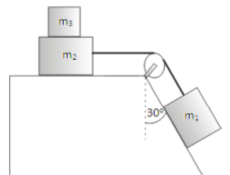
Solusi:
a) When the system is released from rest, the block 3 and the block 2 still slide together?
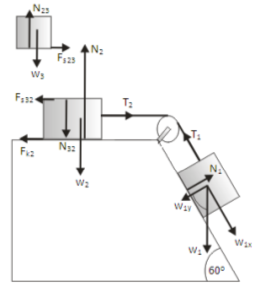
w1 = The weight of the block 1 = m1 g = (16 kg)(9.8 m/s)2) = 156.8 Newton
w1x = w1 dosa 60o = (156.8 N)(0.87) = 136.4 Newton
w1y = w1 kosok 60o = (156.8 N)(0.5) = 78.4 Newton
N1 = The normal force exerted on the block 1 by the inclined plane = w1y = 78.4 Newton
w3 = The weight of the block 3 = m3 g = (5 kg)(9.8 m/s)2) = 49 Newton
N23 = The normal force exerted on the block 3 bythe block 2 = w3 = 49 Newton
N32 = The normal force exerted on the block 2 by the block 3 = N23 = w3 = 49 Newton
(N23 lan N32 are action-reaction pair)
Fs23 = The force of the static friction exerted on the block 3 by the block 2 = μs N23 = (0.3)(49 N) = 14.7 Newton
Fs32 = The force of the static friction exerted on th block 2 by the block 3 = Fs23 = 14.7 Newton
(Fs23 lan Fs32 are action-reaction pair)
w2 = The weight of the block 2 = m2 g = (12 kg)(9.8 m/s)2) = 117.6 Newton
N2 = The normal force exerted on the object 2 by the horizontal surface = w2 +N32 = 117.6 Newton + 49
Newton = 166.6 Newton
Fk2 = The force of the kinetic friction on the block 2 = μk N2 = (0.4)(166.6 N) = 66.64 Newton
Apply Newton’s law of motion on the block 3 :
∑Fx = max
Fs23 =m3 ax
—–> Fs23 = μs N23 = μs w3 = μs m3 g
μs m3 g = m3 ax
μs g = ax
ax = (0.3)(9.8 m/s2) = 2.94 m/s2
The maximum acceleration of the block 3 so that the block 3 and the block 2 still slide together is 2.94 m/s2.
Now we calculate the magnitude of the system’s acceleration after released from rest.
The direction of the block displacement = the direction of the block’s acceleration = the direction of T2 = the direction of w1x.
∑Fx = max
w1x - T1 +T2 - Fk2 - Fs32 +Fs23 = (m1 +m2 +m3) lanx
w1x - Fk2 = (m1 +m2 +m3 ) lanx
136.4 N – 66.64 N = (16 kg + 12 kg + 5 kg) ax
69.76 N = (33 kg) ax
ax = 2.11 m/s2
ax is positive, means direction of the block displacement or the direction of the acceleration is same as direction of T2 or direction of w1x.
The magnitude of the acceleration is 2.11 m / s2 , lower than 2.94 m / s2 so we can conclude that block 3 and block 2 still slide together after released from rest.
b) The magnitude of the acceleration of the block 1 and the block 2
∑Fx = max
w1x - Fk2 = (m1 +m2) lanx
—–> Fk2 = μk N2 = μk w2 = μk m2 g = (0.4)(12 kg)(9.8 m/s2) = 47.04 Newton
136.4 N – 47.04 N = (16 kg + 12 kg) ax
89.36 N = (28 kg) ax
ax = 89.36 N : 28 kg = 3.19 m/s2
[wpdm_package id=’493′]
- Massa lan bobot
- Gaya normal
- Hukum gerak Newton sing kapindho
- Gaya gesekan
- Gerak ing permukaan horisontal tanpa gaya gesekan
- Gerakan rong awak kanthi percepatan sing padha ing permukaan horisontal kasar kanthi gaya gesekan
- Gerak ing bidang miring tanpa gaya gesekan
- Gerak ing bidang miring kasar kanthi gaya gesekan
- Gerakan ing lift
- Gerakan awak disambungake dening tali lan katrol
- Rong benda kanthi gedhene percepatan sing padha
- Ngubengi kurva datar - dinamika gerakan melingkar
- Ngubengi kurva miring - dinamika gerakan bunder
- Gerakan seragam ing bunderan horisontal
- Gaya sentripetal ing gerakan bunder seragam

