Circuiti con condensatori in serie e in parallelo: problemi e soluzioni
1. Qual è la carica totale nei circuiti del condensatore sottostanti (1 μF = 10⁻⁶ F )?
Conosciuto :
Condensatore 1 (C1) = 3 μF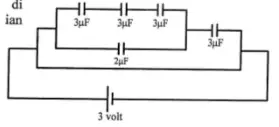
Condensatore 2 (C 2 ) = 3 μF
Condensatore 3 (C 3 ) = 3 μF
Condensatore 4 (C 4 ) = 2 μF
Condensatore 5 (C 5 ) = 3 μF
Tensione (V) = 3 Volt
Si ricerca: carica totale nei circuiti dei condensatori (Q)
soluzione:
Il condensatore equivalente
I condensatori C1 , C2 e C3 sono collegati in serie. Il condensatore equivalente:
1/C 123 = 1/C 1 + 1/C 2 + 1/C 3 = 1/3 + 1/3 + 1/3 = 3/3
C 123 = 3/3 = 1 μF
I condensatori C 123 e C 4 sono collegati in parallelo . Il condensatore equivalente è:
C 1234 = C 123 + C 4 = 1 + 2 = 3 μF
I condensatori C 1234 e C 5 sono collegati in serie. Il condensatore equivalente è:
1/C = 1/C 1234 + 1/C 5 = 1/3 + 1/3 = 2/3
C = 3/2 μF
C = 3/2 x 10 -6 F
L'importo totale delle spese:
La carica totale nel condensatore equivalente è uguale alla carica totale nei circuiti dei condensatori.
Q = VC = (3 Volt)(3/2 x 10 -6 Farad) = 9/2 x 10 -6 Coulomb
Q = 9/2 microCoulomb = 9/2 μC
Q = 4.5 μC
2. Se C 1 = C 2 = 2 μF, C 3 = C 4 = 1 μF e C 5 = 4 μF, determinare le cariche totali nei circuiti dei condensatori come mostrato nella figura sottostante (1 μF = 10 -6 F)
Conosciuto :
Condensatore 1 (C 1 ) = 2 μF
Condensatore 2 (C 2 ) = 2 μF
Condensatore 3 (C3) = 1 μF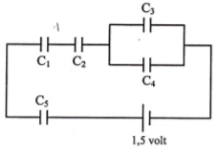
Condensatore 4 (C 4 ) = 1 μF
Condensatore 5 (C 5 ) = 4 μF
Tensione (V) = 1.5 Volt
Si richiede: la carica totale nei circuiti (Q)
soluzione:
Il condensatore equivalente:
I condensatori C3 e C4 sono collegati in parallelo. Il condensatore equivalente è:
C 34 = C 3 + C 4 = 1 + 1 = 2 μF
I condensatori C 5 , C 1 , C 2 e C 34 sono collegati in serie. Il condensatore equivalente:
1/C = 1/C 5 + 1/C 1 + 1/C 2 + 1/C 34
1/C = 1/4 + 1/2 + 1/2 + 1/2
1/C = 1/4 + 2/4 + 2/4 + 2/4
1/C = 7/4
C = 4/7 μF
C = 4/7 x 10 -6 F
L'importo totale delle spese:
La carica totale nel condensatore equivalente è uguale alla carica totale nei circuiti dei condensatori.
Q = VC = (1.5 Volt)(4/7 x 10 -6 Farad) = 6/7 x 10 -6 Coulomb
Q = 6/7 microCoulomb
Q = 6/7 μC
3. Determinare le cariche totali nei circuiti del condensatore come mostrato nella figura sottostante.
Conosciuto :
Condensatore 1 (C1) = 3 μF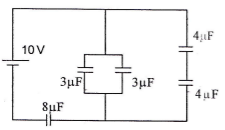
Condensatore 2 (C 2 ) = 3 μF
Condensatore 3 (C 3 ) = 4 μF
Condensatore 4 (C 4 ) = 4 μF
Condensatore 5 (C 5 ) = 8 μF
Tensione (V) = 10 Volt
Si richiede: la carica totale nei circuiti (Q)
soluzione:
Il condensatore equivalente:
I condensatori C1 e C2 sono collegati in parallelo. Il condensatore equivalente è:
C 12 = C 1 + C 2 = 3 + 3 = 6 μF
I condensatori C 3 e C 4 sono collegati in serie. Il condensatore equivalente è:
1/C 34 = 1/C 3 + 1/C 4 = 1/4 + 1/4 = 2/4
C 34 = 4/2 = 2 μF
I condensatori C12 , C34 e C5 sono collegati in parallelo. Il condensatore equivalente è :
C = C 12 + C 34 + C 5 = 6 + 2 + 8 = 16 μF = 16 x 10 -6 Farad
Il totale dei costi dell'energia elettrica:
La carica totale nel condensatore equivalente è uguale alla carica totale nei circuiti dei condensatori.
Q = VC = (10 Volt)(16 x 10⁻⁶ Farad) = 160 x 10⁻⁶ Coulomb
Q = 160 microCoulomb = 160 μC
20 domande e risposte concettuali relative ai circuiti con condensatori in serie e in parallelo:
1. Domanda: Come si collegano i condensatori in serie?
Risposta: In una configurazione in serie, i condensatori sono collegati uno di seguito all'altro, quindi la stessa corrente scorre attraverso tutti i condensatori.
2. Domanda: Come vengono collegati i condensatori in una configurazione in parallelo?
Risposta: In una configurazione in parallelo, i condensatori sono collegati tra loro in punti o giunzioni comuni, consentendo il passaggio di correnti diverse attraverso ciascun condensatore, ma mantenendo la stessa tensione ai loro capi.
3. Domanda: Come si calcola la capacità equivalente di condensatori in serie?
Risposta: Il reciproco della capacità equivalente in una connessione in serie è la somma dei reciproci delle singole capacità: 1/Cₑq = 1/C₁ + 1/C₂ + … + 1/Cₙ.
4. Domanda: Come si calcola la capacità equivalente di condensatori in parallelo?
Risposta: La capacità equivalente in una connessione in parallelo è la somma delle singole capacità: Cₑq = C₁ + C₂ + … + Cₙ.
5. Domanda: Cosa succede alla capacità totale quando si aggiungono condensatori in serie?
Risposta: L'aggiunta di condensatori in serie diminuisce la capacità totale o equivalente.
6. Domanda: Cosa succede alla capacità totale quando si aggiungono condensatori in parallelo?
Risposta: L'aggiunta di condensatori in parallelo aumenta la capacità totale o equivalente.
7. Domanda: Come viene immagazzinata la carica nei condensatori collegati in serie?
Risposta: La carica immagazzinata su ciascun condensatore in una connessione in serie è la stessa perché la stessa corrente scorre attraverso tutti.
8. Domanda: Come si distribuisce la tensione tra i condensatori collegati in serie?
Risposta: La tensione totale si divide tra i condensatori in serie e la tensione ai capi di ciascun condensatore è inversamente proporzionale alla sua capacità.
9. Domanda: Come si confronta l'energia immagazzinata in una combinazione di condensatori in serie o in parallelo con l'energia immagazzinata nei singoli condensatori?
Risposta: L'energia totale immagazzinata in una combinazione di condensatori è la somma dell'energia immagazzinata nei singoli condensatori, indipendentemente dal fatto che siano collegati in serie o in parallelo.
10. Domanda: Come si confronta la tensione di rottura di una combinazione in serie di condensatori con quella dei singoli condensatori?
Risposta: In una combinazione in serie, la tensione di rottura è in genere determinata dal condensatore con la tensione di rottura più bassa.
11. Domanda: Qual è l'importanza di utilizzare condensatori con la stessa tensione nominale in una configurazione in parallelo?
Risposta: L'utilizzo di condensatori con la stessa tensione nominale in parallelo garantisce che ciascun condensatore sia in grado di sopportare la tensione comune ai loro capi, prevenendo potenziali danni o guasti.
12. Domanda: Perché si potrebbero usare condensatori in serie?
Risposta: I condensatori in serie possono essere utilizzati per ottenere una capacità equivalente inferiore o per aumentare la tensione di rottura complessiva della combinazione.
13. Domanda: Perché si potrebbero usare condensatori in parallelo?
Risposta: I condensatori in parallelo possono essere utilizzati per aumentare la capacità totale o per distribuire l'accumulo di carica su più condensatori per applicazioni che richiedono un'elevata capacità di carica.
14. Domanda: Come si può calcolare l'energia totale immagazzinata in una combinazione in parallelo di condensatori?
Risposta: L'energia totale può essere calcolata come ½ Cₑq V², dove Cₑq è la capacità parallela equivalente e V è la tensione comune.
15. Domanda: Qual è l'effetto di avere capacità diverse in una connessione in serie?
Risposta: In un collegamento in serie con capacità diverse, la distribuzione della tensione varierà, con i condensatori di capacità inferiore che presenteranno una caduta di tensione maggiore ai loro capi.
16. Domanda: Come si possono utilizzare i condensatori in serie e in parallelo nei circuiti di sintonizzazione?
Risposta: Le configurazioni in serie e in parallelo dei condensatori possono essere utilizzate per ottenere specifiche frequenze di risonanza o sfasamenti nei circuiti di sintonizzazione, come ad esempio nelle radio o nell'elaborazione del segnale.
17. Domanda: Cosa potrebbe accadere alla capacità equivalente di una combinazione in parallelo se uno dei condensatori si guastasse o andasse in cortocircuito?
Risposta: Un condensatore in cortocircuito in parallelo verrebbe effettivamente rimosso dal circuito, con conseguente diminuzione della capacità equivalente.
18. Domanda: Cosa potrebbe accadere alla capacità equivalente di una combinazione in serie se un condensatore si guastasse interrompendo il circuito?
Risposta: Un condensatore in serie, se interrotto, interromperebbe il flusso di corrente, annullando la capacità equivalente.
19. Domanda: In che modo le combinazioni in serie e in parallelo dei condensatori influenzano l'impedenza nei circuiti in corrente alternata?
Risposta: Le combinazioni in serie aumentano l'impedenza, mentre le combinazioni in parallelo la diminuiscono. Questo comportamento può essere utilizzato per filtrare o far passare frequenze specifiche nei circuiti in corrente alternata.
20. Domanda: È possibile combinare configurazioni in serie e in parallelo nello stesso circuito?
Risposta: Sì, le configurazioni in serie e in parallelo possono essere combinate nello stesso circuito per ottenere i valori di capacità e le caratteristiche desiderate. L'analisi richiede l'applicazione delle regole valide sia per le combinazioni in serie che per quelle in parallelo.
Comprendere le proprietà e il comportamento dei condensatori in configurazioni in serie e in parallelo è fondamentale nella progettazione e nell'analisi dei circuiti elettronici, consentendo agli ingegneri di adattare i circuiti a esigenze e funzioni specifiche.
