Artaigil mu na Resistors ann an sreath
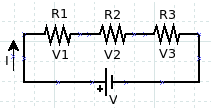
Ma tha na resistors ceangailte mar a chithear san fhigear, tha na resistors air an cur ann an sreath. Faodaidh an resistor no an aghaidh dealain a tha fo cheist a bhith ann an cruth phàirtean resistor, solais, no strì dealain eile.
Bidh an cosgais dealain a’ gluasad tro aghaidh 1 (R1) = an cosgais dealain a’ gluasad tro aghaidh 2 (R2) = bidh an cosgais dealain a’ gluasad tro aghaidh 3 (R3). Sruth dealain Is e (I) cosgais dealain a bhios a’ sruthadh rè ùine shònraichte (I = Q / t), agus mar sin tha an sruth dealain tro aghaidh 1 (I1) = sruth dealain tro aghaidh 2 (I2) = sruth dealain tro aghaidh 3 (I3). Gu matamataigeach, tha an sruth dealain iomlan (I) = I1 = Mise2 = Mise3.
Air an làimh eile, lùghdaichidh am bholtaids dealain (V) nuair a ghluaiseas an cosgais dealain tro gach resistor. 'S e bholtaids dealain, ris an canar cuideachd eadar-dhealachadh comasachd dealain, lùth comasachd dealain gach aonad de chosgais dealain. Tha bholtaids dealain air a lùghdachadh leis gu bheil dealan air a chleachdadh anns gach resistor dealain. Mar sin, tha am bholtaids dealain iomlan (V) co-ionann ris an ìre dealain anns gach resistor. Gu matamataigeach, tha am bholtaids dealain iomlan (V) = V1 + V.2 + V.3V = IR agus mar sin is e co-aontar a’ bholtaids dealain V = IR1 + IR2 + IR3Tha an sruth dealain a tha a’ sruthadh air gach resistor co-ionann agus mar sin bidh an co-aontar seo ag atharrachadh gu V = I (R1 + R.2 + R.3).
Stèidhichte air a’ cho-aontar gu h-àrd, faodar a cho-dhùnadh gur e an aghaidh dealain iomlan (R) no an aghaidh co-ionann ris an aghaidh dealain
a tha ceangailte ann an sreath co-ionann ri suim gach strì dealain, gu matamataigeach R = R1 + R.2 + R.3Ma tha dìreach dà resistor ann an sreath, tha an resistor co-ionann (R) = R1 + R.2Ma tha ceithir resistors ann an sreath, tha an resistor co-ionann (R) = R1 + R.2 + R.3 + R.4Mar an ceudna, ma tha còig no barrachd resistors ann a tha ceangailte ann an sreath.
Eisimpleir de dhuilgheadas 1:
Ma tha fios, tha R1 = 2 Ω, R2 = 3 Ω agus R3 = 4 Ω. Tha na trì resistors ceangailte ann an sreath. Dè an luach a th’ aig an resistor co-ionann? (Ω = Ohm ).
fuasgladh:
R = R1 + R2 + R3 = 2 + 3 + 4 = 9 Ω.
Tha an toradh seo a’ sealltainn gu bheil an aghaidh cho-ionann nas motha na luach nan resistors a tha ceangailte ann an sreath.
Eisimpleir de dhuilgheadas 2:
Tha dà resistor R1 = 50 Ω agus 50 Ω ceangailte ann an sreath agus ceangailte ri bataraidh 12 Volt. Obraich a-mach
(a) An aghaidh cho-ionann
(b) Sruth dealain tro gach resistor
fuasgladh:
(a) R = R 1 + R 2 = 50 Ω + 50 Ω = 100 Ω.
(b) I = V / R = 12 Volt / 100 Ω = 0.12 A
