Conservación de la energía mecánica: problemas y soluciones.
1. Un bloque de m kg se suelta desde la parte superior de un plano inclinado liso , como se muestra en la figura siguiente. La comparación entre la energía potencial gravitatoria y la energía cinética del bloque en el punto M es…
Solución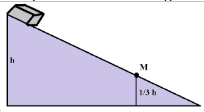
Energía potencial gravitatoria en el punto M:
PE M = mg (1/3h) = 1/3 mgh
Energía cinética en el punto M:
KE M = EP = mg (2/3 h) = 2/3 mgh
EP M : EK M
1/3 mgh : 2/3 mgh
1/3 : 2/3
1: 2
2. Un esquiador sobre hielo se desliza desde una altura A, como se muestra en la figura siguiente. Si la velocidad inicial es 0 y la aceleración debida a la gravedad es de 10 m/ s² , ¿cuál es la velocidad del esquiador en el punto B?
Conocido :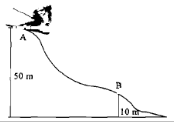
Velocidad inicial (v o ) = 0
Aceleración debida a la gravedad (g) = 10 m/ s²
El cambio de altura = 50 metros – 10 metros = 40 metros
Se busca: Velocidad del esquiador en el punto B
solución:
El principio de conservación de la energía mecánica establece que la energía mecánica inicial es igual a la energía mecánica final.
La energía mecánica inicial es igual a la energía potencial en el punto B (altura = 40 metros).
La energía mecánica final = energía cinética en el punto B
La energía mecánica final = La energía mecánica inicial
½ mv t 2 = mgh
½ v t 2 = gh
½ v t 2 = (10)(50-10)
½ v t 2 = (10)(40)
½ v t 2 = 400
v t 2 = (2)(400) = 800
v t = √800 = √(2)(400) = 20√2 m/s
3. Un objeto comienza a deslizarse desde el punto A sin velocidad inicial. Si no hay fuerza de fricción, ¿cuál es la velocidad del objeto en el punto más bajo?
Conocido :
Masa del objeto = m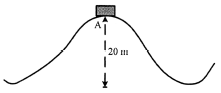
Velocidad inicial (v o ) = 0
Altura (h) = 20 metros
Aceleración debida a la gravedad (g) = 10 m/ s²
Se busca: Velocidad final (v t )
solución:
Energía mecánica inicial (EM 1 ) = Energía potencial gravitatoria en el punto A (EP A ) = mgh = (m)(10)(20) = 200 m
Energía mecánica final (EM2 ) = energía cinética (EC) = ½ mv t2
¿Cuál es la velocidad del objeto en el punto más bajo (v t )?
Aplicando el principio de conservación de la energía mecánica, se establece que la energía mecánica inicial es igual a la energía mecánica final.
EM1 = EM2
200 m = ½ mv t 2
200 = ½ v t 2
400 = v t 2
v t = 20 m/s
4. Una bola de 2 kg cae en caída libre desde el punto A, como se muestra en la figura (g = 10 m/ s² ). Al llegar al punto B, su energía cinética es igual al doble de su energía potencial. ¿Cuál es la altura del punto B sobre la superficie terrestre?
Conocido :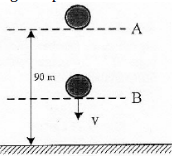
Masa de la bola (m) = 2 kg
Aceleración debida a la gravedad (g) = 10 m /s²
Altura del punto A (h A ) = 90 metros
Se busca: Altura del punto B (h B )
solución:
Al llegar al punto B, la energía cinética de la bola en el punto B es igual a 2 veces la energía potencial gravitatoria en el punto B.
EK = 2 EP
½ mv² = 2 mgh B
½ v 2 = 2 gh B
v 2 = 2(2)(10) h B
v 2 = 40 h B
Velocidad (v) de la pelota cuando llega al punto B después de una caída libre desde el punto A:
v 2 = 2 gh = 2(10)(90–h B ) = 20(90–h B )
Sustituye v 2 en la ecuación anterior por v 2 en esta ecuación.
v 2 = 40 h B
20(90–h B ) = 40 h B
1800–20 h B = 40 h B
1800 = 40 h B + 20 h B
1800 = 60 h B
h B = 1800 / 60
h B = 30 metros
5. Se suelta una bola de 1 kg y se desliza desde el punto A hasta el punto C, como se muestra en la figura siguiente. Si la aceleración debida a la gravedad es de 10 m/ s² , ¿cuál es la energía cinética de la bola cuando llega al punto C?
Conocido :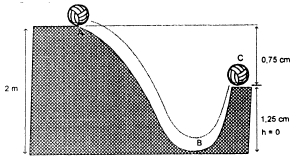
Masa de la bola (m) = 1 kg
Aceleración debida a la gravedad (g) = 10 m/ s²
El cambio de altura (h) = 0.75 m
La energía potencial inicial (PE o ) = mgh = (1)(10)(0.75) = 7.5 julios
Energía cinética inicial (KE o ) = ½ mv o 2 = ½ m (0) 2 = 0
La energía potencial gravitatoria final (PE t ) = mgh = mg (0) = 0
Se busca: Energía cinética de la bola en el punto C
solución:
La energía mecánica inicial (ME o ) = La energía mecánica final (ME t )
La energía potencial gravitatoria inicial (PE o ) + la energía cinética inicial (KE o ) = La energía potencial gravitatoria final (PE t ) + la energía cinética final (KE t )
7.5 julios + 0 = 0 + KE t
7.5 Julios = KE t
Energía cinética de la bola en el punto C = 7.5 julios.
6. Se suelta una bola de 2 kg desde el punto A, como se muestra en la figura siguiente. El plano curvo es liso. Si la aceleración debida a la gravedad es de 10 m/ s² , ¿cuál es la energía cinética de la bola en el punto B?
Conocido :
Masa de la bola (m) = 2 kg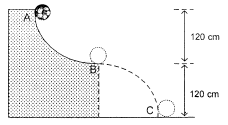
Aceleración debida a la gravedad (g) = 10 m/ s²
El cambio de altura (h) = 120 cm = 1.2 metros
La energía potencial gravitatoria inicial (PE o ) = mgh = (2)(10)(1.2) = 24 Julios
La energía cinética inicial (KE o ) = ½ mv o 2 = ½ m (0) 2 = 0
La energía potencial gravitatoria final (PE t ) = mgh = mg (0) = 0
Se busca: Energía cinética de la bola en el punto B
solución:
La energía mecánica en el punto A (energía mecánica inicial) = la energía mecánica en el punto B (energía mecánica final)
La energía mecánica inicial (ME o ) = la energía mecánica final (ME t )
La energía potencial gravitatoria inicial (PE o ) + la energía cinética inicial (KE o ) = la energía potencial gravitatoria final (PE t ) + la energía cinética final (KE t )
24 julios + 0 = 0 + KE t
24 Julios = KE t
Energía cinética (EC) de la bola en el punto C = 24 julios.
7. Un objeto tiene una energía mecánica fija, una energía cinética mayor y una energía potencial gravitatoria menor. El objeto es…
A. En reposo
B. moverse hacia arriba
C. moverse hacia abajo
D. Acelerado hacia arriba
solución:
La energía cinética aumenta, lo que significa que la velocidad del objeto aumenta, y la energía potencial gravitatoria disminuye, lo que significa que la altura del objeto con respecto a la superficie del suelo disminuye. Esto ocurre cuando el objeto se mueve desde cierta altura hasta el suelo.
La relación entre velocidad y energía cinética se muestra mediante la fórmula de la energía cinética:
KE = ½ mv²
Descripción de la fórmula: KE = energía cinética, m = masa, v = velocidad
La relación entre la altura y la energía potencial gravitatoria se representa mediante la fórmula de la energía potencial gravitatoria:
PE = mgh
Descripción de la fórmula: PE = energía potencial gravitatoria, m = masa, g = aceleración de la gravedad, h = altura
La respuesta correcta es c.
- ¿Qué es la energía mecánica?
- Respuesta La energía mecánica es la suma de la energía cinética y la energía potencial de un objeto. La energía cinética se relaciona con el movimiento del objeto, mientras que la energía potencial se relaciona con su posición o configuración.
- ¿Qué establece el principio de conservación de la energía mecánica?
- Respuesta El principio establece que, en un sistema aislado donde solo actúan fuerzas conservativas, la energía mecánica total permanece constante. Esto significa que la suma de la energía cinética y potencial no cambia con el tiempo.
- ¿Cómo afectan las fuerzas conservativas y no conservativas a la conservación de la energía mecánica?
- Respuesta Las fuerzas conservativas, como la gravedad, no alteran la energía mecánica total de un sistema. Pueden convertir la energía potencial en energía cinética o viceversa, pero la suma permanece constante. Las fuerzas no conservativas, como la fricción, pueden disipar energía mecánica, transformándola generalmente en energía térmica.
- ¿Por qué no se conserva la energía mecánica en situaciones reales donde hay fricción?
- Respuesta La fricción es una fuerza no conservativa. A medida que los objetos se mueven uno hacia el otro, la fricción convierte parte de la energía mecánica del sistema en energía térmica, lo que provoca una disminución de la energía mecánica total del sistema.
- ¿Cómo se demuestra la conservación de la energía mecánica en un péndulo oscilante?
- Respuesta En ausencia de resistencia del aire (una fuerza no conservativa), a medida que el péndulo oscila hacia arriba, su energía cinética se convierte en energía potencial gravitatoria. En el punto más alto de su oscilación, posee la máxima energía potencial y la mínima energía cinética. Al descender, esta energía potencial se transforma nuevamente en energía cinética. La energía mecánica total permanece constante, aunque las formas de energía se intercambien.
- ¿Por qué una pelota que rebota acaba deteniéndose incluso en ausencia de fuerzas externas?
- Respuesta Cuando una pelota rebota, no toda su energía cinética se convierte de nuevo en energía potencial. Parte de la energía se pierde, a menudo en forma de sonido o deformación de la pelota, y especialmente debido a la fricción interna del material. Estas son fuerzas no conservativas que actúan y que reducen la energía mecánica de la pelota con cada rebote hasta que se detiene.
- En una montaña rusa, ¿dónde se encuentra la energía mecánica máxima y mínima?
- Respuesta La energía mecánica total de la montaña rusa permanece constante si despreciamos la resistencia del aire y la fricción. Sin embargo, en el punto más alto, la energía potencial es máxima y la energía cinética mínima. A medida que desciende, la energía potencial se transforma en energía cinética, por lo que en el punto más bajo, la energía cinética es máxima y la energía potencial mínima.
- ¿Cómo ayuda la conservación de la energía mecánica a comprender las órbitas planetarias?
- Respuesta Los planetas que orbitan una estrella como el Sol poseen energía cinética (debido a su movimiento) y energía potencial gravitatoria (debido a su posición con respecto al Sol). A medida que un planeta se acerca al Sol, acelera, aumentando su energía cinética mientras que su energía potencial gravitatoria disminuye, y viceversa. La energía mecánica total del planeta permanece constante en el tiempo, suponiendo que otras fuerzas (como las de otros planetas) sean despreciables.
- ¿Por qué un satélite en órbita estable no cae sobre la Tierra?
- Respuesta Si bien el satélite es atraído hacia la Tierra por la gravedad, su energía cinética de avance lo mantiene en movimiento dentro de su órbita. El equilibrio entre esta energía cinética y la energía potencial gravitatoria mantiene al satélite en una órbita estable con energía mecánica constante.
- Si una esquiadora parte del reposo en la cima de una colina sin fricción y luego esquía cuesta abajo, ¿cómo se comparará su velocidad al llegar abajo con la que tendría si hubiera comenzado a mitad de la colina?
- Respuesta En una pendiente sin fricción, la energía mecánica total de la esquiadora se conserva. Si comienza desde la cima, tendrá más energía potencial que si comienza a mitad de la pendiente. Esta energía potencial se convertirá completamente en energía cinética durante el descenso. Por lo tanto, llegará más rápido abajo si comienza desde la cima que si comienza a mitad de la pendiente.
