1. 200-grama pilko, A, moviĝanta kun rapido de 10 m/s, trafas 200-graman pilkon, B, en ripozo. Kio estas la rapido de pilko A kaj pilko B post la kolizio?
Konata:
Maso de pilko A (m² A ) = 200 gramoj = 0.2 kg
Maso de pilko B (m² B ) = 200 gramoj = 0.2 kg
Rapido de pilko A antaŭ kolizio (v A ) = 10 m/s
Rapido de pilko B antaŭ kolizio (v B ) = 0
Dezirata: rapido de pilko A (v A ') kaj rapido de pilko B (v B ') post kolizio
Solvo:
v A ' = v B = 0
v B ' = v A = 10 m/s
[irp]
2. Du objektoj kun egalaj masoj alproksimiĝas unu al la alia, kolizias kaj poste resaltas. La rapido de maso A antaŭ la kolizio estas 8 m/s kaj la rapido de maso B antaŭ la kolizio estas 12 m/s. Kio estas la grando kaj direkto de la rapido de maso A kaj maso B post la kolizio!
Konata:
Maso A (m² A ) = m²
Maso B (m² B ) = m²
Rapido de maso A antaŭ kolizio (v A ) = -8 m/s
Rapido de maso B antaŭ kolizio (v B ) = 12 m/s
La plus- kaj minus-signoj indikas, ke la objektoj moviĝas en la kontraŭa direkto.
Dezirata: la grando kaj direkto de la rapido de maso A (v A ') kaj maso B (v B ') post kolizio
Solvo:
En perfekte elasta kolizio, se la objektoj havas egalan mason, tiam la rapido de A post la kolizio (v A ') = la rapido de B antaŭ la kolizio (v B ) kaj la rapido de B post la kolizio (v B ') = la rapido de A antaŭ la kolizio (v A ).
Se antaŭ la kolizio, A moviĝas dekstren kaj B moviĝas maldekstren, tiam, post la kolizio, A moviĝas maldekstren kaj B moviĝas dekstren.
La objektoj havas egalan mason kaj la kolizio estas perfekte elasta, do ambaŭ objektoj interŝanĝis rapidon.
v A ' = -v B = -12 m/s
v B ' = v A = 8 m/s
La plus- kaj minus-signoj indikas, ke la objektoj moviĝas en la kontraŭa direkto.
[irp]
3. 2-kg-peza objekto, A, moviĝanta kun rapideco de 10 m/s, trafas 4-kg-pezan pilkon, B, moviĝantan kun rapideco de 20 m/s. Se la kolizio estas perfekte elasta, kio estas la rapideco de objekto A kaj objekto B post la kolizio?
Konata:
Maso A (m² A ) = 2 kg
Maso B (m² B ) = 4 kg
Rapido de objekto A antaŭ kolizio (v A ) = 10 m/s
Rapido de objekto B antaŭ kolizio (v B ) = 20 m/s
Dezirata : la rapido de objekto A (v A ') kaj la rapido de objekto B (v B ') post kolizio
Solvo :
En perfekte elasta kolizio , se la objektoj havas egalan mason kaj alproksimiĝas unu al la alia, la rapido de la objekto post la kolizio estas kalkulata per ĉi tiu formulo:
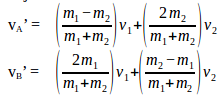
Rapido de objekto A post kolizio:

[irp]
4. Objekto de 100 gramoj, moviĝanta je 20 m/s, kolizias kontraŭ muro perfekte elaste. Kio estas la grando kaj direkto de la rapido de la objekto post la kolizio?
Konata:
Maso (mA ) = 100 gramoj = 0.1 kg
Maso de muro (m² B ) = senfineco
La rapido de maso antaŭ kolizio (v A ) = 20 m/s
La rapido de maso post kolizio (v B ) = 0
Dezirata : la grando kaj direkto de rapido post kolizio
Solvo:
Se v B = 0, m A tre malgranda kaj m² tre granda, tiam v A ' = -v A kaj v² ' = 0.
La plus- kaj minus-signoj indikas, ke la objektoj moviĝas en la kontraŭa direkto.
5. Du pilkoj, A kun maso de 2 kg kaj pilko B kun maso de 5 kg, antaŭ kaj post la kolizio estas montritaj en la suba figuro. Se la kolizio estas perfekte elasta, kio estas la rapido de pilko A antaŭ la kolizio?
Konata:
Maso de pilko A (mA) = 2 kg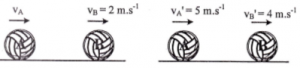
Maso de pilko B (m² B ) = 5 kg
Rapido de pilko B antaŭ kolizio (v B ) = 2 m/s
Rapido de pilko A post kolizio (v A ') = 5 m/s
Rapido de pilko B post kolizio (v B ') = 4 m/s
Ambaŭ pilkoj moviĝas dekstren, do ilia rapido estas pozitiva.
Dezirata: Rapido de pilko A antaŭ kolizio (v A )
Solvo:
mA vA +mB vB = mA vA' + mB vB'
2(v A ) + (5)(2) = (2)(5) + (5)(4)
2(v A ) + 10 = 10 + 20
2(v A ) + 10 = 30
2(v A ) = 30 – 10
2(v A ) = 20
v A = 20/2
v A = 10 m/s
[irp]
6. Objektoj A kaj B vojaĝas laŭ horizontala ebeno, kiel montrite en la suba figuro. Se la kolizio estas perfekte elasta kaj la rapido de objekto B post la kolizio estas 15 m/s⁻¹ , kio estas la rapido de objekto A post la kolizio?
Konata:
Maso de objekto A (mA) = 5 kg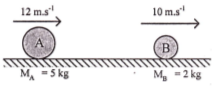
Maso de objekto B (m² B ) = 2 kg
Rapido de objekto A antaŭ kolizio (v A ) = 12 m/s
Rapido de objekto B antaŭ kolizio (v B ) = 10 m/s
Rapido de objekto B post kolizio (v B ') = 15 m/s
Ambaŭ objektoj, antaŭ kaj post la kolizio, moviĝas dekstren do ilia rapido havas pozitivan signon.
Dezirata: Rapido de objekto A post kolizio (v A ')
Solvo:
mA vA +mB vB = mA vA' + mB vB'
(5)(12) + (2)(10) = (5)v A ' + (2)(15)
60 + 20 = (5)v A ' + 30
80 = (5)v A ' + 30
80 – 30 = (5)v A '
50 = (5)v A '
v A ' = 50/5
v A ' = 10 m/s
[wpdm_pakaĵo id='1156′]
- Problemoj kaj solvoj de lineara impeto
- Problemoj kaj solvoj pri impeto kaj impulso
- Perfekte elastaj kolizioj en unudimensiaj problemoj kaj solvoj
- Perfekte malelastaj kolizioj en unudimensiaj problemoj kaj solvoj
- Problemoj kaj solvoj pri malelastaj kolizioj en unudimensioj
