Vektor – masalah sareng solusi
Vector and Scalar
1. Among the following options, which are scalar-vector pairs…
A. Force – acceleration
B. tekenan – force
C. kapindahan – speed
D. Electric current – pressure
Solusi:
Force = vector, acceleration = vektor
Pressure = scalar, force = vector
Displacement = vector, speed = scalar
Listrik ayeuna = scalar, pressure = scalar
Jawaban anu leres nyaéta B.
2.
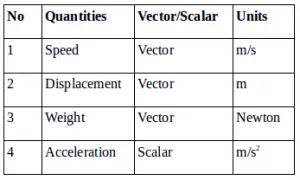
The correct answer is shown by number…
A. 1 and 4
B. 1 and 2
C. 2 and 3
D. 3 and 4
Solusi:
Speed = scalar
Displacement = vector
beurat = vector
Acceleration = vector
Jawaban anu bener nyaéta C.
Components of vectors
3. Two vectors, F1 = 20 N sareng F2 = 30 N, have direction as shown in the figure below. Determine the resultant of components of vectors in x-axis and y-axis.
A. 5√3 N and -25 N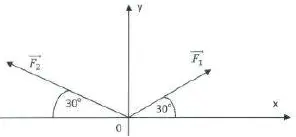
B. -5√3 N and 25 N
C. 25 N and 5√3 N
D. 30 N and 25√3 N
Dipikanyaho:
F1 = 20 Newton
Angle between F1 jeung sumbu x = 30o
F2 = 30 Newton
Angle between F2 and x axis =30o
Dipilari: Fx sareng Fy
Solusi:
F1x =F1 éta 30o = (20)(0.5√3) = 10√3 Newton (plus sign because points to +x axis)
F1y =F1 dosa 30o = (20)(0.5) = 10 Newton (plus sign because point to +y axis)
F2x =F2 éta 30o = (30)(0.5√3) = -15√3 Newton (minus sign because points to -x axis)
F2y =F2 dosa 30o = (30)(0.5) = 15 Newton (plus sign because points to +y axis)
The resultant of the x component :
Fx =F1x + F2x = 10√3 N – 15√3 N = -5√3 Newton
The resultant of the y component :
Fy =F1y + F2y = 10 N + 15 N = 25 Newton
Jawaban anu leres nyaéta B.
The resultant of two vectors
4. Two children A and B push a block, if A push the block southward with force of 400 N and at the same time B push the block eastward with force of 300 N, then determine the resultant of force A and B.
A. 100 N southward
B. 100 N eastward
C. 500 N southeastward
D. 700 N southeastward
Dipikanyaho:
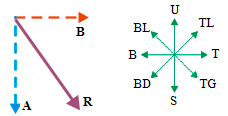 U = north, T = east, S = south, B = west
TL = northeast, TG = southeast, BD = southwest, BL = northwest
A = 400 Newton southward
B = 300 Newton eastward
miharep: magnitude and direction of net force (R)
Solusi:
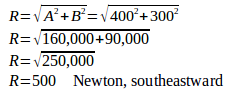
Jawaban anu bener nyaéta C.
The resultant of the vector of displacement
5. Someone riding a motorcycle from home 6 km to north then 8 km to east. Determine the final position of the person from the initial position.
A. 14 km northeast
B. 14 km southwest
C. 10 km northeast
D. 10 km northwest
Dipikanyaho:
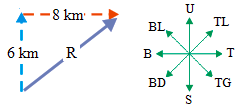
miharep: magnitude and direction of the resultant of displacement
Solusi:
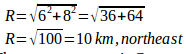
Jawaban anu bener nyaéta C.
6.
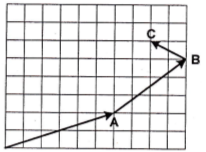
Based on the figure above, If 1 square represents 1 km, then what is the total displacement.
Solusi:
Distance = A + B + C = 6 + 6 + 2 = 14 km
Displacement = R = 12 km
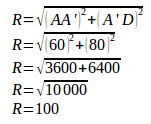
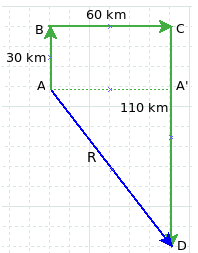
7. A car travels from A to B along 30 km north, then 60 km east, then 110 km south. Determine the displacement of the car from A to D.
Solusi:
AA' = 60 km
A'D = 110 km – 30 km = 80 km
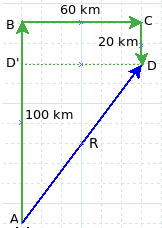
8. A car travels from town A to town B 100 km north, then to town C 60 km east, and then to town D 20 km south. Determine the displacement of the car.
Solusi:
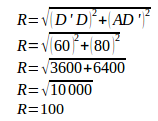
D'D = 60 km
AD' = 100 km – 20 km = 80 km
- What is a vector?
- Jawab: A vector is a quantity that has both magnitude (size) and direction. Examples include velocity, force, and acceleration.
- How does a vector differ from a scalar?
- Jawab: A scalar has only magnitude, while a vector has both magnitude and direction. For instance, temperature is a scalar because it has a value but no direction, whereas velocity is a vector because it indicates speed (magnitude) in a particular direction.
- How can a vector be represented graphically?
- Jawab: A vector can be represented graphically by an arrow. The length of the arrow represents the magnitude of the vector, and the direction of the arrow indicates the direction of the vector.
- What is the significance of the tail and head of a vector?
- Jawab: The tail is the starting point of the vector, and the head (or tip) is the endpoint. When performing operations like vector addition, the tail of one vector is placed at the head of the other.
- How are vectors added together?
- Jawab: Vectors are added using the head-to-tail method. The tail of the second vector is placed at the head of the first. The resultant vector is then drawn from the tail of the first vector to the head of the second vector.
- What is the difference between a unit vector and a null vector?
- Jawab: A unit vector has a magnitude of one and points in a specified direction. It’s used to represent the direction of a vector without regard to its magnitude. A null (or zero) vector has no magnitude and no specific direction.
- How can a vector be multiplied by a scalar?
- Jawab: Multiplying a vector by a scalar changes its magnitude but not its direction. If the scalar is positive, the direction remains the same; if negative, the direction is reversed.
- What does it mean for two vectors to be orthogonal or perpendicular?
- Jawab: Two vectors are orthogonal or perpendicular if the angle between them is 90 degrees. Their dot product will be zero.
- How is the resultant of two vectors determined?
- Jawab: The resultant is the sum of the two vectors. Graphically, when the vectors are represented as arrows, you can find the resultant by placing the tail of the second vector at the head of the first and drawing a new arrow (the resultant) from the tail of the first vector to the head of the second.
- If a vector points due east with a magnitude of 10 units, how would you describe its opposite?
- Jawab: The opposite of this vector would have the same magnitude (10 units) but would point in the opposite direction, i.e., due west.

