Artikel ngeunaan Énergi listrik anu disimpen dina kapasitor
nu kapasitor diwangun ku pelat dua konduktor sareng, di antara dua konduktor éta, aya dielektrik. Mimitina, dua konduktor éta nétral sacara listrik. Supados kapasitor tiasa fungsina, unggal pelat atanapi lambaran konduktor kedah dicas sacara listrik, dimana jumlah muatan listrik dina unggal konduktor sami tapi béda jinisna. Anggap yén salah sahiji konduktor anu dicas nyaéta Q = +10 Coulomb, konduktor anu sanésna nyaéta Q = -10 Coulomb. Ayana muatan listrik anu sami ageung tapi sabalikna dina dua konduktor ngahasilkeun medan listrik antara dua pelat konduktor, dimana arah medan listrik nyaéta ti muatan positif ka muatan négatif. Salian ti éta, aya ogé béda poténsial listrik antara dua konduktor, dimana konduktor anu muatanna positif gaduh poténsial listrik anu langkung luhur sedengkeun konduktor anu muatanna négatif gaduh poténsial listrik anu langkung handap.
In order for both conductors to be electrically charged, the two conductors are connected to a power source, such as a battery or other power source. At first, the two conductors are neutral, where the number of negatively charged electrons and positively charged protons is equal. Then the electrons are transferred from a conductor to another conductor so that the conductor that loses the electron becomes positively charged and the conductor that receives the electron becomes negatively charged. The number of electrons transferred is equal to the number of electrons received so that each conductor has the same electrical charge. Note that when the capacitor is connected to the battery, the battery acts to move electrons from one conductor to another.
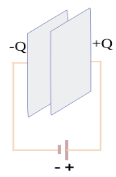 One of the conductors is connected to the negative pole and the other conductor is connected to the positive pole. The existence of an electric potential difference (V) between the two battery poles causes the movement of electrons (q) from one conductor to another. The movement of electrons stops after the potential difference between the two conductors equals the battery potential difference. At first, when the conductor is not electrically charged, no work is needed to move electrons. After there is an electric charge on each conductor, it takes does work to move electrons. The greater the electric charge in each conductor, the greater the work to move electrons because of the repulsion force between electrons.
The movement of electrons from one conductor to another does not occur simultaneously but gradually so that the electric voltage between the two conductors also increases gradually. So to calculate the total work (W) during an electric transfer, the average voltage value (V/2) is used. So, the work done to move electrons is W = Q (V/2) = 1/2 Q V.
Because the work to move electrons changes the electric potential energy stored in the capacitor, the electric potential energy stored in the capacitor is PE = 1/2 Q V.
Since Q = CV, the formula PE = 1/2 QV can be converted to PE = 1/2 QV = 1/2 (CV) (V) = 1/2 C V2 and PE = 1/2 QV = 1/2 (Q) (Q/C) = 1/2 Q2 / C. Where Q = electric charge, C = capacitance, V = electrical voltage.
Electrical energy in the electric field
During the charge filing process, when each conductor starts to be electrically charged, between the two plates or sheets, an electric field arises. So, the work is done, in addition to making the conductor electrically charged, also indirectly presents an electric field between the two plates or sheets of conductors. Because work changes to the electric potential energy stored in the capacitor, it can be considered that energy is stored in an electric field.
The following formula proves mathematically the relationship between the electric potential energy and the electric field.
In the article about the parallel plate capacitor, the formula C = A εo / d has been derived and the article about the electric potential has been stated the formula V = E d. Previously, the formula has been derived from the electric potential energy stored in the capacitor, PE = 1/2 C V2.
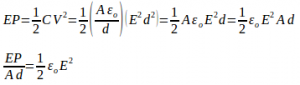
PE = the electric potential energy, A = surface area, d = distance, A d = volume, E = electric field, PE / A d = electrical potential energy per unit volume = energy density.
The above formula states that the electric potential energy per unit volume of space in an electric field is proportional to the square of the electric field. If between the two plates or sheets of the conductor there is a dielectric, then εo (permittivity of the vacuum) is replaced by the permittivity of the material (ε). Although this equation of the energy density is derived using the equation of the parallel plates capacitor, this equation also applies to all spaces that have an electric field.

