Circuiti elettrici con resistori in parallelo e resistenza interna: problemi e soluzioni
1. In base alla figura sottostante, se la sorgente di forza elettromotrice (f.e.m.) è di 24 Volt, determinare la corrente elettrica I.
Conosciuto :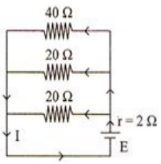
Sorgente di forza elettromotrice = 24 Volt
Resistenza interna (r) = 2 Ohm
Resistenze da 40 Ohm, 20 Ohm e 20 Ohm.
Cercasi : corrente elettrica I
soluzione:
Resistori collegati in parallelo, la resistenza equivalente è:
1/R = 1/40 + 1/20 + 1/20
1/R = 1/40 + 2/40 + 2/40
1/R = 5/40
R = 40/5
R = 8 Ohm
Tensione ai terminali:
V = f.e.m. – I r
V = 24 – I 2
Corrente elettrica I :
V = IR
24 – I 2 = I 8
24 = I 8 + I 2
24 = I (10)
I = 24/10
I = 2.4 Ampere
[irp]
2. In base alla figura sottostante, se R 1 = 3 Ω, R 2 = 4 Ω, R 3 = 4 Ω e la corrente elettrica è di 0.5 A, determinare la tensione elettrica.
Conosciuto :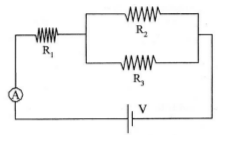
Corrente elettrica (I) = 0.5 Ampere
Resistenza R 1 = 3 Ohm
Resistenza R 2 = 4 Ohm
Resistenza R 3 = 4 Ohm
Cercasi: Tensione elettrica (V)
soluzione:
Calcola la resistenza equivalente:
R 2 e R 3 sono collegati in parallelo. La resistenza equivalente è:
1 /R 23 = 1/R 2 + 1/R 3 = 1/4 + 1/4 = 2/4
R 23 = 4/2 = 2 Ohm
R1 e R23 sono collegati in serie. La resistenza equivalente è :
R = R 1 + R 23 = 3 + 2 = 5 Ohm
Tensione elettrica:
V = IR = (0.5)(5) = 2.5 Volt
[irp]
