Definizio-formula eta uhin mekanikoen motei buruzko artikuluak
UHIN MEKANIKOEN DEFINIZIOA
Sokaren mutur bat heldu eta gora eta behera bibratzen baduzu, sokan zehar hedatzen den uhin bat agertzen da. Edo harri bat uretara botatzen baduzu, uhinak agertuko dira uraren gainazalean. Soka eta ura gora eta behera bakarrik oszilatzen dira, ez dira horizontalki mugitzen. Soka bateko uhinak eta uretan dauden uhinak uhin mekanikoen adibideak dira.
Uhin mekanikoak ingurune batean zehar bidaiatzen duten uhinak dira. Uhin mekanikoen adibideak hauek dira: soka edo harietan hedatzen diren uhinak, uretan hedatzen diren uhinak, airean hedatzen diren soinu-uhinak eta lurzoruan hedatzen diren lurrikara-uhinak. Uhinek distantzia luzeak egin ditzakete, uhinak bibratzen dituzten ingurunea oreka-puntuaren inguruan dagoen bitartean.
UHIN MEKANIKOEN MOTAK
Beren formaren arabera, uhin mekanikoak bi motatakoak dira, zeharkako uhinak eta luzetarako uhinak.
Zeharkako uhinak uhinen mugimenduaren norabidea partikulen mugimenduaren norabidearekiko perpendikularra denean gertatzen diren uhinak dira. Adibidez, uhinak soka batean, uhinak uretan.
Sokako uhinak norabide horizontalean mugitzen badira, sokako partikulak norabide bertikalean mugitzen dira. Era berean, ur-uhinak norabide horizontalean mugitzen badira, ur-partikulak norabide bertikalean mugitzen dira.
Uhin longitudinalak uhinen mugimenduaren norabidea partikulen mugimenduaren norabidearekiko paraleloa denean sortzen diren uhinak dira. Adibidez, malgukietako uhinak eta aireko soinu-uhinak.
Malgukiko uhina norabide horizontalean mugitzen bada, malgukian sortzen den dentsitatea eta tentsioa ere aurrera eta atzera mugitzen dira norabide horizontalean.
Era berean, soinu-uhina bertikalki mugitzen bada, airea uzkurtu eta luzatu egiten da bertikalki.
Lurrikara-uhinak zeharkako uhinez (zizaila-uhinak deiturikoak) eta luzetarako uhinez (presio-uhinak deiturikoak) osatuta daude.
UHIN MEKANIKOEN FORMULA
Zeharkako uhinen formula
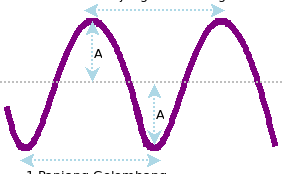
Hainbat magnitude erabiltzen dira uhinak deskribatzeko, hain zuzen ere, Anplitudea (A), Maiztasuna (f), Periodoa (T) eta Uhinaren abiadura (v).
Anplitudea desbideratze maximoa da. Periodoa espazioko puntu beretik igarotzen diren bi uhin-gandor/haran jarraien denbora-tartea da. Maiztasuna denbora-unitateko puntu beretik igarotzen diren gailur/haran kopurua da.
Uhin mekanikoak abiadura jakin batean mugitzen dira. Uhinaren abiaduraren formula hau da:
v = λ f = λ/T
v = uhin-abiadura, λ = uhin-luzera, f = maiztasuna, T = periodoa.
Uhin-luzeraren nazioarteko unitatea metroa da, maiztasunarena hertza eta periodoarena segundoak. Uhin-abiaduraren unitatea metro/segundoa da.
Arazoaren adibidea:
Soka bateko zeharkako uhin batek 2 Hz-ko maiztasuna du (2 uhin-gandor espazioko puntu beretik igarotzen dira, segundo 1ez) eta 3 metroko uhin-luzera du (bi gandor hurbilenen arteko distantzia 2 metrokoa da). Zein da uhinaren abiadura?
Ezagunak:
Maiztasuna (f) = 2 Hz
Uhin-luzera (λ) = 3 metro
Bilatzen dena: Abiadura (b)
Irtenbidea:
v = λ f = 3 (2) = 6 m/s
Ingurune batean zeharkako uhin baten abiadura igarotzen den ingurunearen izaeraren araberakoa da. Adibidez, soka bateko uhinaren abiadura (soka, haria, alanbrea) hariaren tentsioaren (FT) eta hariaren masa-dentsitatearen (hariaren masa unitateko) araberakoa da.

Arazoaren adibidea:
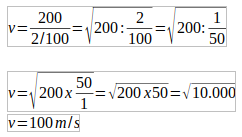
Uhin batek metro 1eko luzera du eta 100 metroko luzera eta 2 kg-ko masa duen soka batean hedatzen da. Sokaren tentsioa 200 N-koa da. Zein da uhinen abiadura sokan?
Ezagunak:
Uhin-luzera (λ) = 1 metro
Sokaren luzera (L) = 100 metro
Sokaren masa (m) = 2 kg
Sokaren tentsioa (T) = 200 N
Bilatzen dena: Soka batean uhinen abiadura (v)
Irtenbidea:
Uhin longitudinalaren formula
Ingurune batean luzetarako uhinen abiadura igarotzen den ingurunearen izaeraren araberakoa da. Barra solidoetan hedatzen diren luzetarako uhinen abiadura formula hau erabiliz kalkulatzen da:

v = uhin-abiadura, E = Young-en elastikotasun-modulua, ρ = dentsitatea
Arazoaren adibidea:
Kalkulatu altzairuzko errailean zehar bidaiatzen duen soinu-uhinaren abiadura. Young Steel-en elastikotasun-modulua = 2 x 10 11 N/m 2 eta altzairuaren dentsitatea = 7.8 x 10 3 kg/m 3
Ezagunak:
Altzairuaren elastikotasun-modulua (E) = 2 x 10 11 N/m 2
Altzairuaren dentsitatea (ρ) = 7.8 x 10³ kg / m³
Bilatzen dena: Soinu-uhinen abiadura
Irtenbidea:

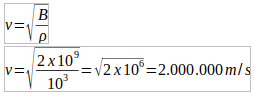
Likido eta gasetan hedatzen diren luzetarako uhinen abiadura formula hau erabiliz kalkulatzen da: v = uhin-abiadura, B = bolumen-modulua, ρ = dentsitatea
Arazoaren adibidea:
Zein da luzetarako uhinen abiadura uretan zehar hedatzen direnean?
Uraren modulua (B) = 2 x 10⁹ N / m2
Uraren dentsitatea (ρ) = 1000 kg/ m³
Irtenbidea:
Uhin longitudinalaren abiadura uretan hedatzean: