Articulu nantu à e Resistenze in serie
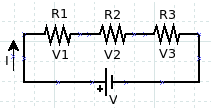
Sè e resistenze sò cunnesse cum'è mostratu in a figura, e resistenze sò disposte in serie. A resistenza o a resistenza elettrica in quistione pò esse in forma di cumpunenti di resistenza, luci o altre resistenze elettriche.
A carica elettrica si move attraversu a resistenza 1 (R1) = u carica elettrica si move attraversu a resistenza 2 (R2) = a carica elettrica si move à traversu a resistenza 3 (R3). Corrente elettrica (I) hè una carica elettrica chì scorre durante un certu intervallu di tempu (I = Q / t), dunque a corrente elettrica attraversu a resistenza 1 (I1) = corrente elettrica attraversu a resistenza 2 (I2) = corrente elettrica attraversu a resistenza 3 (I3Matematicamente, a corrente elettrica tutale (I) = I1 = Eiu2 = Eiu3.
À u cuntrariu, a tensione elettrica (V) diminuisce quandu a carica elettrica si move per ogni resistenza. A tensione elettrica, chjamata ancu differenza di putenziale elettricu, hè un'energia putenziale elettricu per unità di carica elettrica. A tensione elettrica hè ridutta perchè l'elettricità hè aduprata in ogni resistenza elettrica. Cusì, a tensione elettrica tutale (V) hè uguale à a quantità di elettricità in ogni resistenza. Matematicamente, a tensione elettrica tutale (V) = V1 + v2 + v3V = IR dunque l'equazione di a tensione elettrica hè V = IR1 + IR2 + IR3A corrente elettrica chì scorre nantu à ogni resistenza hè uguale cusì chì sta equazione cambia in V = I (R1 + R2 + R3).
Basatu annantu à l'equazione sopra, si pò cunclude chì a resistenza elettrica tutale (R) o a resistenza equivalente di a resistenza elettrica
chì hè cunnessu in serie hè uguale à a somma di ogni resistenza elettrica, matematicamente R = R1 + R2 + R3S'ellu ci sò solu duie resistenze in serie, a resistenza equivalente (R) = R1 + R2Sè ci sò quattru resistenze in serie, a resistenza equivalente (R) = R1 + R2 + R3 + R4In listessu modu, s'ellu ci sò cinque o più resistenze chì sò cunnesse in serie.
Prublema di mostra 1:
Sè cunnisciutu, R1 = 2 Ω, R2 = 3 Ω è R3 = 4 Ω. Tutte e trè resistenze sò cunnesse in serie. Chì ghjè u valore di a resistenza equivalente? (Ω = Ohm ).
Vergogna à tè:
R = R1 + R2 + R3 = 2 + 3 + 4 = 9 Ω.
Stu risultatu indica chì a resistenza equivalente hè più grande di u valore di e resistenze cunnesse in serie.
Prublema di mostra 2:
Dui resistori R 1 = 50 Ω è 50 Ω sò cunnessi in serie è cunnessi à una batteria di 12 Volt. Determinate
(a) A resistenza equivalente
(b) Corrente elettrica attraversu ogni resistenza
Vergogna à tè:
(a) R = R 1 + R 2 = 50 Ω + 50 Ω = 100 Ω.
(b) I = V / R = 12 Volt / 100 Ω = 0.12 A
