熱力學—問題與解答

熱力學—問題與解答

熱力學第一定律

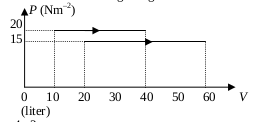
1. Based on graph P-V below, what is the ratio of the 工作 done by the gas in the process I, to the work done by the gas in the process II?

已知:Thermodynamics – problems and solutions 1

Process 1 :

壓力 (P) = 20 N/m2

初始體積(V)1) = 10 公升 = 10 分米3 = 10 × 10-3 m3

最終卷(V)2) = 40 公升 = 40 分米3 = 40 × 10-3 m3

Process 2 :

Process (P) = 15 N/m2

初始體積(V)1) = 20 公升 = 20 分米3 = 20 × 10-3 m3

最終卷(V)2) = 60 公升 = 60 分米3 = 60 × 10-3 m3

招募: The ratio of the work done by gas

解決方案:

The work done by gas in the process I :

W = P ΔV = P (V2-V1) = (20)(40-10)(10-3 m3) = (20)(30)(10-3 m3) = (600)(10-3 m3) = 0.6米3

The work done by gas in the process II :

W = P ΔV = P (V2-V1) = (15)(60-20)(10-3 m3) = (15)(40)(10-3 m3) = (600)(10-3 m3) = 0.6米3

The ratio of the work done by gas in the process I and the process II :

0.6平方米3 :永遠不會3

1:1

2.

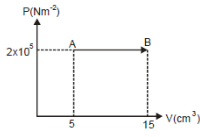
Based on the graph below, what is the work done by helium gas in the process AB?

Thermodynamics – problems and solutions 2已知:

Pressure (P) = 2 x 10⁵ N /米2 = 2 × 10⁵ 帕斯卡爾

初始體積(V)1)= 5厘米3 = 5 × 10⁻⁶ m3

最終卷(V)2)= 15厘米3 = 15 × 10-6 m3

招募: Work done by gas in process AB

解決方案:

W = ∆P ∆V

W = P (V2 - V.1)

W = (2 x 10⁵(15 x 10)-6 - 5 x 10⁻⁶)

W = (2 x 10⁵(10 x 10)-6) = (2 x 10⁵(1 x 10)-5)

瓦特 = 2 焦耳

3.

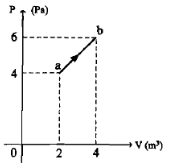
Based on the graph below, what is the work done in process a-b?

Thermodynamics – problems and solutions 3已知:

初始壓力(P)1) = 4 Pa = 4 N/m2

最終壓力(P)2) = 6 Pa = 6 N/m2

初始體積(V)1) = 2米3

最終卷(V)2) = 4米3

招募: work done I process a-b

解決方案:

Work done by gas = area under curve a-b

W = area of triangle + area of rectangle

W = ½ (6-4)(4-2) + 4(4-2)

W = ½ (2)(2) + 4(2)

W = 2 + 8

瓦特 = 10 焦耳

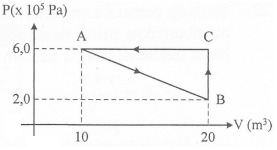
4. Based on graph below, what is the work done in process A-B-C-A.

解決方案:

Thermodynamics – problems and solutions 4Work (W) = Area of the triangle A-B-C

也可以看看  放射性—問題與解決方案

W = ½ (20-10)(6 x 10⁵ - 2 x 10⁵)

W = ½ (10)(4 x 10⁵)

W = (5)(4 x 10⁵)

W = 20 x 105

W = 2 x 10⁶ 焦耳

熱機

5. An engine absorbs 2000 Joule of heat at a high temperature and exhausted 1200 Joule of heat at a low temperature. What is the efficiency of the engine?

已知:

熱輸入(Q)H) = 2000 焦耳

熱輸出(Q)L) = 1200 焦耳

Work done by engine (W) = 2000 – 1200 = 800 Joule

招募: efficiency (e)

解決方案:

e = W / QH

e = 800/2000

e = 0.4 x 100%

e = 40%

Carnot engine

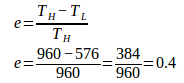
6. An engine absorbs heat at 960 Kelvin and the engine discharges heat at 576 Kelvin. What is the efficiency of the engine.

已知:

高溫(TH) = 960 K

Low temperature (TL) = 576 K

通緝: efficiency (e)

解決方案:

Thermodynamics – problems and solutions 5

Efficiency of Carnot engine = 0.4 x 100% = 40%

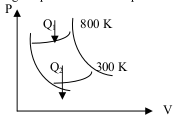
7. Based on the graph below, work done by the engine is 6000 Joule. What is the heat discharged by engine each circle?

已知:Thermodynamics – problems and solutions 6

功 (W) = 6000 焦耳

高溫(TH) = 800 Kelvin

Low temperature (TL) = 300 Kelvin

通緝: heat discharged by the engine

解決方案 :

Carnot (ideal) efficiency :

Thermodynamics – problems and solutions 7

Heat absorbed by Carnot engine :

W = e Q1

6000 = (0.625) Q1

Q1 = 6000/0.625

Q1 = 9600

Heat discharged by Carnot engine :

Q2 = Q.1 - W

Q2 = 9600 - 6000

Q2 = 3600 焦耳

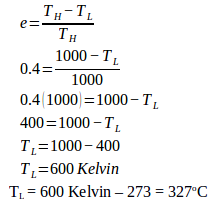
8. The efficiency of a Carnot engine is 40%. If heat absorbed at 727°C then what is the low temperature.

已知:

Efficiency (e) = 40% = 40/100 = 0.4

高溫(TH)= 727oC + 273 = 1000 K

招募: 低溫

解決方案:

Thermodynamics – problems and solutions 8

TL = 600 Kelvin – 273 = 327oC

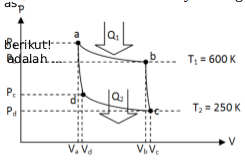
9. Based on graph below, if the engine absorbs 800 J of heat, what is the work done by the engine.

已知:Thermodynamics – problems and solutions 9

高溫(TH) = 600 Kelvin

Low temperature (TL) = 250 Kelvin

熱輸入(Q)1) = 800 焦耳

通緝: 工作 (W)

解決方案:

The efficiency of Carnot engine :

Thermodynamics – problems and solutions 10

Work was done by the engine :

W = e Q1

W = (7/12)(800 Joule)

瓦特 = 466.7 焦耳

10. The high temperature of a Carnot engine is 600 K. If the engine absorbs 600 J of heat and the low temperature is 400 K, what is the work done by the engine.

也可以看看  開普勒定律—問題與解決方案

已知:

Low temperature (TL) = 400 K

高溫(TH) = 600 K

熱輸入(Q)1) = 600 焦耳

通緝: Work was done by Carnot engine (W)

解決方案:

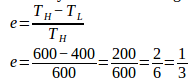
The efficiency of the Carnot engine :

Thermodynamics – problems and solutions 11

Work was done by Carnot engine :

W = e Q1

W = (1/3)(600) = 200 焦耳

  1. What is the primary focus of thermodynamics? 回答: Thermodynamics focuses on the study of energy, its transformations, and its relationship with matter, especially in systems at equilibrium.
  2. How is the zeroth law of thermodynamics related to temperature? 回答: The zeroth law states that if two systems are each in thermal equilibrium with a third system, then they are in thermal equilibrium with each other. This implies the existence of a property called temperature, which is the same for all systems in thermal equilibrium.
  3. What does the first law of thermodynamics describe? 回答: The first law, also known as the law of energy conservation, states that energy cannot be created or destroyed, only converted from one form to another. In a closed system, the change in internal energy is equal to the heat added to the system minus the work done by the system on its surroundings.
  4. Why is the second law of thermodynamics crucial for understanding the direction of natural processes? 回答: The second law states that the entropy (or disorder) of an isolated system always increases or remains constant. This dictates that energy spontaneously disperses if not hindered from doing so, providing a direction to natural processes and essentially explaining why certain processes occur spontaneously while others do not.
  5. What is entropy, and how does it relate to disorder in a system? 回答: Entropy is a measure of the amount of energy in a system that is unavailable to do work. It is also often described as a measure of the system’s disorder or randomness. In general, higher entropy corresponds to greater disorder or randomness.
  6. How does the third law of thermodynamics describe the entropy of a perfect crystal at absolute zero? 回答: The third law states that the entropy of a perfect crystal is exactly zero at absolute zero temperature (0 Kelvin). This means that at this temperature, the system is perfectly ordered.
  7. Why can’t heat flow from a colder body to a hotter body on its own? 回答: This behavior is a consequence of the second law of thermodynamics. If heat were to flow from a colder body to a hotter one spontaneously, it would lead to a decrease in the overall entropy of the system, which is not favored by natural processes.
  8. What is the difference between an isolated, closed, and open system in thermodynamics? 回答: An isolated system does not exchange energy or matter with its surroundings. A closed system can exchange energy but not matter with its surroundings. An open system can exchange both energy and matter with its surroundings.
  9. How is the concept of “work” in thermodynamics different from the everyday use of the term? 回答: In thermodynamics, “work” refers to the process of energy transfer where forces applied to an object move it in a direction parallel to the force. For example, when a gas expands against a piston, it does work on the piston. This is a more specific definition compared to the everyday use of “work,” which might simply mean any task or activity.
  10. What is a Carnot cycle, and why is it significant in thermodynamics? 回答: The Carnot cycle is an idealized thermodynamic cycle that provides an upper limit on the efficiency that any classical thermodynamic engine can achieve during the conversion of heat into work (or vice versa). It’s significant because it sets a fundamental efficiency limit based on the temperatures of the heat reservoirs between which an engine operates.