扩散

仔细观察,一开始可以看到燃烧产生的烟雾。过一段时间后,烟雾就看不见了。你用过香水吗?即使你在房间里喷洒香水,屋外的人也能闻到香味。如果妈妈在厨房做了美味可口的饭菜,邻居家也能闻到香味。这是为什么呢?

还有许多其他例子。如果你在一杯清水中滴入几滴墨水或食用色素,墨水或色素会均匀地扩散到水中。这是自动发生的。以上一些例子都是日常生活中常见的扩散现象。扩散是指物质从高浓度区域向低浓度区域移动的过程。浓度指的是单位体积内物质的分子数/摩尔数。高浓度区域是指单位体积内物质分子数量较多的区域。相反,低浓度区域是指单位体积内物质分子数量较少的区域。
了解更多

理想气体的内能

单原子理想气体中的能量

单原子理想气体的能量等于所有单原子理想气体分子平动动能的总和。理想气体分子平动动能的总和等于每个分子的平均平动动能与分子数 (N) 的乘积。数学表达式为:

了解更多

能量均分定理

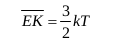
The energy equipartition theorem was derived theoretically by Clerk Maxwell using statistical mechanics. It is called a theorem because there is no proof through experimentation. The energy partition means equal distribution of energy.

Energy equipartition theory 1

KE = average translational kinetic energy of gas molecules (Joule)

k = Boltzmann’s constant = 1.38 x 10⁻²³ J / K

T = absolute temperature of the ideal gas molecule (Kelvin)

了解更多

气体的平均动能

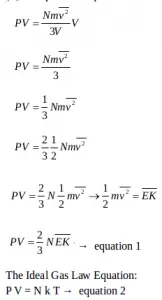
In addition to pressure, one of the quantities that states the macroscopic nature of gas is temperature (T). Gas pressure equation:

Average kinetic energy of gases 1

了解更多

气体动力学理论

kinetic theory states that every substance consists of atoms or molecules and that the atom or molecule moves continuously carelessly. This assumption of kinetic theory matches the situation and condition of the atom or molecule of the gas constituent. The force of attraction between the atoms or molecules making up the gas is feeble so that atoms or molecules can move freely.

了解更多

波义耳定律、查理定律、盖-吕萨克定律

Article Boyle’s law, Charles’s law, Gay-Lussac’s law

波义耳定律

Robert Boyle (1627-1691) conducted experiments to investigate the quantitative relationship between gas pressure and volume. This experiment is carried out by inserting a certain amount of gas into a closed container. Until a pretty good approach, he found that if the gas temperature was kept constant, then when the gas pressure increased, the gas volume was reduced. Likewise, when the gas pressure decreases, the gas volume increases. Gas pressure is inversely proportional to gas volume. This relationship is known as Boyle’s Law. Mathematically:

了解更多

理想气体定律

The gas laws of Boyle, Charles law and Gay-Lussac do not apply to all gas conditions, so our analysis becomes more difficult. Therefore, presented the ideal gas model. Ideal gas does not exist in everyday life; the ideal gas is the just perfect form to facilitate analysis. The existence of this ideal gas concept also really helps us in reviewing the relationship between the three laws of gas.

The relationship among temperature, volume, and gas pressure

By referring to the three gas laws above, we can derive a more general relationship between temperature, volume, and gas pressure.

了解更多

The specific statements of the second law of thermodynamics can’t describe for all irreversible processes, so we need a general statement. This general statement is expected to explain all irreversible processes occurring in the universe. The general statement of the second law of thermodynamics was formulated in the mid-nineteenth century, through a quantity called entropy (S). Entropy was first introduced by Clausius and was formulated from the Carnot cycle (perfect caloric engine). According to Clausius, entropy changes are experienced by a system, when the system gets additional heat (Q) at a constant temperature, which is represented by the equation:

了解更多

冷却机的性能系数

Article about Coefficient of performance of the cooling machine

A cooling machine is a machine that takes heat from a low-temperature place, then transfers it to a high-temperature area. For this process to happen, the machine must do the work because the heat naturally flows from high temperature to low temperature. This is by Clausius’s statement:

It is impossible for a cooling machine to transfer heat from a low-temperature place to a high-temperature place, without work (Second law of thermodynamics—Clausius statement).

The machine works (W) to transfer heat, from low temperature (QL) to high temperature (QH). Based on conservation of energy, QL + W = QH.

了解更多

卡诺热机和卡诺循环

To find out how to increase the efficiency of 热度 engine, a French scientist named Sadi Carnot (1796-1832) examined an ideal theoretical caloric machine in 1824. At that time, the first law of thermodynamics had not been formulated, nor the second law of thermodynamics. The first law has not been formulated because scientists do not yet know that heat is energy. After Joule and his colleagues experimented in the 1830s, scientists discovered heat is energy that moves due to temperature differences. So, the first law of thermodynamics was formulated after 1830. Sadi Carnot had been researching the theoretical ideal caloric engine in 1824. His research was actually to increase the efficiency of the steam engine. Most steam engines of that time were less efficient.

了解更多