Непружні зіткнення
The conservation of kinetic energy law is not applicable in inelastic collisions. The conservation of momentum law is applicable in inelastic collisions if only no external force acts on the two colliding objects. In an inelastic collision, two objects stick together or are attached to each other after the collision.
Example question 1.
Two objects are of the same mass, namely 1 kg. Object 1 moves on a flat plane at a speed of 10 m/s and collides with object two which is at rest. After the collision, the two objects stick together. What is the speed of the two objects after the collision?
Відомо:
m1 = 1 кг, м2 = 1 kg, v1 = 10 m/s, v2 = 0
Потрібні : v’
Рішення:
m1 v1 + m2 v2 = (M1 + m2) v'
(1 kg)(10 m/s) + 0 = (1 kg + 1 kg) v’
10 kg m/s = (2 kg) v’
v’ = 10 kg m/s : 2 kg = 5 m/s
Example question 2.

Three blocks move at 3 m.s-1 collide another block at rest.
Зіткнення непружне. Порядок block’s velocity after the collision, from the largest to the smallest is…
Рішення:
Figure 1 :
Final momentum = initial momentum
m1 v1 + m2 v2 = (M1 + m2) v
(4m)(3) + (m)(0) = (4m + m) v
12m + 0 = (5m) v
12m = 5m v
v = 12m / 5m = 12/5 = 2.4 m/s
Figure 2 :
Final momentum = Initial momentum
m1 v1 + m2 v2 = (M1 + m2) v
(m)(3) + (3m)(0) = (m + 3m) v
3m + 0 = (4m) v
3m = 4m v
v = 3m / 4m = 3/4 = 0.75 m/s
Figure 3 :
m1 v1 + m2 v2 = (M1 + m2) v
(m)(3) + (m)(0) = (m + m) v
3m + 0 = (2m) v
3m = 2m v
v = 3m / 2m = 3/2 = 1.5 m/s
Example question 3.
Two balls with mass of m1 = 2 кг та м2 = 1 kg are move in opposite direction with speed of v1 = 2 ms-1 і v2 = 4 ms-1 as shown in figure below. If a collision is inelastic, what is the speed of both balls after the collision?
Відомо:
Маса кулі 1 (м1) = 2 кг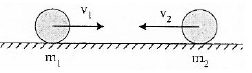
Маса кулі 2 (м2) = 1 кг
Velocity of ball 1 before collision (v1) = 2 м/с
Velocity of ball 2 before collision (v2) = -4 м/с
Plus and minus sign indicates that both balls move in opposite direction.
Потрібні : Velocity of balls after collision (v’)
Рішення:
m1 v1 + m2 v2 = (M1 + m2) v'
(2)(2) + (1)(-4) = (2 + 1) v'
4 – 4 = (3) v'
0 = (3) v’
v’ = 0
Example question 4.
Two objects, A and B, with a mass of each object, is 1.5-kg approach each other with speed of vA = 4 мс-1 і vB = 5 мс-1. If the collision is inelastic, what is the speed of both objects after the collision?
Відомо:
Маса об'єкта A (мA) = 1.5 кг
Маса об'єкта B (мB) = 1.5 кг
Velocity of object A before collision (vA) = 4 m/s (plus sign, to rightward)
Velocity of object B before collision (vB) = -5 m/s (minus sign, to leftward)
Розшукується: Швидкість обох об'єктів після зіткнення
Рішення:
Conservation of linear momentum :
mA vA + mB vB = (MA + mB) v'
(1.5)(4) + (1.5)(-5) = (1.5 +1.5) v’
6 – 7.5 = (3) v'
-1.5 = (3) v'
v' = -1.5 / 3
v' = -0.5 м/с
Minus sign indicates that both objects move to leftward.
20 conceptual questions and answers about inelastic collisions:
1. Питання: What defines an inelastic collision? Відповідь: In an inelastic collision, kinetic energy is not conserved, though momentum is. Some of the initial kinetic energy is transformed into other forms of energy.
2. Питання: How does a perfectly inelastic collision differ from a partially inelastic collision? Відповідь: In a perfectly inelastic collision, the objects stick together after the collision. In a partially inelastic collision, the objects separate, but there’s still a loss of kinetic energy.
3. Питання: What remains conserved in all types of collisions, including inelastic ones? Відповідь: Momentum is always conserved in all collisions, regardless of their elasticity.
4. Питання: Why isn’t kinetic energy conserved in inelastic collisions? Відповідь: Some of the kinetic energy gets converted into other forms of energy, such as potential energy, heat, or sound.
5. Питання: How can one identify an inelastic collision just by observing the velocities before and after the collision? Відповідь: The total kinetic energy before the collision will be greater than the total kinetic energy after the collision.
6. Питання: Can inelastic collisions occur in one dimension only? Відповідь: No, inelastic collisions can occur in one, two, or three dimensions. The principles remain the same, only the vector calculations become more complex.
7. Питання: In the context of particle physics, what’s a common outcome of inelastic collisions? Відповідь: In particle physics, inelastic collisions often result in the transformation of the colliding particles into different particles.
8. Питання: How can you determine the amount of energy lost in an inelastic collision? Відповідь: By calculating the difference between the total initial kinetic energy and the total final kinetic energy.
9. Питання: Why don’t inelastic collisions violate the law of conservation of energy? Відповідь: Energy is still conserved; it’s just converted from one form (kinetic) to others (like heat or sound) rather than remaining purely as kinetic energy.
10. Питання: Are most real-world collisions inelastic? Відповідь: Yes, most real-world collisions are inelastic because there’s typically some conversion of kinetic energy to other forms.
11. Питання: In an inelastic collision, if two objects stick together, what can be said about their combined velocity? Відповідь: Their combined velocity is determined by the conservation of momentum. The two objects will move with a common velocity after the collision.
12. Питання: How does the coefficient of restitution relate to inelastic collisions? Відповідь: The coefficient of restitution, denoted as , measures the “bounciness” of a collision. For perfectly inelastic collisions, �=0.
13. Питання: Why might an inelastic collision produce sound? Відповідь: The collision can cause vibrations in the colliding objects, which may produce sound waves in the surrounding medium.
14. Питання: Can gravitational potential energy be a factor in inelastic collisions? Відповідь: Yes, especially if the collision results in a change in height or position of the objects, converting kinetic energy into gravitational potential energy.
15. Питання: Why do rubber balls not undergo perfectly inelastic collisions, despite being “bouncy”? Відповідь: Rubber balls undergo elastic or near-elastic collisions because they tend to retain much of their kinetic energy and bounce back. They don’t stick together, which would be characteristic of a perfectly inelastic collision.
16. Питання: Can two soft clay balls demonstrate a perfectly inelastic collision? Відповідь: Yes, because when two soft clay balls collide, they tend to stick together and not bounce back, which is characteristic of a perfectly inelastic collision.
17. Питання: Is it possible for an inelastic collision to occur without any sound or heat generation? Відповідь: It’s rare, but possible. The energy could be dissipated in other subtle ways or stored as internal potential energy.
18. Питання: Can inelastic collisions be reversed? Відповідь: Generally, inelastic collisions are not reversible because the conversion of kinetic energy to other forms makes it difficult to revert to the initial state.
19. Питання: How does air resistance relate to inelastic collisions? Відповідь: Air resistance can make collisions more inelastic by dissipating some of the kinetic energy as heat.
20. Питання: Do inelastic collisions have implications in safety designs, such as car crumple zones? Відповідь: Yes, crumple zones in cars are designed to undergo inelastic collisions, absorbing kinetic energy and reducing the forces acting on occupants.
Inelastic collisions play a vital role in understanding the conservation laws of physics and are integral in numerous practical applications and safety designs.

