Article about Equation of converging (convex) lens
Before learning the equation of the convex lens, understand the sign rules of the convex lens below.
Sign rules of the convex lens
- Відстань до об'єкта (do)
If an object is passed through a beam of light, then відстань до об'єкта позитивний.
- Відстань зображення (di)
If the beam of light passes the image, then відстань зображення is positive (real image). If the beam of light does not pass through the image, відстань зображення є негативним (віртуальне зображення).
- Фокусна відстань (f)
When the beam of light passes through the focal point of the lens, the lens’s focal length is positive. Conversely, if the light beam does not pass the focal point of the lens, the focal length of the lens is negative. The focal point of the convex lens is passed through the beam of light. Therefore, the focal length of the convex lens is positive.
- The object height (ho)
If the object is above the principal axis, then the object height is signed positive (object is upright). Conversely, if the object is under the principal axis of the convex lens, the object height is negative (object is inverted).
- The image height (hi)
Якщо зображення розташоване вище головної осі, висота зображення додатна (зображення розташоване вертикально). Якщо зображення розташоване нижче головної осі, висота зображення від'ємна (зображення інвертоване).
- Збільшення зображення (м)
If the magnification of image > 1, then the image size is greater than the object size. If the magnification of the image = 1, then the image size is equal to the object size. If the magnification of the image is < 1, the image size is smaller than the object size.
The equation of the convex lens
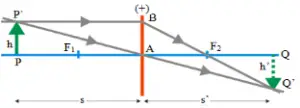
s = do = the object distance, s’ = di = the image distance, ho = P P’ = the object height, hi = Q Q’ = the image height, F1 і F2 = the focal point of the converging lens.
Трикутник P'AP подібний до трикутника Q'AQ. Отже:
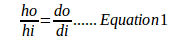
Triangle BF2A = Q’F2Q where the distance of AB = the object height (h) and the distance of F2A = the focal length (f) of the convex lens. Therefore :
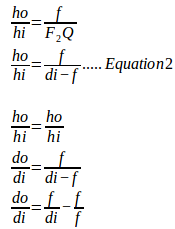

do = the object distance (positive if the object is passed through by the light beam)
di = the image distance (positive if the image is passed through by the light beam or image is real)
f = the focal length (positive if the focal point of the convex lens is passed through by the light beam)
Always remember the sign rules of the convex lenses when using this equation to solve the problem of the convex lenses.
Збільшення зображення (М)
Observe the formation of the image above. Similar to the PAP ‘and QAQ’ triangles, we can derive the relationship between the object distance and the image distance with the object height and the image height:

The equation above can be written again as below by adding the symbol m:
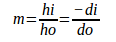
m = збільшення зображення
ho = the object height (positive if the object is above the principal axis of the convex lens or the object is upright)
hi = the image height (negative if the image is below the principal axis of the convex lens or the image is inverted)
do = the object distance (positive if the object is passed through by the light beam)
di = the image distance (positive if the image is passed through the light beam or the image is real)

