Statika fluida - masalah sareng solusi
Liquid pressure
1. What is the difference between the hydrostatic pressure of blood between the brain and the soles of the feet of a person whose height 165 cm (suppose the dénsitas of blood = 1.0 × 10³ kg / m3, akselerasi alatan gravitasi = 10 m/s2)
Dipikanyaho:
Height (h) = 165 cm = 165/100 m = 1.65 meters
Density of bloods (ρ) = 1.0 × 10³ kg / m3
Akselerasi alatan gravitasi (g) = 10 m/s2
miharep: liquid pressure
Solusi:
P = ρ g h
P = (1.0 × 10³)(10)(1.65)
P = (1.0 × 10⁴)(1.65)
P = 1.65 x 10⁴ N / m2
Pipe U
2. A U pipe is initially filled with water than on one pipe filled with oil, as shown in the figure below. The density of water is 1000 kg/m3. If the height of oil is 8 cm and the height of the water is 5 cm, what is the density of oil?
Dipikanyaho: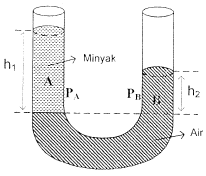
Kapadetan cai = 1000 kg.m-3
The height of water (h2) = 5 séntiméter
The height of oil (h1) = 8 séntiméter
Dipilari: dénsitas minyak
Solusi:
ρ1 gh1 =ρ2 gh2
ρ1 h1 =ρ2 h2
(1000)(5) = (ρ2)(8)
5000 = (ρ2)(8)
ρ2 = 625 kg.m-3
3. A U pipe was first filled with kerosene then added water. If the mass of kerosene is 0.8 grams/cm3 jeung dénsitas cai is 1 gram/cm3 and the cross sectional area is 1.25 cm2. Determine how much water should be added so that the height difference of the kerosene surface is 15 cm
A. 9 ml
B. 12 ml
C. 15 ml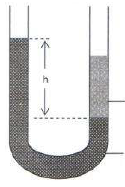
D. 18 ml
Dipikanyaho:
Density of kerosene (ρ1) = 0.8 gram/cm3
Kapadetan cai (ρ2) = 1 gram/cm3
Sectional area of the pipe = 1.25 cm2
The height difference of the surface of kerosene (h1) = 15 séntiméter
Dipilari: Volume cai
Solusi:
The height of water (h2):
ρ1 gh1 = ρ2 gh2
(0,8)(15)(1)(h2)
h2 = 12 cm
Volume of water :
V = (Sectional area of the pipe)(height of water)
V = (1.25 cm2)(12 cm)
V = 15 cm3
1 liter = 1 dm3 = 103 cm3
1 mililiter = 10-3 liters = (10-3)(103) cm3 = 1 cm3
Volume of water is 15 cm3 = 15 mililiters
Jawaban anu bener nyaéta C.
4. A pipe U filled with water with density of 1000 kg/m3. One column of pipe U filled with glyserin with density of 1200 kg/m3. If the height of glyserin is 4 cm, determine the height difference of both columns of the pipe.
A. 0.8 cm
B. 4 cm
C. 8 cm
D. 12 cm
Dipikanyaho:
Kapadetan cai (ρ1) = 1000 kg/m3
Density of glycerin (ρ2) = 1200 kg/m3
Height of glycerin (h2) = 4 séntiméter
miharep: The height difference of both columns of the pipe.
Solusi:
The height of the column of the pipe (h1):
ρ1 h1 = ρ2 h2
(1000)(h1) = (1200)(4)
(1000)(h1) = 4800
h1 = 4.8 cm
The height difference of both columns of the pipe U = h1 – h2 = 4.8 cm – 4 cm = 0.8 cm
Jawaban anu leres nyaéta A.
5. Pipa U has two ends are open filled with water jeung a mass of 1 g / cm3. The sectional area along the pipe is the same, that is 1 cm2. Someone blows on one end of the foot of the pipe so that the permukaan the water at the other foot rises 10 cm from its original position. If nu gagancangan due to gravity is 10 m/s2 then nangtukeun gaya éta acted by that jalma.
A. 20 kilodyne
B. 10 kilodyne
C. 2 kilodyne
D. 1 kilodyne
Dipikanyaho:
Change all units to the International system.
Kapadetan cai (ρ1) = 1 gr/cm3 = 10-3 kg / 10-6 m3 = 103 kg / m3
Cross sectional area of pipe (A) = 1 cm2 = 10-4 m2
The change of column of pipe (h) = 10 cm = 1 dm = 10-1 m
Akselerasi alatan gravitasi (g) = 10 ms-2 = 101 Ibu-2
Volume of moved water (V) = (A)(h) = (1 cm2)(10 cm) = 10 cm3 = (101)(10-6 m3) = 10-5 m3
Dipilari: Force (F) acted by the person.
Solusi:
The force that acted by that person = weight of water with a height of 10 cm
F = w
F = m g —–> Equation of density : m = ρV
F = ρ V g
F = (103)(10-5)(101)
F = (104)(10-5)
F=10-1 Newton —–> 1 Newton = 105 dyne
F = (10-1)(105 dyne)
F=104 dyne
F = 10 kilodyne
Jawaban anu leres nyaéta B.
6. A Y-shaped tube is inserted upside down so that the left foot and right foot are immersed in two kinds of liquid. After both feet are immersed in the liquid, then the top of the Y pipe is closed with the finger and pulled upwards, so that the two legs of the Y pipe are filled with a column of different high-density liquids. If the density of the first liquid is 0.80 gram.cm-3 and the second density is 0.75 gram.cm-3, and the lower liquid column is 8 cm, then nangtukeun the height difference between the two liquid columns on U pipe.
A. 1.0666 cm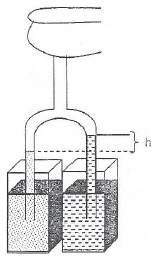
B. 0.9375 cm
C. 0.3533 cm
D. 0.5333 cm
Dipikanyaho:
Density of first liquid (ρ1) = 0,80 gram.cm-3
Density of second liquid (ρ2) = 0,75 gram.cm-3
The height of the lower liquid (h1) = 8 séntiméter
Dipilari: The height difference between the two liquid columns on U pipe
Solusi:
The height of the higher liquids (h2):
ρ1 h1 = ρ2 h2
(0.80)(8) = (0.75)(h2)
6.4 = 0.75 (h2)
h2 = 6.4/0.75
h2 = 8.5 cm
The height difference of liquids = h2 – h1 = 8.5333 cm – 8 cm = 0.5333 cm
Jawaban anu leres nyaéta D.
7. A stone with the volume of 0.5 m3 placed in a liquid with the density of 1.5 gr cm-3. Acceleration due to gravity is 10 m s-2. What is the buoyant force?
Dipikanyaho:
Volume batu (V) = 0.5 m3
Density of water (ρ) = 1.5 gr cm-3 = 1500 kg m²-3
Akselerasi alatan gravitasi (g) = 10 ms-2
miharep: buoyant force (FA)
Solusi:
The equation of the buoyant force :
FA = ρ g V = (1500 kg m-3)(10 m s-2)(0.5 m3) = 7500 kg m/s2 = 7500 Newton
ngambang
8. A block of ice float in the sea as shown in the figure below. The density of sea is 1.2 gr cm-3 and density of ice is 0.9 gr c-3. The volume of ice in sea water = ……. x the volume of ice in the air.
Dipikanyaho: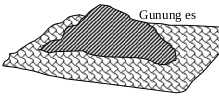
Density of sea (ρsagara) = 1.2 gr cm-3
Density of ice (ρes) = 0.9 gr c-3
miharep: The volume of ice in sea water = ……. x the volume of ice in the air.
Solusi:
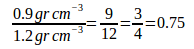
The volume of ice in sea = 0.75
The volume of ice in air = 0.25
The volume of ice in sea water = 3 x the volume of ice in air (3 x 0.25 = 0.75).
9. An object float in a liquid where 2/3 of the object in the liquid. If the density of the object is 0.6 gr cm3, then what is the density of water.
Dipikanyaho:
The part of the object in liquid = 2/3
Density of object = 0.6 gr cm3 = 600 kg m²3
miharep: the density of the liquid (x)
Solusi:
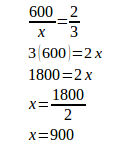
The density of the liquid is 900 kg m3
10. A wood float in water, where 3/5 part of wood in the water. If the density of water is 1 × 10³ kg / m3, what is the density of wood?
Dipikanyaho:
Part of object in water = 3/5
Density of water = 1×10³ kg / m3 = 1000 kg / m3
Dipilari: The density of wood (x)
Solusi:
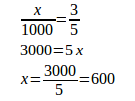
Kapadetan kai nyaéta 600 kg/m3 = 6 x 10² kg / m3
- What is fluid statics?
- Jawab: Fluid statics, also known as hydrostatics, is the branch of fluid mechanics that studies fluids at rest and the forces exerted by static fluids on immersed objects and container walls.
- How does pressure in a fluid vary with depth?
- Jawab: In a static fluid, pressure increases linearly with depth due to the weight of the fluid column above any given depth. The change in pressure with depth is given by , di mana is the fluid density, nyaéta percepatan gravitasi, sareng ℎ is the depth.
- What is Pascal’s principle?
- Jawab: Pascal’s principle states that a change in pressure applied to an enclosed fluid is transmitted undiminished to all portions of the fluid and to the walls of its container.
- How does a hydraulic lift work based on fluid statics principles?
- Jawab: A hydraulic lift utilizes Pascal’s principle. When a small force is applied to a small piston, it creates a pressure in the fluid. This pressure is transmitted undiminished throughout the fluid, exerting a much larger force on a larger piston, enabling the lift to raise heavy objects with relatively little effort.
- What is buoyant force and how is it related to fluid statics?
- Jawab: The buoyant force is the upward force exerted by a fluid on any immersed object. According to Archimedes’ principle, the buoyant force on an object is equal to the weight of the fluid displaced by the object.
- Why do objects float or sink in fluids?
- Jawab: Whether an object floats or sinks depends on the relationship between the buoyant force and the object’s weight. If the buoyant force (due to the displaced fluid) is greater than the object’s weight, it will float. If the object’s weight is greater, it will sink.
- What is the concept of hydrostatic pressure?
- Jawab: Hydrostatic pressure is the pressure exerted by a fluid at rest due to the force of gravity. It increases linearly with depth in the fluid, and is calculated as , di mana is the pressure at the surface, is the fluid density, nyaéta percepatan gravitasi, sareng ℎ is the depth.
- How is atmospheric pressure related to fluid statics?
- Jawab: The atmosphere can be thought of as a fluid. Atmospheric pressure is the pressure exerted by the weight of the air above a given point. It decreases with altitude, similar to how pressure in a liquid decreases as one moves upward in the fluid column.
- What role does the shape of a container play in the pressure distribution of a static fluid within it?
- Jawab: In fluid statics, the pressure at a given depth depends only on the height of the fluid column above that depth, not on the shape of the container. Thus, pressure at a specific depth is the same regardless of the container’s shape.
- What is the significance of the hydrostatic paradox?
- Jawab: The hydrostatic paradox highlights that in fluid statics, the force exerted by a static fluid on the bottom of a container depends only on the height of the fluid column, not its volume or the shape of the container. Thus, very different containers with the same fluid height exert the same pressure at their base, even if they hold different amounts of fluid.

