Sehlooho se buang ka Resistors letotong
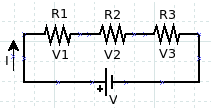
Haeba di-resistor di hokahantswe jwalo ka ha ho bontshitswe setshwantshong, di-resistor di hlophisitswe ka tatellano. Resistor kapa khanyetso ya motlakase e amehang e ka ba ka sebopeho sa dikarolo tsa resistor, mabone, kapa khanyetso e nngwe ya motlakase.
Tefiso ea motlakase e tsamaea ka har'a khanyetso 1 (R)1) = ea tefiso ea motlakase e tsamaea ka har'a khanyetso ea 2 (R)2) = tjhaja ya motlakase e tsamaya kganyetsong ya 3 (R)3). Motlakase (I) ke tjhaja ya motlakase e phallang nakong e itseng ya nako (I = Q / t), kahoo motlakase o phalla ka kganyetso ya 1 (I1) = motlakase o fetang kganyetsong 2 (I2) = motlakase o fetang kganyetsong 3 (I3Ho ya ka dipalo, motlakase o felletseng (I) = I1 = KE2 = KE3.
Ka lehlakoreng le leng, motlakase (V) oa fokotseha ha tjhaja ea motlakase e feta ka har'a resistor ka 'ngoe. Motlakase oa motlakase o boetse o bitsoa phapang ea motlakase, ke matla a motlakase ka yuniti ea tjhaja ea motlakase. Motlakase oa motlakase oa fokotseha hobane motlakase o sebelisoa khanyetsong e 'ngoe le e 'ngoe ea motlakase. Kahoo, motlakase oohle oa motlakase (V) o lekana le bongata ba motlakase khanyetsong ka 'ngoe. Ho ea ka lipalo, motlakase oohle oa motlakase (V) = V1 +V2 +V3. V = IR kahoo equation ea motlakase oa motlakase ke V = IR1 + IR2 + IR3Motlakase o phallang ho resistor ka 'ngoe o lekana hoo equation ena e fetohang ho V = I (R)1 + R2 + R3).
Ho latela equation e ka holimo, ho ka fihlelletsoa qeto ea hore khanyetso eohle ea motlakase (R) kapa khanyetso e lekanang ea khanyetso ea motlakase
e hokahaneng ka letoto e lekana le kakaretso ea khanyetso e 'ngoe le e 'ngoe ea motlakase, ka lipalo R = R1 + R2 + R3Haeba ho na le li-resistor tse peli feela ka tatellano, resistor e lekanang (R) = R1 + R2Haeba ho na le li-resistor tse 'ne ka tatellano, resistor e lekanang (R) = R1 + R2 + R3 + R4Ka ho tšoanang, haeba ho na le li-resistor tse hlano kapa ho feta tse hlano tse hokahaneng ka tatellano.
Bothata ba mohlala oa 1:
Haeba ho tsebahala, R 1 = 2 Ω, R 2 = 3 Ω le R 3 = 4 Ω. Li-resistor tsohle tse tharo li hokahane ka letoto. Boleng ba resistor e lekanang ke bofe? (Ω = Ohm ).
tharollo:
R = R 1 + R 2 + R 3 = 2 + 3 + 4 = 9 Ω.
Sephetho sena se bontša hore khanyetso e lekanang e kholo ho feta boleng ba li-resistor tse hokahantsoeng ka tatellano.
Bothata ba mohlala oa 2:
Li-resistor tse peli R 1 = 50 Ω le 50 Ω li hokahane ka tatellano 'me li hokahane le betri ea 12 Volt.
(a) Khanyetso e lekanang
(b) Motlakase o fetang ka har'a resistor ka 'ngoe
tharollo:
(a) R = R 1 + R 2 = 50 Ω + 50 Ω = 100 Ω.
(b) I = V / R = 12 Volts / 100 Ω = 0.12 A
