Përplasje plotësisht elastike
Një përplasje e dy objekteve quhet përplasje plotësisht elastike nëse impulsi ose energjia kinetike e secilit objekt para përplasjes është e barabartë me impulsin dhe energjinë kinetike të secilit objekt pas përplasjes. Me fjalë të tjera, ligji i ruajtjes së impulsit dhe ligji i ruajtjes së energjisë kinetike janë të zbatueshëm në përplasjet plotësisht elastike. Përdorimi i fjalës elastik tregon se pas përplasjes, dy objektet nuk ngjiten së bashku ose nuk janë të bashkangjitura me njëri-tjetrin, por kërcejnë. Impulsi i secilit objekt ruhet.
Impulsi i secilit objekt ruhet.
m 1 v 1 + m 2 v 2 = m 1 v 1 ' + m 2 v 2 ' ………………….. Ekuacioni 1.5
Energjia kinetike e secilit objekt ruhet.
1⁄2 mv 1 2 + 1⁄2 mv 2 2 = 1⁄2 mv 1 ' 2 + 1⁄2 mv 2 ' 2 ………………….. Ekuacioni 1.6
[irp]
Përplasja perfekte elastike duhet të jetë e heshtur dhe të mos gjenerojë nxehtësi për shkak të fërkimit midis dy objekteve që përplasen. Nëse përplasja e dy objekteve gjeneron zhurmë dhe nxehtësi, energjia kinetike e objekteve nuk ruhet. Një pjesë e energjisë kinetike shndërrohet në energji zanore dhe energji nxehtësie, dhe një pjesë shndërrohet në energji të brendshme. Një shembull i një përplasjeje perfekte elastike është përplasja e grimcave atomike dhe subatomike.
Në një problem me përplasje krejtësisht elastike, nëse shpejtësia fillestare dihet ndërsa shpejtësia përfundimtare është e panjohur, problemi nuk mund të zgjidhet vetëm duke përdorur ekuacionet 1.5 dhe 1.6. Për këtë arsye, të dy ekuacionet manipulohen për të nxjerrë ekuacione të tjera, të cilat mund të përdoren për të përcaktuar shpejtësinë përfundimtare.
Hiq faktorin 1/2 pastaj manipulo 1.6
m 1 v 1 2 + m 2 v 2 2 = m 1 v 1 ' 2 + m 2 v 2 ' 2
m 1 v 1 2 – m 1 v 1 ' 2 = m 2 v 2 ' 2 - m 2 v 2 2
m 1 (v 1 2 – v 1 ' 2 ) = m 2 (v 2 ' 2 – v 2 2 ) —> (a + b)(a – b) = a 2 – b 2
m 1 (v 1 + v 1 ') (v 1 – v 1 ') = m 2 (v 2 ' + v 2 ) (v 2 ' – v 2 ) …………………….. Ekuacioni 1.7
[irp]
Manipuloni ekuacionin 1.5
m 1 v 1 – m 1 v 1 ' = m 2 v 2 ' - m 2 v 2
m 1 (v 1 – v 1 ') = m 2 (v 2 ' – v 2 ) ………………….. Ekuacioni 1.8
Pjesëtoni ekuacionin 1.7 me ekuacionin 1.8 për të marrë rezultatin përfundimtar
(v 1 + v 1 ') = (v 2 ' + v 2 )
v 1 – v 2 = v 2 ' – v 1 '
v 1 – v 2 = – (v 1 ' – v 2 ') ………………….. Ekuacioni 1.9
Ekuacionet 1.5 dhe 1.9 mund të përdoren për të zgjidhur problemet e përplasjeve elastike në mënyrë të përkryer. Kombinoni ekuacionet 1.5 dhe 1.9 për të përftuar dy ekuacione për përcaktimin e shpejtësive përfundimtare të dy objekteve nëse masat dhe shpejtësitë e tyre fillestare janë të panjohura.


Kur zgjidhni pyetje duke përdorur ekuacionet e mësipërme, përdorni shenjën e saktë për v1 dhe v2 . Nëse objekti 1 lëviz djathtas, v1 është pozitiv dhe anasjelltas, nëse objekti dy lëviz majtas, v2 është negativ. Nëse të dy objektet lëvizin në drejtime të ndryshme, por nuk ka informacion në lidhje me drejtimet e lëvizjes, v1 dhe v2 duhet të kenë shenja të ndryshme, për shembull, v1 është pozitiv dhe v2 është negativ.
4.1.1 Dy objekte me të njëjtën masë
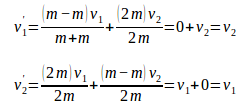
Nëse m1 = m2 , v1 ' = v2 dhe v2 ' = v1.
Po sikur dy objektet të lëvizin në drejtime të ndryshme?
Për shembull, nëse para përplasjes objekti 1 lëviz djathtas dhe objekti 2 lëviz majtas, objekti 1 do të lëvizë majtas (v1 ' = –v2 ) dhe objekti 2 do të lëvizë djathtas (v2 ' = v1 ) pas përplasjes.
Po sikur ndonjëri prej objekteve të jetë fillimisht në qetësi?
Për shembull, nëse para përplasjes objekti 2 është në qetësi (v2 = 0), objekti 1 do të jetë në qetësi (v1 ' = 0) dhe objekti 2 do të lëvizë me të njëjtën shpejtësi si shpejtësia fillestare e objektit 1 (v2 ' = v1 ) pas përplasjes. Nëse para përplasjes objekti 1 lëviz djathtas, objekti 2 do të lëvizë djathtas pas përplasjes. Prandaj, dy objektet shkëmbejnë shpejtësi.
[irp]
Shembull pyetjeje 4
Objektet A (2 kg) dhe B (2 kg) lëvizin në drejtime të kundërta me shpejtësi përkatësisht 4 m/s dhe 2 m/s. Nëse objektet A dhe B përplasen në një përplasje plotësisht elastike, cilat janë shpejtësitë përfundimtare të objekteve A dhe B?
I njohur:
m A = 2 kg, m B = 2 kg, v A = 4 m/s, v B = – 2 m/s
Kërkohen: v A ' dhe v B '
zgjidhje:
v A ' = – 2 m/s dhe v B ' = 4 m/s
Pas përplasjes, objekti A lëviz me një shpejtësi prej 2 m/s dhe objekti B lëviz me një shpejtësi prej 4 m/s në drejtime të kundërta. Nëse para përplasjes objekti A lëviz djathtas dhe objekti B lëviz majtas, objekti A do të lëvizë majtas dhe objekti B do të lëvizë djathtas pas përplasjes.
Shembull pyetjeje 5
Objekti A (2 kg) lëviz në të djathtë me një shpejtësi prej 2 m/s dhe përplaset me objektin B (2 kg) i cili është në qetësi. Nëse dy objektet përplasen në një përplasje plotësisht elastike, cilat janë shpejtësitë përfundimtare të objekteve A dhe B?
I njohur:
m A = 2 kg, m B = 2 kg, v A = 2 m/s, v B = 0 m/s
Kërkohen: v A ' dhe v B '
zgjidhje:
v A ' = 0 dhe v B ' = 2 m/s
Pas përplasjes, objekti A është në qetësi dhe objekti B lëviz në të djathtë me një shpejtësi prej 2 m/s.
[irp]
4.1.2 Dy objekte me masa të ndryshme
Nëse dy objekte kanë shpejtësi dhe masa fillestare të ndryshme (ndryshim i vogël), shpejtësitë përfundimtare njihen duke përdorur ekuacionet 1.10 dhe 1.11.
Nëse fillimisht objekti 2 është në qetësi (v2 = 0), ekuacioni 1.10 bëhet ekuacioni 1.12 dhe ekuacioni 1.11 bëhet ekuacioni 1.13.
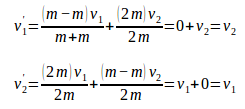
Nëse v2 = 0, m1 është shumë i madh dhe m2 është shumë i vogël, duke zgjidhur ekuacionet 1.12 dhe 1.13 fitohen v1 ' = v1 dhe v2 ' = 2v1. Nëse v2 = 0 , m1 është shumë i vogël dhe m2 është shumë i madh, duke zgjidhur ekuacionet 1.12 dhe 1.13 fitohen v1 ' = -v1 dhe v2 ' = 0. Notat pozitive dhe negative tregojnë drejtime të kundërta lëvizjeje.
Shembull pyetjeje 6
Një objekt me masë 1 kg lëviz me një shpejtësi prej 20 m/s dhe përplaset me një mur në një përplasje krejtësisht elastike. Cilat janë shpejtësitë përfundimtare të objektit dhe të murit?
I njohur:
m A = 1 kg, v A = 20 m/s, m B = shumë e madhe, v B = 0
Kërkohen : v A 'dhe v B '
zgjidhje:
v A ' = -20 m/s dhe v B ' = 0
Pas përplasjes, objekti A kthehet me një shpejtësi prej 20 m/s dhe objekti B mbetet në qetësi. Nëse para përplasjes objekti A lëviz djathtas, ai lëviz majtas pas përplasjes.
