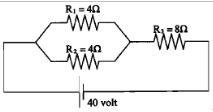
1. Zvichibva pamufananidzo uri pazasi, sarudza magetsi kuburikidza neR 1.
 Zvinozivikanwa:
Mudziviriri 1 (R1 ) = 4 Ω
Mudziviriri 2 (R2 ) = 4 Ω
Mudziviriri 3 (R3 ) = 8 Ω
Mhepo yemagetsi (V) = 40 Volts
Zvinodiwa: Magetsi kuburikidza neR1
Solution:
Mwenje wemagetsi unoyerera kubva pakukwanisa kukuru kuenda pakukwanisa kushoma. Kutungamira kwemagetsi mudunhu riri pamusoro kwakafanana nekutungamira kwewachi.
Magetsi anobuda mubhatiri
Kutanga, verenga resistance yakaenzana ( R). Mushure mezvo, verenga magetsi uchishandisa equation yemutemo weOhm :
V = IR kana I = V / R
V = voltage , I = magetsi emagetsi , R = resistance yakaenzana
Kuramba kwakaenzana:
Resistor R1 ne resistor R2 zvakabatana zvakafanana . Resistor yakaenzana:
1/R 12 = 1/R 1 + 1/R 2 = 1/4 + 1/4 = 2/4
R 12 = 4/2 = 2 Ω
Resistor R 12 ne resistor R 3 zvakabatana zvakatevedzana . Kuramba kwakafanana:
R = R 12 + R 3 = 2 + 8 = 10 Ω
Magetsi anobuda mubhatiri:
Ini = V / R = 40 / 10 = 4 A
Simba remagetsi rinobuda mubhatiri i4 Ampere.
Voltage yemagetsi V ab uye V bc
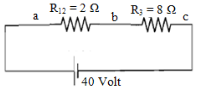 Kirchhoffmutemo wekutanga inotaura kuti pa chero nzvimbo yekusangana, huwandu hwemafungu ese anopinda munosangana hunofanira kuenzana nehuwandu hwemafungu ese anopinda munosangana.
Zvichibva pamutemo wekutanga waKirchhoff , zvakagumiswa kuti kana magetsi achibuda mubhatiri ari 4 A saka magetsi kuburikidza neab akaenzana ne4 Ampere, saka magetsi kuburikidza nebc i4 Ampere.
Vheji yemagetsi V ab :
V ab = I ab R ab = (4)(2) = 8 Volts
Voltage yemagetsi V bc :
V bc = I bc R bc = (4)(8) = 32 Volts
Dunhu riri pamusoro apa rakabatana muzvikamu zvakatevedzana kuitira kuti magetsi ese ari V = V ab + V bc = 8 Volts + 32 Volts = 40 Volts.
Mwenje wemagetsi unoyerera kuburikidza neR1 = 4 Ω
I 1 = V ab / R 1 = 8 Volts / 4 Ohms = 2 A
I 2 = V ab / R 2 = 8 Volts / 4 Ohms = 2 A
Magetsi anobuda mubhatiri i4 A. Kana asvika panzvimbo a, magetsi anokamurwa kuita maviri, magetsi e2 Ampere anoyerera nepakati pe resistor R1 uye
magetsi e2 A anoyerera nepakati pe resistor R 2 . 2 A + 2 A = 4 A.
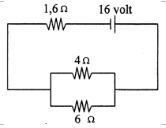
2. Zvichibva pamufananidzo uri pazasi, sarudza magetsi anoyerera nemuchina we4-Ω resistor.
 Zvinozivikanwa:
Mudziviriri 1 (R1 ) = 6 Ω
Mudziviriri 2 (R2 ) = 4 Ω
Mudziviriri 3 (R3 ) = 1.6 Ω
Voltage yemagetsi (V) = 16 Volts
Zvinodiwa: Magetsi anoyerera nepakati pe4 Ω
Solution:
Mwenje wemagetsi unoyerera kubva pakukwanisa kukuru kuenda pakukwanisa kushoma. Kutungamira kwemagetsi mudunhu riri pamusoro kwakafanana nekutungamira kwewachi.
Magetsi anobuda mubhatiri
Kuramba kwakaenzana:
Resistor R 1 ne resistor R 2 zvakabatana zvakafanana. Resistor yakaenzana:
1/R 12 = 1/R 1 + 1/R 2 = 1/6 + 1/4 = 2/12 + 3/12 = 5/12
R 12 = 12/5 = 2.4 Ω
Resistor R 12 ne resistor R 3 zvakabatana zvakatevedzana. Resistor yakaenzana:
R = R 12 + R 3 = 2.4 + 1.6 = 4 Ω
Magetsi anobuda mubhatiri:
Ini = V / R = 16 / 4 = 4 A
Voltage yemagetsi V ab uye V bc
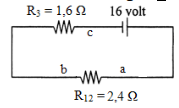 Zvichibva pamutemo wekutanga waKirchhoff, vakagumisa kuti kana magetsi achibuda mubhatiri ari 4 A saka magetsi kuburikidza neab akaenzana ne4 Ampere, saka magetsi kuburikidza nebc i4 Ampere.
Voltage yemagetsi V ab :
V ab = I ab R ab = (4)(2.4) = 9.6 Volts
Voltage yemagetsi V bc :
V bc = I bc R bc = (4)(1.6) = 6.4 Volts
Dunhu riri pamusoro apa rakabatana muzvikamu zvakatevedzana kuitira kuti magetsi ese emagetsi ave V = V ab + V bc = 9.6 Volts + 6.4 Volts = 16 Volts.
Mwenje wemagetsi unoyerera kuburikidza neR2 = 4 Ω
I 1 = V ab / R 1 = 9.6 Volts / 6 Ohms = 1.6 A
I 2 = V ab / R 2 = 9.6 Volts / 4 Ohms = 2.4 A
Simba remagetsi rinobuda mubhatiri i4 A. Kana rasvika panzvimbo imwe chete, simba remagetsi rinokamurwa kuita maviri,
magetsi 1.6 A anoyerera nemuchinodzivisa R 1 uye magetsi 2.4 A anoyerera nemuchinodzivisa R 2 . 1.6 A + 2.4 A = 4 A.
