Nkhani yokhudza Resistors mu mndandanda
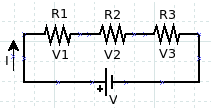
Ngati zotsutsanazo zalumikizidwa monga momwe zasonyezedwera pachithunzichi, zotsutsanazo zimayikidwa motsatizana. Kukana kwa resistor kapena magetsi komwe kukubweraku kungakhale ngati zigawo za resistor, magetsi, kapena kukana kwina kwamagetsi.
Mphamvu yamagetsi imayenda kudzera mu kukana 1 (R)1) = ndi mtengo wamagetsi imayenda kudzera mu kukana 2 (R)2) = mphamvu yamagetsi imayenda kudzera mu kukana 3 (R)3). Zamagetsi zamagetsi (I) ndi mphamvu yamagetsi yomwe imayenda mkati mwa nthawi inayake (I = Q / t), motero mphamvu yamagetsi kudzera mu kukana 1 (I1) = mphamvu yamagetsi kudzera mu kukana 2 (I2) = mphamvu yamagetsi kudzera mu kukana 3 (I3Mwa masamu, mphamvu yonse yamagetsi (I) = I1 = Ine2 = Ine3.
Mosiyana ndi zimenezi, magetsi (V) amachepa magetsi akamayenda kudzera mu resistor iliyonse. Magetsi otchedwanso electric potential difference, ndi mphamvu yamagetsi pa unit iliyonse ya magetsi. Magetsi amachepa chifukwa magetsi amagwiritsidwa ntchito mu resistor iliyonse yamagetsi. Chifukwa chake, magetsi onse (V) ndi ofanana ndi kuchuluka kwa magetsi mu resistor iliyonse. Mwa masamu, magetsi onse (V) = V1 +V2 +V3. V = IR kotero equation ya magetsi amagetsi ndi V = IR1 + IR2 + IR3Mphamvu yamagetsi yomwe ikuyenda pa resistor iliyonse ndi yofanana kotero kuti equation iyi imasintha kukhala V = I (R1 +R2 +R3).
Kutengera ndi equation yomwe ili pamwambapa, zitha kutsimikiziridwa kuti kukana konse kwamagetsi (R) kapena kukana kofanana kwa kukana kwamagetsi
yomwe yalumikizidwa motsatizana ndi yofanana ndi kuchuluka kwa kukana kulikonse kwamagetsi, mwa masamu R = R1 +R2 +R3Ngati pali zotsutsa ziwiri zokha motsatizana, chotsutsa chofanana (R) = R1 +R2Ngati pali zotsutsa zinayi motsatizana, chotsutsa chofanana (R) = R1 +R2 +R3 +R4Mofananamo, ngati pali ma resistors asanu kapena kuposerapo asanu omwe alumikizidwa motsatizana.
Chitsanzo cha vuto 1:
Ngati zidziwika, R 1 = 2 Ω, R 2 = 3 Ω ndi R 3 = 4 Ω. Ma resistors onse atatu amalumikizidwa motsatizana. Kodi mtengo wa resistor yofanana ndi wotani? (Ω = Ohm ).
yankho;
R = R 1 + R 2 + R 3 = 2 + 3 + 4 = 9 Ω.
Zotsatirazi zikusonyeza kuti kukana kofananako kuli kwakukulu kuposa mtengo wa zotsutsana zomwe zalumikizidwa motsatizana.
Chitsanzo cha vuto 2:
Ma resistors awiri R 1 = 50 Ω ndi 50 Ω amalumikizidwa motsatizana ndipo amalumikizidwa ku batri ya 12 Volt.
(a) Kukana kofanana
(b) Mphamvu yamagetsi kudzera mu resistor iliyonse
yankho;
(a) R = R 1 + R 2 = 50 Ω + 50 Ω = 100 Ω.
(b) I = V / R = 12 Volts / 100 Ω = 0.12 A
