Roti konnessi permezz ta' ċinturini – problemi u soluzzjonijiet
1. Tliet roti huma konnessi kif muri fil -figura t'hawn taħt.
Jekk R A = 10 cm, R B = 4 cm, u R C = 40 cm, allura l- proporzjon tal- veloċità angolari tar-rota A u r-rota C huwa …
Magħruf: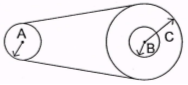
Ir-raġġ tar-rota A (r A ) = 10 ċm
Ir-raġġ tar-rota B (r B ) = 4 ċm
Ir-raġġ tar-rota C (r C ) = 40 ċm
Meħtieġ: il-proporzjon tal-veloċità angolari tar-rota A u r-rota C
Soluzzjoni:
Il-veloċità angolari tar-roti A u C
Iċ -ċirkonferenza tar-rota A hija ħafna akbar miċ-ċirkonferenza tar-rota C. Meta r-rota C tkun daret ċirku wieħed (360 ° ), matul l-istess intervall ta' ħin ir-rota A tkun għadha ma daretx ċirku wieħed (360 ° ). Għalhekk, il-veloċità angolari tar-rota A mhijiex ugwali għall-veloċità angolari tar-rota C.
Madankollu, ir-rota A u r-rota C huma interkonnessi permezz ta' ħbula, sabiex fl-istess intervall ta' ħin, id -distanza vjaġġata mit-tarf tar-rota A hija ugwali għad-distanza vjaġġata mit-tarf tar-rota C. Għalhekk il-veloċità lineari tat-tarf tar-rota C (v C ) hija ugwali għall- veloċità lineari tat-tarf tar-rota A (v A ).
v A = v Ċ
r A ω A = r C ω C
10 ω A = 40 ω C
ω A / ω C = 40 / 10
ω A / ω C = 4 / 1
[irp]
2. Ir-roti B u C għandhom l-istess assi ta' rotazzjoni u r-rota A hija tanġent mar-rota B. Jekk ir-raġġ tar-rota A = ir-raġġ tar -rota C = 30 ċm, ir-raġġ tar-rota B = 60 ċm, allura ddetermina l-proporzjon tal- veloċità lineari bejn ir-roti A, B, u C.
Magħruf:
Ir-raġġ tar-rota A (rA) = 30 ċm = 0.3 metri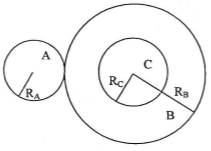
Ir-raġġ tar-rota B (r B ) = 60 ċm = 0.6 metri s
Ir-raġġ tar-rota C (r C ) = 30 ċm = 0.3 metri s
Meħtieġa: il-proporzjon tal-veloċità lineari bejn ir-roti A, B, u C.
Soluzzjoni:
Il-veloċità lineari tat-tarf tar-rota A :
Ir -rota A u r-rota B huma interkonnessi kif muri fil-figura t'hawn taħt, għalhekk il-veloċità angolari tar-rota A mhijiex ugwali għall-veloċità angolari tar-rota B. Dan għaliex iċ-ċirkonferenza tar-rota B hija akbar mir-rota A. Matul l-istess intervall ta' ħin, meta r-rota A ddur madwar ċirku wieħed (360 ° ) , ir-rota B għadha mhix madwar ċirku wieħed (360 ° ). Madankollu, matul l-istess intervall ta' ħin, id-distanza vjaġġata mit-tarf tar-rota A hija ugwali għad-distanza vjaġġata mit-tarf tar-rota B. Għalhekk il-veloċità lineari tat-tarf tar-rota A (vA ) hija ugwali għall-veloċità lineari tat-tarf tar-rota B (vB ).
Il-veloċità lineari tat-tarf tar-rota A:
v A = r A ω A = 0.3 ω A
Il -veloċità lineari tat-tarf tar-rota B :
Ir -rota B u r-rota B jeħlu flimkien, għalhekk, ir-rota B u r-rota C iduru flimkien. Meta r-rota B iddur ċirku wieħed (360 ° ) fl-istess intervall ta' ħin, ir-rota C iddur ukoll ċirku wieħed (360 ° ). Peress li ddur flimkien, il-veloċità angolari tar-rota B (ω₃B ) hija ugwali għall-veloċità angolari tar-rota C (ω₃C ) = ω. Iżda l-veloċità lineari tar-rota B (vB) mhijiex ugwali għall-veloċità lineari tar-rota C (v₃C ).
Il-veloċità lineari tat-tarf tar-rota B:
v B = r B ω B = 0.6 ω B = 0.6 ω
Il-veloċità lineari tat-tarf tar-rota C:
v C = r C ω C = 0.3 ω C = 0.3 ω
Il-veloċità lineari tat-tarf tar-rota A ( vA ) hija l-istess bħall-veloċità lineari tat-tarf tar-rota B ( vB )
vA = vB
0.3 ω A = 0.6 ω
ω A = 0.6 ω / 0.3
ω A = 2 ω
Il-veloċità lineari tat-tarf tar-rota A (v A ):
v A = 0.3 ω A = 0.3 ( 2 ω) = 0.6 ω
Il-proporzjon tal-veloċità lineari bejn ir-roti A, B, u C.
vA: vB : vĊ
0.6 ω : 0.6 ω : 0.3 ω
0.6: 0.6: 0.3
6: 6: 3
2:2:1
[irp]
