Impuls tal-Momentum u Mozzjoni tal-Projettili – Problemi u Soluzzjonijiet
1. Ballun ta' 0.2 kg se jiddaħħal fit-toqba C, kif muri fil-figura t'hawn taħt. Min jolqot il-ballun f'0.01 sekonda u t-triq ta' BC tivvjaġġa f'sekonda. Iddetermina l-kobor tal-forza sabiex il-ballun ikun jista' jiddaħħal fit-toqba C. L-aċċelerazzjoni minħabba l-gravità hija ta' 10 m/ s².
Magħruf: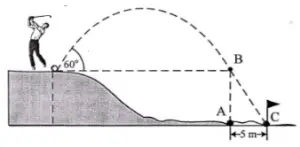
Angolu (θ) = 60 °
Massa tal-ballun (m) = 0.2 kg
Aċċelerazzjoni minħabba l-gravità (g) = 10 m/ s²
Intervall ta' ħin (Δt) = 0.01 sekondi
Intervall ta' ħin biex tivvjaġġa l-mogħdija BC (t) = sekonda waħda
Meħtieġa: Forza (F)
Soluzzjoni:
Ekwazzjoni tal -impuls : I = F Δt
Ekwazzjoni tal-bidla fil -momentum : Δp = m (vt – v o ).
L-impuls huwa ugwali għall-bidla fil-momentum :
I = Δp
FΔt = m (vt – v o )
F = m (vt – v o ) / Δt
Magħruf:
Δt = 0.01 sekonda
m = 0.2 kg
v t = il-veloċità finali fl-ekwazzjoni tal-impuls-momentum = il-veloċità inizjali tal-ballun (v o ) fil-moviment tal-projettili
v o = il-veloċità inizjali fl-ekwazzjoni tal-impuls-momentum = 0 m/s (inizjalment il-ballun ikun mistrieħ)
F = m (vt – v o ) / Δt
F = 0.2 (vt – 0) / 0.01
F = 0.2 v t / 0,01
kompla ……
Iddetermina l-veloċità inizjali tal-ballun (v o ) fil-moviment tal-projettili
Billi l-ballun jintlaqat sakemm il-ballun jilħaq il-punt B = parti 1 tal- moviment tal-projettili.
Il-ballun jivvjaġġa mill-punt B għal C = parti 2 tal-moviment tal-projettili.
Parti 2 tal-moviment tal-projettili:
Il-moviment tal-projettili jista' jinftiehem billi jiġu analizzati l-komponenti orizzontali u vertikali tal-moviment separatament. Il-moviment x iseħħ b'veloċità kostanti u l-moviment y iseħħ b'aċċelerazzjoni kostanti tal-gravità.
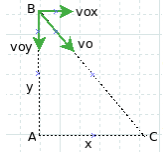 Magħruf:
Distanza orizzontali (x) = 5 metri
Ħin fl-arja (t) = sekonda waħda
x u t huma magħrufa sabiex v ox jista' jiġi kkalkulat bl-użu tal-ekwazzjoni tal- moviment lineari uniformi . v ox huwa l-komponent orizzontali tal-veloċità inizjali tal-ballun.
v ox = x / t = 5 metri / sekonda waħda = 5 m/s.
Parti 1 tal-moviment tal-projettili:
Il-komponent orizzontali tal-veloċità, v ox, huwa dejjem l-istess, għalhekk v ox fil-parti 1 tal-moviment tal-projettili = v ox fil-parti 2 tal-moviment tal-projettili = 5 m/s.
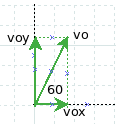 Magħruf
v ox = 5 m/s
θ = 60 °
v ox u θ huma magħrufa għalhekk il-veloċità inizjali (v o ) tista' tiġi kkalkulata.
cos θ = aġġust / iper
cos θ = v ox / v o
v o = v ox / cos θ = 5 / cos 60 o = 5 / 0.5 = 10 m/s
Il-veloċità inizjali (v o ) hija 10 m/s.
Il-veloċità inizjali tal-ballun (v o ) fil-moviment tal-projettili = il-veloċità finali tal-ballun (v t ) fl-ekwazzjoni tal-impuls-momentum.
Iddetermina l-kobor tal-forza (F)
F = 0.2 v t / 0.01
F = 0.2 (10) / 0.01
F = 2 / 0.01
F = 200 Newton
- X'inhi r-relazzjoni bejn l-impuls u l-bidla fil-momentum?
- Tweġiba: L-impuls huwa l-prodott tal-forza u l-ħin li matulu taġixxi, u huwa ugwali għall-bidla fil-momentum ta' oġġett. Matematikament, , Fejn hija l-bidla fil-momentum.
- Kif żieda fil-ħin tal-impatt, bħal fil-każ ta' żona ta' tiġbid f'karozza, taffettwa l-forza esperjenzata waqt ħabta?
- Tweġiba: Iż-żieda fil-ħin tal-impatt tnaqqas il-forza medja esperjenzata waqt ħabta. Dan għaliex l-impuls (bidla fil-momentum) huwa kostanti għal ħabta partikolari, u billi jiżdied il-ħin, il-forza tinfirex fuq tul ta' żmien itwal, u b'hekk titnaqqas il-forza medja.
- X'jibqa' kostanti għal projettili f'moviment taħt l-influwenza tal-gravità biss?
- Tweġiba: Il-veloċità orizzontali ta' projettili tibqa' kostanti meta l-gravità biss taġixxi fuqha. Madankollu, il-veloċità vertikali tinbidel minħabba l-aċċelerazzjoni gravitazzjonali.
- Għaliex it-triq ta' projettili hija parabolika taħt l-influwenza tal-gravità?
- Tweġiba: Il-mogħdija hija parabolika għaliex filwaqt li l-veloċità orizzontali tibqa' kostanti, il-veloċità vertikali tinbidel kontinwament bl-aċċelerazzjoni gravitazzjonali, u dan iwassal għal relazzjoni kwadratika bejn l-ispostamenti orizzontali u vertikali.
- X'jiġri mill-momentum ta' sistema iżolata jekk l-ebda forza esterna ma taġixxi fuqha?
- Tweġiba: Jekk l-ebda forza esterna ma taġixxi fuq sistema iżolata, il-momentum totali tagħha jibqa' kkonservat. Dan huwa magħruf bħala l-konservazzjoni tal-momentum.
- Kif jitqabbel l-impuls provdut minn mazza tal-baseball lil ballun meta l-ballun jintlaqat għal home run ma' meta jiġi sempliċement ippuntat ħafif?
- Tweġiba: L-impuls mogħti lill-ballun tal-baseball huwa akbar meta jintlaqat għal home run meta mqabbel ma' meta jiġi mħabbat ħafif, billi l-bidla fil-momentum tal-ballun (minn wieqaf għal dak li jtir 'il barra mill-mazza) hija ħafna akbar fix-xenarju ta' home run.
- Jekk projettili jitnieda mil-livell tal-art f'angolu u jirritorna lejn il-livell tal-art, kif jitqabblu l-veloċitajiet tat-tnedija u tal-inżul tiegħu?
- Tweġiba: Jekk nassumu li ma jkunx hemm reżistenza għall-arja, il-veloċità tal-inżul tal-projettil tkun ugwali għall-veloċità tat-tnedija tiegħu. Dan minħabba l-konservazzjoni tal-enerġija.
- Kif huma relatati l-angolu tat-tnedija u l-firxa ta' projettili, jekk nassumu li m'hemm l-ebda reżistenza għall-arja?
- Tweġiba: Għal veloċità inizjali partikolari, il-firxa massima ta' projettili tinkiseb f'angolu ta' tnedija ta' 45 grad. It-tnedija f'angoli inqas jew akbar minn 45 grad tirriżulta f'firxa iqsar.
- Għaliex iż-żieda fil-ħin li matulu forza taġixxi fuq oġġett, bħal meta taqbad bajda b'moviment żgħir tal-id, tnaqqas il-probabbiltà li l-oġġett jinkiser jew isirlu ħsara?
- Tweġiba: Iż-żieda fil-ħin li matulu taġixxi forza tifrex l-impuls (bidla fil-momentum) fuq perjodu itwal, u b'hekk tnaqqas il-forza medja esperjenzata mill-oġġett. Billi taqbad bajda b'moviment żgħir tal-id, il-forza tal-qabda tinfirex, u b'hekk titnaqqas iċ-ċans li l-bajda tinkiser.
