1. Erba ' capacitors , C1 = 2 μF, C2 = 1 μF, C3 = 3 μF, C4 = 4 μF, huma konnessi b'mod parallel. Iddetermina l-kapaċitanza ta' capacitor wieħed li jkollu l-istess effett bħall-kombinazzjoni.
Magħruf:
Kondensatur C1 = 2 μF
Kondensatur C2 = 1 μF
Kondensatur C3 = 3 μF
Kondensatur C3 = 4 μF
Meħtieġa: Il-kapaċitanza ekwivalenti
Soluzzjoni:
Il-kapaċitanza ekwivalenti:
Ċ = Ċ1 + Ċ2 + Ċ3
C = 4 μF + 2 μF + 3 μF = 9 μF
Il-kapaċitanza ekwivalenti tal-kombinazzjoni kollha hija 9 μF.
[irp]
2. Iddetermina l -ċarġ fuq il-kapaċitatur C2 jekk id- differenza potenzjali bejn il-punti A u B hija ta ' 9 Volts…
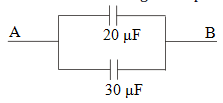
Magħruf:
Kapa ċ itur C 1 = 20 μ F = 20 x 10 -6 F
Kapa ċ itur C 2 = 30 μ F = 30 x 10 -6 F
Id-differenza potenzjali bejn il-punti A u B (V AB ) = 9 Volts
Meħtieġa : iċ-ċarġ fuq il- kapaċitatur C2 ( Q2 )
Soluzzjoni:
Differenza potenzjali:
Il-kapaċitaturi huma konnessi b'mod parallel sabiex id-differenza potenzjali bejn A u B (V AB ) = id-differenza potenzjali fuq il-kapaċitatur C 1 (V 1 ) = id-differenza potenzjali fuq il-kapaċitatur C 2 (V 2 ) = 9 Volts.
Ċarġ elettriku fuq il- kapaċitatur C2 :
Q2 = C2 V2 = (30 x 10-6 ) ( 9 ) = 270 x 10-6 C
Q2 = 270 μC
Iċ-ċarġ elettriku fuq il- kapaċitatur C2 huwa 27 0 μC.
[irp]
3. Tliet capacitors, C1 = 4 μF, C2 = 2 μF, C3 = 3 μF, huma konnessi b'mod parallel. Il-capacitors huma ċċarġjati. Id-differenza potenzjali fuq il-capacitor C2 hija ta ' 4 Volts. Iddetermina
(a) Ċarġ elettriku fuq il-kapaċitaturi C1 , C2 u C3
(b) Ċarġ elettriku fuq il-kapaċitatur ekwivalenti tal-kombinazzjoni kollha
Magħruf:
Kapa ċ itur C 1 = 4 μ F = 4 x 10 -6 F
Kondensatur C C 2 = 2 μ F = 2 x 10 -6 F
Kondensatur C C 3 = 3 μ F = 3 x 10 -6 F
Differenza potenzjali fuq il-kapaċitatur C2 ( V2 ) = 4 Volts
Meħtieġ : Ċarġ elettriku fuq il- kapaċitatur C3 ( Q3 )
Soluzzjoni:
(a) Ċarġ elettriku fuq il- kapaċitatur C3
Id - differenza potenzjali fuq il-kapaċitatur C3 :
Il-kapaċitaturi huma konnessi b'mod parallel sabiex id-differenza potenzjali fuq il-kapaċitatur C3 (V3) = id-differenza potenzjali fuq il-kapaċitatur C2 (V2) = id-differenza potenzjali fuq il-kapaċitatur C1 (V1) = id-differenza potenzjali fuq capacitor ekwivalenti (V) = 4-il Volt
Ċarġ elettriku fuq il- kapaċitatur C1 :
Q1 = C1 V1 = (4 x 10⁻⁶ ) (4 ) = 16 x 10-6C
Q1 = 16 μC
Ċarġ elettriku fuq il- kapaċitatur C2 :
Q2 = C2 V2 = (2 x 10⁻⁶ ) (4 ) = 8 x 10⁻⁶C
Q2 = 8 μC
Ċarġ elettriku fuq il- kapaċitatur C3 :
Q3 = C3 V3 = (3 x 10⁻⁶ ) (4 ) = 12 x 10-6C
Q3 = 12 μC
(b) Ċarġ elettriku fuq kapaċitatur ekwivalenti
Q = Q1 + Q2 + Q3
Q = 16 μ C + 8 μ C + 12 μ C = 36 μ C
Soluzzjoni alternattiva:
Il-kapaċitanza ekwivalenti:
Ċ = Ċ1 + Ċ2 + Ċ3
C = 4 μF + 2 μF + 3 μF = 9 μF
Ċ = 9 x 10⁻⁶ F
Id-differenza potenzjali fuq il-kapaċitatur ekwivalenti:
V1 = V2 = V3 = V = 4 Volt
Iċ-ċarġ elettriku fuq il-kapaċitatur ekwivalenti:
Q = CV = (9 x 10⁻⁶ ) (4) = 36 x 10-6 Ċ
Q = 36 μC
