Pūnga pereti whakarara

Te whakamāramatanga o te pūnga pereti whakarara
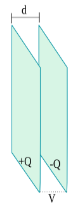
Pūnga pereti whakarara 1Ko te pūnga pereti whakarara he pūnga e rua ngā pereti arataki whakarara, he rite te horahanga whakawhiti-wāhanga o ia pereti (A) me ngā pereti e rua e wehea ana e tētahi tawhiti (d), e whakaaturia ana i te pikitia i te taha maui. Ko tētahi o ngā pereti arataki he utu pai (+Q) ko tētahi atu pereti arataki he utu kino (-Q), ko te nui o utu hiko He ōrite te nui o ia pereti. Kia kore ai te utu e neke ki te ngota hau, ka wehea te pūnga i te taiao, ā, i waenganui i ngā pereti e rua, he korehau.
Pānuitia atu

Te ture a Kepler

He tuhinga mō Te ture a Kepler

Kei te maumahara tonu koe ki ngā maharatanga o te ekenga tuatahi i tētahi motuka? I roto i tētahi motuka e neke ana, ka kite koe me te mea kei te neke tētahi rākau, tētahi whare rānei. I taua wā, tera pea ka whakaaro koe kei te neke ngā rākau, ngā whare rānei, i a koe e okioki ana me te motuka. Inaa, kei te neke koe me te motuka, i a koe e okioki ana me ngā rākau, ngā whare rānei. Ka wheakohia tēnei wheako o te nekehanga rūpahu i ia rā. I ia ata, ka "putanga o te rā" i te pae rawhiti, kātahi ka neke ki te hauauru, ā, ka "tō" ki te pae hauauru i te ahiahi.

Waihoki, i te pō, ka kite pinepine koe i te marama e neke ana mai i te rawhiti ki te hauauru. Kua whakaaro koe, kua whakapae rānei koe i te neke haere o te rā me te marama i te whenua, i te wā e okioki ana te whenua?

Pānuitia atu

Te wā o te kaha

Article about Moment of force

1. Lever arm

Review an object that rotates, such as the door of a room. When the door is opened or closed, the door rotates. The hinges that connect the door to the wall act as the axis of rotation.

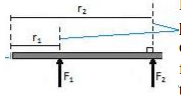
Moment of force 1The door image is seen from above. Review an example where the door is pushed in the same two forces that have the same magnitude and direction, where the direction of the force is perpendicular to the door. At first, the door is pushed with a force of F1, r1 from the axis of rotation. Subsequently, the door is pushed with the force of F2, r2 away from the axis of rotation. Although the magnitude and direction of the force F1 =F2, the force of F2 causes the door to rotate faster than the force of F1. In other words, the force of F2 causes a greater angular acceleration compared to the force of F1. You can prove this.

Pānuitia atu

Te ture tuarua a Newton mō te nekehanga hurihuri

Article about the Newton’s second law on rotational motion

4.1 The relationship between the moment of force, the moment of inertia, and the angular acceleration

If there is a resultant force (ΣF) acting on an object with mass (m) then the object moves linearly with a certain acceleration (a). The relationship between the resultant force, mass, and whakatere is expressed by the equation:

ΣF = ma

This is the equation of Newton‘s second law.

The quantities of the rotational motion which are identical to the resultant force (ΣF) in linear motion is the resultant moment of force (Στ). The quantities of the rotational motion that are identical to mass (m) in linear motion is the moment of inertia (I). The quantities of the rotational motion that are identical to acceleration (a) in linear motion is the angular acceleration (α).

Pānuitia atu

Tuhinga o mua

1. Te Whakamāramatanga o te Tuhinga o mua

He maha ngā matūriki o te tinana pakari; nō reira, ka pā te kaha ā-papa ki ia matūriki. Arā, he taumaha tō ia matūriki. Ko te pokapū o te taumaha o tētahi mea he pūwāhi kei runga i te mea e kiia ana ko te taumaha o ngā wāhanga katoa o te mea kei waenganui i taua pūwāhi.

Pānuitia atu

Ngā momo taurite o te tinana mārō

Article about the Types of equilibrium of the rigid body

Not all things we find in everyday life always rest. Maybe at first the object rest, but if it is moved (for example by the wind) objects can move. The problem is, whether after moving, objects return to their original position or not. This depends on the type of balance of the object. After moving, there will be three possibilities, namely:

(1) the object returns to its original position,

(2) the object moves away from its original position,

(3) the object remains in its new position.

Pānuitia atu

Te taurite o te tinana mārō

He tuhinga mō te taurite o te tinana mārō

1. Te tūnga tuatahi

Te Ture Tuarua a Newton e kī ana mēnā ehara te kaha hua i runga i tētahi mea (he mea e whakaarohia ana he matūriki kotahi) i te kore,

kātahi ka neke te mea me te whakaterenga pumau, ko te ahunga o te nekehanga o te mea = te ahunga o te kaha katoa. Mena he kore te kaha hua, kei te okioki te mea, kei te neke rānei i te tere pumau.

ΣF = ma

Ina noho okioki te mea, ina neke rānei i te tere pumau, kāore he whakaterenga (a) o te mea. Nā te mea ko te whakaterenga (a) = 0, ka huri te whārite i runga ake nei ki:

Pānuitia atu

Ngā puna raupapa me ngā puna whakarara

He tuhinga mō te Ngā puna raupapa me ngā puna whakarara

1. Ngā puna raupapa

Mena ka honoa te puna i roto i te raupapa, pērā i te ahua kei te taha, ka:

1. Ko te pikinga o te roa o te puna = te pikinga o te roa 1 + te pikinga o te roa 2

Δy = Δy1 + Δy1

2. Ko te kaha e pāngia ana e te puna ōrite = te kaha e pāngia ana e te puna 1 = te kaha e pāngia ana e te puna 2

Fs =F1 =F2

Pānuitia atu

Te ture a Hooke

1. Hooke’s law for springs

If the spring is pulled to the right, the spring will stretch and increase in length (figure 1). If the pull force is not huge, it is found that the increase in spring length (Δx) is proportional to the magnitude of the pull force (F). In other words, the greater the pull force, the greater the length of the spring. Comparison of the magnitude of the pull force (F) and the increase in the spring length (Δx) is constant.

Pānuitia atu

Te ture a Ohm

Te whakamāramatanga o te ture a Ohm

I roto i te nuinga o ngā ara iahiko whakarewa, he rite te āpure hiko ki te mātotoru o te iahiko hiko, ina he pumau te ōwehenga o te āpure hiko ki te mātotoru o te iahiko hiko. Ka whakaaturia mā te pāngarau mā te whārite:

ρ = E / J

E= mara hiko, ρ = pautuutu, J = kiato o nāianei

Ka kiia te pūmau ρ he ātete, he pūmau tōna uara, ā, kāore e whakawhirinaki ki te papa hiko e puta ai te iahiko.

Pānuitia atu