Whakawhitinga

Ki te āta tirohia, ka kitea tuatahitia te paoa o te tahunga. I muri i tētahi wā, kāore e kitea te paoa. Kua whakamahia e koe he hinu kakara? Ahakoa ka rehuhia e koe te hinu kakara ki roto i te rūma, ka taea hoki e ētahi atu tāngata kei waho o te whare te rongo i te kakara o te hinu kakara. Ki te tunu te whaea i te kai reka me te reka i roto i te kīhini, ka taea hoki te rongo i te kakara o te tunu kai mai i te whare o te hoa noho. He aha ai?

He maha atu anō ngā tauira. Mēnā ka makahia e koe ētahi pata waituhi ki roto i tētahi karāhe kei roto he wai mārama, ka horapa ōrite te waituhi, te tae kai rānei puta noa i te wai. Ka tupu aunoa tēnei. Ko ētahi o ngā tauira o mua ko ngā mahi horapa e kitea pinepine ana i roto i te oranga o ia rā. Ko te horapa te tukanga o te neke i ngā matū mai i te kukū teitei ki te kukū iti. Ko te tikanga o te kukū ko te maha o ngā ngota/mōra o tētahi matū mō ia rōrahi. Ko te wāhi kukū teitei he wāhi kei reira he maha ngā ngota o ngā matū mō ia rōrahi. I tetahi atu taha, ko ngā kukū iti he wāhi kei reira he iti noa ngā ngota mō ia rōrahi.
Pānuitia atu

Pūngao ā-roto o te hau pai

Energy in a monatomic ideal gas

The energy in the monatomic ideal gas is the total amount of translational kinetic energy of monatomic ideal gas molecules. The total amount of translational kinetic energy of the ideal gas molecules = the product of the average translational kinetic energy of each molecule and the number of molecules (N). Mathematically:

Pānuitia atu

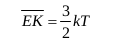
Theorem of equipartition of energy

The energy equipartition theorem was derived theoretically by Clerk Maxwell using statistical mechanics. It is called a theorem because there is no proof through experimentation. The energy partition means equal distribution of energy.

Energy equipartition theory 1

KE = average translational kinetic energy of gas molecules (Joule)

k = Boltzmann’s constant = 1.38 x 10⁻²³ J/K

T = absolute temperature of the ideal gas molecule (Kelvin)

Pānuitia atu

Pūngao nekeneke toharite o ngā hau

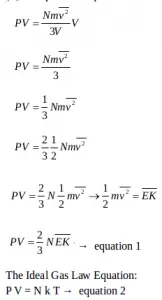
In addition to pressure, one of the quantities that states the macroscopic nature of gas is temperature (T). Gas pressure equation:

Average kinetic energy of gases 1

Pānuitia atu

Te ariā kinetic o te hau

Ko te kinetic theory states that every substance consists of atoms or molecules and that the atom or molecule moves continuously carelessly. This assumption of kinetic theory matches the situation and condition of the atom or molecule of the gas constituent. The force of attraction between the atoms or molecules making up the gas is feeble so that atoms or molecules can move freely.

Pānuitia atu

Te ture a Boyle Te ture a Charles Te ture a Gay-Lussacs

Article Boyle’s law, Charles’s law, Gay-Lussac’s law

Boyle’s law

Robert Boyle (1627-1691) conducted experiments to investigate the quantitative relationship between gas pressure and volume. This experiment is carried out by inserting a certain amount of gas into a closed container. Until a pretty good approach, he found that if the gas temperature was kept constant, then when the gas pressure increased, the gas volume was reduced. Likewise, when the gas pressure decreases, the gas volume increases. Gas pressure is inversely proportional to gas volume. This relationship is known as Boyle’s Law. Mathematically:

Pānuitia atu

Te ture hau pai rawa atu

Kāore ngā ture hau a Boyle, a Charles, me Gay-Lussac e pā ki ngā āhuatanga hau katoa, nō reira ka uaua ake tā mātou tātari. Nō reira, i whakaaturia te tauira hau pai. Kāore te hau pai e noho ana i te oranga o ia rā; ko te hau pai te āhua tino tika hei whakahaere i te tātari. Ko te noho o tēnei ariā hau pai he tino āwhina i a mātou ki te arotake i te whanaungatanga i waenga i ngā ture e toru o te hau.

Te whanaungatanga i waenga i te pāmahana, te rōrahi, me te pēhanga hau

Mā te titiro ki ngā ture hau e toru i runga ake nei, ka taea e tātou te whakaputa i tētahi whanaungatanga whānui ake i waenga i te pāmahana, te rōrahi, me te pēhanga hau.

Pānuitia atu

Entropy

Kāore e taea e te kōrero motuhake o te ture tuarua o te thermodynamics te whakaahua i ngā tukanga kore e taea te huri katoa, nō reira me whai kōrero whānui tātou. E tumanakohia ana ka whakamāramahia e tēnei kōrero whānui ngā tukanga kore e taea te huri katoa e puta ana i te ao whānui. I hangaia te kōrero whānui o te ture tuarua o te thermodynamics i waenganui o te rautau tekau mā iwa, mā te rahinga e kiia nei ko te entropy (S). I whakaurua tuatahitia te entropy e Clausius, ā, i hangaia mai i te huringa Carnot (mīhini caloric tino tika). E ai ki a Clausius, ka pāngia te pūnaha e ngā huringa entropy, ina whiwhi te pūnaha i te wera tāpiri (Q) i te pāmahana pumau, e tohuhia ana e te whārite:

Pānuitia atu

Te tauwehenga o te mahi a te mīhini whakamatao

Article about Coefficient of performance of the cooling machine

A cooling machine is a machine that takes heat from a low-temperature place, then transfers it to a high-temperature area. For this process to happen, the machine must do the work because the heat naturally flows from high temperature to low temperature. This is by Clausius’s statement:

It is impossible for a cooling machine to transfer heat from a low-temperature place to a high-temperature place, without work (Second law of thermodynamics—Clausius statement).

The machine works (W) to transfer heat, from low temperature (QL) to high temperature (QH). Based on conservation of energy, QL + W = QH.

Pānuitia atu

Mīhini wera Carnot me te huringa Carnot

To find out how to increase the efficiency of te wera engine, a French scientist named Sadi Carnot (1796-1832) examined an ideal theoretical caloric machine in 1824. At that time, the first law of thermodynamics had not been formulated, nor the second law of thermodynamics. The first law has not been formulated because scientists do not yet know that heat is energy. After Joule and his colleagues experimented in the 1830s, scientists discovered heat is energy that moves due to temperature differences. So, the first law of thermodynamics was formulated after 1830. Sadi Carnot had been researching the theoretical ideal caloric engine in 1824. His research was actually to increase the efficiency of the steam engine. Most steam engines of that time were less efficient.

Pānuitia atu