1. 5000 kg smaga automašīna paātrinājās no miera stāvokļa līdz 20 m/s. Nosakiet automašīnas paveikto neto darbu .
Zināms:
Masa (m) = 5000 kg
Sākotnējais ātrums (v0 ) = 0 m/s ( automašīna miera stāvoklī )
Galīgais ātrums (vt ) = 20 m/s
Meklē : tīklu
šķīdums:
Darba kinētiskās enerģijas princips :
W neto = Δ EK
W neto = ½ m (v t 2 – v o 2 )
W neto = neto darbs
ΔEK = kinētiskās enerģijas izmaiņas
m = masa (kg),
vt = beigu ātrums ( m/s),
v0 = sākotējais ātrums (m/s).
Tīkls:
W neto = ½ m (v t 2 – v o 2 )
W neto = ½ (5000) ( 20 2–0 2 )
W neto = (2500)(400 – 0)
W neto = (2500)(400)
W neto = 1000,000 džouli
[irp]
2. 10 kg smags objekts paātrinājās no 5 m/s līdz 10 m/s. Nosakiet objektam paveikto neto darbu!
Zināms:
Masa (m) = 10 kg
Sākotnējais ātrums (v0 ) = 5 m/s
Galīgais ātrums (vt ) = 10 m/s
Meklē : tīklu
šķīdums:
Tīkls:
W neto = Δ EK
W neto = ½ m (v t 2 – v o 2 )
W neto = ½ (10) ( 10 2–5 2 )
W neto = (5)(100 – 25)
W neto = (5)(75)
W neto = 375 džouli
3. 2000 kg smaga automašīna palēnina ātrumu no 10 m/s līdz 5 m/s. Kāds ir automašīnas veiktais darbs?
Zināms:
Automašīnas masa (m) = 2000 kg
Sākotnējais ātrums (v0 ) = 10 m/s
Galīgais ātrums (vt ) = 5 m/s
Meklē: tīklu
šķīdums:
Tīkls:
W neto = Δ EK
W neto = ½ m (v t 2 – v o 2 )
W neto = ½ (2000) ( 5 2–10 2 )
W neto = (1000)(25 – 100)
W neto = (1000)(-75)
W neto = -75 000 džoulu
Mīnusa zīme norāda, ka pārvietojuma virziens ir pretējs neto spēka virzienam.
4. Uz 10 kg smagu objektu 12 sekundes iedarbojas 60 N liels nemainīgs spēks. Objekta sākotnējais ātrums ir 6 m/s, un objekta virziens sakrīt ar spēka virzienu.
(1) Objektā paveiktais darbs ir 30 240 džouli
(2) Galīgā kinētiskā enerģija ir 30 240 džouli
(3) Jauda ir 2,520 vati
(4) Objekta kinētiskās enerģijas pieaugums ir 180 džouli
Pareizie apgalvojumi ir…
Zināms:
Spēks (F) = 60 N
Laika intervāls (t) = 12 sekundes
Objekta masa (m) = 10 kg
Sākotnējais ātrums (v0 ) = 6 m/s
Meklē: Pareizos apgalvojumus
šķīdums:
Objekta paātrinājums:
∑F = mA
60 = 10 a
a = 60 / 10 = 6 m/ s²
Galīgais ātrums:
v t = v o + pie
vt = 6 + (6)(12 )
vt = 6 + 72
vt = 78 m/s
12 sekundēs veiktais attālums :
s = v o t + 1/2 pie 2
s = (6)(12) + 1/2 (6)(12) ²
s = 72 + (3)(144)
s = 72 + 432
s = 504 metri
(1) Ar spēku paveiktais darbs
W = F s = (60)(504) = 30 240 džouli
(2) Galīgā kinētiskā enerģija
KE = 1/2 mv t 2 = 1/2 (10) (78) 2 = (5) (6084) = 30 420 džouli
(3) Jauda
P = W / t = 30 240 / 12 = 2,520 džouli sekundē
(4) Kinētiskās enerģijas pieaugums
ΔKE = 1/2 mv t 2 - 1/2 mv o 2 = 1/2 m (vt 2 - v o 2 ) = 1/2 (10) (78 2 - 6 2 ) = 5 (6084 -36) = 5 (6048)
ΔKE = 30 240 džouli
[irp]
5. Lielāko darbu veic objekta numurs…
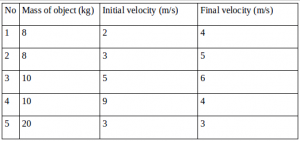
šķīdums:
Neto darbs = kinētiskās enerģijas izmaiņas
W neto = ½ m (v t 2 – v o 2 )
Lielākais darbs:
W 1 = ½ (8)(4 2 – 2 2 ) = (4)(16 – 4) = (4)(12) = 48 džouli
W2 = ½ (8)(5 2 –3 2 ) = (4)(25 – 9) = (4)(16) = 64 džouli
W 3 = ½ (10)(6 2 – 5 2 ) = (5)(36 – 25) = (5)(11) = 55 džouli
W 4 = ½ (10)(4 2 – 0 2 ) = (5)(16 – 0) = (5)(16) = 80 džouli
W 5 = ½ (20)(3 2 – 3 2 ) = (10)(9 – 9) = (10)(0) = 0 džouli
6. 4000 kg smaga automašīna brauc pa taisnu līniju ar ātrumu 25 m/s. Automašīna tiek palēnināta tā, lai tās gala ātrums būtu 15 m/s. Kāds ir automašīnas veiktais darbs?
Zināms:
Masa (m) = 4000 kg
Sākotnējais ātrums (v0 ) = 25 m/s
Galīgais ātrums (vt ) = 15 m/s
Meklē : Darbs pie automašīnas
šķīdums:
W neto = ½ m (vt² – vo² ) = ½(4000)(15² -25² ) = (2000)(225-625) = (2000)(-400) = -800 000 džouli = -800 kJ
[irp]
7. 0.1 kg smags objekts tiek mests horizontāli ar ātrumu 6 m/s no 5 metru augstuma. Ja brīvās krišanas paātrinājums ir 10 m/s² , tad kāda ir bumbas kinētiskā enerģija 2 metru augstumā?
Zināms: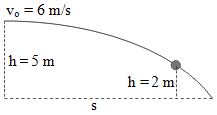
Masa (m) = 0.1 kg
Augstuma izmaiņas (h) = 5 m – 2 m = 3 metri
Brīvās krišanas paātrinājums (g) = 10 m/ s²
Vēlama: kinētiskā enerģija 2 metru augstumā.
šķīdums:
Šāviņa kustību var izprast, atsevišķi analizējot kustības horizontālo un vertikālo komponenti. Kustība horizontālā virzienā tiek analizēta kā kustība ar nemainīgu ātrumu , bet kustība vertikālā virzienā tiek analizēta kā brīvā kritiena kustība vai vertikāla kustība.
Sākotnējā mehāniskā enerģija = gravitācijas potenciālā enerģija.
PE = mgh = (0.1)(10)(3) = 3 džouli.
Galīgā mehāniskā enerģija = kinētiskā enerģija.
KE = 3 džouli.
8. 1000 kg smaga automašīna paātrinās no miera stāvokļa un pārvietojas ar ātrumu 5 m/s. Kādu darbu automašīna veic?
Zināms:
Masa (m) = 1000 kg
Sākotnējais ātrums (v0 ) = 0
Galīgais ātrums (vt ) = 5 m/s
Meklē: Darbu (W) ar automašīnu
šķīdums:
W neto = ½ m (v t 2 – v o 2 )
Ar automašīnu paveiktais darbs:
W neto = ½ (1000)(5 2 – 0 2 ) = (500)(25 – 0) = (500)(25) = 12 500 džouli
[irp]
9. 500 gramu bumba tiek mesta vertikāli uz augšu no Zemes virsmas ar sākotnējo ātrumu 10 m/s² . Brīvās krišanas paātrinājums ir 10 ms⁻² . Kādu darbu veic svara spēks, kad bumba sasniedz maksimālo augstumu?
Zināms :
Bumbas masa (m) = 500 grami = 0.5 kg
Sākotnējais ātrums (v0 ) = 10 m/ s2
Galīgais ātrums (vt ) = 0 (ātrums augstākajā punktā)
Brīvās krišanas paātrinājums (g) = 10 m/ s²
Meklē: Darba (W) don pēc svara
šķīdums:
Neto spēka paveiktais tīrais darbs uz objektu = kinētiskās enerģijas izmaiņas.
W neto = ΔEK = EKt – EKo
Wnet = ½ mv t 2 – ½ mv o 2 = ½ m (v t 2 – v o 2 )
KE t = galīgā kinētiskā enerģija, KE o = sākotnējā kinētiskā enerģija, m = objekta masa, v t = objekta galīgais ātrums, v o = objekta sākotnējais ātrums.
Tīkls:
W neto = ½ m (v t 2 – v o 2 ) = ½ (0.5) (0 2 – 10 2 )
W neto = (0.25)(-100) = -25 džouli
Mīnusa zīme norāda, ka pārvietošanās virziens ir pretējs bumbas svaram. Bumbas virziens ir vertikāls, bet svara virziens ir tieši uz leju.
10. 1 kg smags objekts brīvi krīt ar augstuma starpību = 2.5 metri. Brīvās krišanas paātrinājums ir 10 ms -2 . Kāds ir objekta paveiktais darbs?
Zināms:
Bumbas masa (m) = 1 kg
Sākotnējais ātrums (v0 ) = 0 m/s
Augstums (h) = 2.5 metri
Brīvās krišanas paātrinājums (g) = 10 m/ s²
Meklē: Tīkla darbs pārvietošanas laikā
šķīdums:
Bumbas galīgais ātrums ( vt )
Aprēķināts, izmantojot brīvā kritiena kustības vienādojumu. Zināms: brīvās krišanas paātrinājums (g) = 10 m/s² , bumbas augstuma izmaiņas (h) = 2.5 metri. Vēlams: beigu ātrums.
v t 2 = 2 gh = 2(10)(2.5) = 2(25)
v t = √2(25)
v t = 5√2
Neto darbs = kinētiskās enerģijas izmaiņas
W neto = ΔEK = ½ m (v t 2 – v o 2 ) = ½ (1) {(5√2) 2 – 0 2 }
W neto = ½ (25)(2) = 25 džouli
[irp]
11. 2 kg smags objekts pārvietojas ar ātrumu 72 km/h. Pēc 400 metru nobraukuma objekta galīgais ātrums ir 144 km/h. Brīvās krišanas paātrinājums ir 10 m/s -2 . Aprēķiniet neto ātrumu.
Zināms:
Objekta masa (m) = 2 kg
Sākotnējais ātrums (v0 ) = 72 km/h = 20 m/s
Galīgais ātrums (vt ) = 144 km/h = 40 m/s
Attālums (s) = 400 metri
Brīvās krišanas paātrinājums (g) = 10 m/ s²
Meklē: Tīkls
šķīdums:
Tīkla darbs = kinētiskās enerģijas izmaiņas
W neto = ΔEK = ½ m (v t 2 – v o 2 ) = ½ (2) (40 2 – 20 2 }
W neto = ½ (2)(1600 – 400) = 1200 džouli
12. 2 kg smags objekts pārvietojas ar ātrumu 2 ms –1 . Objektam veiktais darbs ir 21 džouls. Kāds ir objekta gala ātrums?
Zināms:
Masa (m) = 2 kg
Sākotnējais ātrums (v0 ) = 2 m/s
Darbs (W) = 21 džouli
Vēlamais: beigu ātrums ( vt )
šķīdums:
W neto = ΔEK
W neto = 1/2 mv t² -1/2 mv o²
W neto = 1/2 m (v t 2 – v o 2 )
21 = 1/2 (2) (v t 2 – 2 2 )
21 = ( vt2 – 22 )
21 = vt 2 – 4
vt2 = 21 + 4 = 25
v t = √25
vt = 5 m/s
[irp]
1 3. Uz objektu ar masu 16 kg iedarbojas 8 N liels nemainīgs spēks. Ja objekts sākotnēji ir miera stāvoklī, tad nosakiet tā ātrumu pēc tam, kad spēks iedarbojas uz objektu 4 sekundes.
Zināms:
Pastāvīgais spēks (F) = 8 ņūtoni
Objekta masa (m) = 16 kg
Objekta sākotnējais ātrums (v0 ) = 0 m/s
Laika intervāls, kurā spēks iedarbojas uz objektu (t) = 4 sekundes
Vēlamais: Galīgais ātrums ( vt )
šķīdums:
Darbs = kinētiskās enerģijas izmaiņas
W = KE galīgais – KE sākotnējais
W = ½ mv t² – ½ mv o²
W = ½ mv t2 – 0
W = ½ mv t 2 —— 1. vienādojums
Darbs = Spēks x Nobīde
W = Fd
W = 8 d
Izmantojiet zemāk esošo nevienmērīgas lineāras kustības vienādojumu, lai aprēķinātu pārvietojumu (d):
d = v o t + ½ pie 2
d = pārvietojums, v = o = sākotnējais ātrums, t = laika intervāls, a = paātrinājums
d = 0 + ½ pie 2 = ½ pie 2 —-> a = (vt – v0 ) / t = vt / t
d = ½ (v t / t) t 2
d = ½ (vt ) t
Mainīt pārvietojumu (d) vienādojumā Darbs ar pārvietojumu (d) šajā vienādojumā:
W = 8 d
W = 8(1/2)(vt ) (t)
W = (4)(v t )(t) —— 2. vienādojums
1. vienādojums = 2. vienādojums
W = W
½ mv t 2 = (4)(v t )(t)
½ mv t = (4)(t)
½ (16)(vt ) = 4(4)
8 v t = 16
vt = 16 / 8
vt = 2 metri sekundē
14. Lai palielinātu objekta ātrumu līdz 2 reizēm no sākotnējā ātruma, nosakiet procesā nepieciešamo darbu…
Zināms:
Objekta masa (m) = 1 kg
Sākotnējais ātrums (v0 ) = 1 m/s
Galīgais ātrums (vt ) = 2 x sākotnējais ātrums = 2 x 1 = 2 m/s
Meklē: Darbu
šķīdums:
Sākotnējā kinētiskā enerģija:
KE sākotnējais = ½ mv o 2 = ½ (1) (1) 2 = ½ (1) (1) = ½ (1) = 0.5
Galīgā kinētiskā enerģija, kad objekta ātrums kļūst 2 reizes lielāks par tā sākotnējo ātrumu:
TO galīgais = ½ mv t 2 = ½ (1)(2) 2 = ½ (4) = 2
Darba kinētiskās enerģijas teorēma:
Darbs = kinētiskās enerģijas izmaiņas
Darbs = galīgā kinētiskā enerģija – sākotnējā kinētiskā enerģija
Darbs = 2 – 0.5
Darbs = 1.5
Sākotnējā kinētiskā enerģija = 0.5
Darbs = 3 x 0.5 = 1.5
Nepieciešamais darbs, kas ir 3 reizes lielāks par sākotnējo kinētisko enerģiju.
15. Automašīna ar masu 1500 kg pārvietojas ar ātrumu 36 km/h pa taisnu un gludu horizontālu ceļu. Automašīna paātrinājās līdz 72 km/h. Nosakiet darbu, kas nepieciešams, lai automašīnu paātrinātu.
Zināms:
Automašīnas masa (m3) = 1500 kg
Automašīnas sākotējais ātrums (v0 ) = 36 km/h = 36 000 metri / 3600 sekundes = 10 metri/sekundē
Automašīnas gala ātrums (vt ) = 72 km/h = 72 000 metri / 3600 sekundes = 20 metri/sekundē
Meklē: Darbs, kas nepieciešams, lai paātrinātu automašīnu
šķīdums:
Darba kinētiskās enerģijas teorēma:
W = EK galīgais rezultāts – EK sākotnējais rezultāts
W = ½ mv t 2 – ½ mv o 2 = ½ m (v t 2 – v o 2 )
W = ½ (1500)( 20² – 10² )
W = ½ (1500)(400–100)
W = ½ (1500)(300)
W = (1500)(150)
W = 225 000 džouli
16. Objekts ar masu 2 kg sākotnēji pārvietojas ar ātrumu 72 km/h -1 . Pēc pārvietošanās pa horizontālu taisnu ceļu līdz 400 m attālumam objekta ātrums ir 144 km/h -1 . Nosakiet objekta kopējo paveikto darbu.
Zināms:
Objekta masa (m) = 2 kg
Sākotnējais ātrums (v0 ) = 72 km/h = 72 000 metri / 3600 sekundes = 20 m/s
Galīgais ātrums (vt ) = 144 km/h = 144 000 metri / 3600 sekundes = 40 m/s
Objekta pārvietojums = 400 metri
Meklē: Tīkla darbs objektā
šķīdums:
Darba kinētiskās enerģijas teorēma apgalvo, ka neto darbs iedarbojas uz objektu tāpat kā objekta kinētiskās enerģijas izmaiņas.
W neto = TO galīgais – TO sākotnējais
W neto = ½ mv t² – ½ mv o²
W neto = ½ m (v t 2 – v o 2 )
W neto = ½ (2) (40 2 – 20 2 )
Neto W = 1600–400
W neto = 1200 džouli
Apraksts:
W = darbs, KE = kinētiskā enerģija
Kinētiskā enerģija
17. 10 gramu lode, kas pārvietojas ar nemainīgu ātrumu 100 m/s. Kāda ir lodes kinētiskā enerģija?
Zināms:
Lodes masa (m) = 10 grami = 10/1000 kilogrami = 1/100 kilogrami = 0.01 kilograms
Lodes ātrums (v) = 100 metri sekundē
Meklē: kinētisko enerģiju
šķīdums:
KE = 1/2 mV²
KE = 1/2 (0,01 kg)(100 m/s) ²
KE = 1/2 (0,01 kg) (10 000 m 2 / s 2 )
KE = (0,01 kg) (5000 m2 / s2 )
KE = 50 kg m² / s²
KE = 50 džouli
[wpdm_package id='1191′]
- Spēka paveiktā darba problēmas un risinājumi
- Darba kinētiskās enerģijas problēmas un risinājumi
- Darba-mehāniskās enerģijas principu problēmas un risinājumi
- Gravitācijas potenciālās enerģijas problēmas un risinājumi
- Elastīgo atsperu potenciālā enerģija, problēmas un risinājumi
- Barošanas problēmas un risinājumi
- Mehāniskās enerģijas nezūdamības likuma piemērošana brīvā kritiena kustībai
- Mehāniskās enerģijas nezūdamības likumsakarības pielietojums kustībai augšup un lejup brīvā kritienā
- Mehāniskās enerģijas nezūdamības likumsakarības piemērošana kustībai uz līknes virsmas
- Mehāniskās enerģijas nezūdamības likuma piemērošana kustībai slīpā plaknē
- Mehāniskās enerģijas nezūdamības likuma piemērošana šāviņa kustībai
